
Maritime ·
10 Reasons Alligators Rule the Wetlands Like Apex Predators
Alligator Supremacy
By Rebecca "Madam Chronicler" Ryan
Alligator Supremacy
When most people think of aquatic predators, sharks often steal the spotlight. But in the swamps, bayous, and freshwater rivers of the American Southeast, there’s one ruler: the alligator.
This prehistoric predator has reigned for millions of years. But why do gators dominate the waterways so thoroughly? The answer lies in their biology, behavior, and role in the ecosystem.
Ancient Survivors with Evolutionary Perfection
Alligators are evolutionary marvels. Their lineage stretches back 37 million years, with few changes needed. Their rugged bodies are covered in osteoderms—bony plates that double as armor. Their tails are muscular powerhouses, helping them glide through water silently.
Their bite? It’s a jaw-dropping 2,000+ pounds per square inch—strong enough to crush turtles and bones alike.
This ancient design has helped them outlast dinosaurs, ice ages, and human threats.
Stealth Hunters: Masters of the Ambush
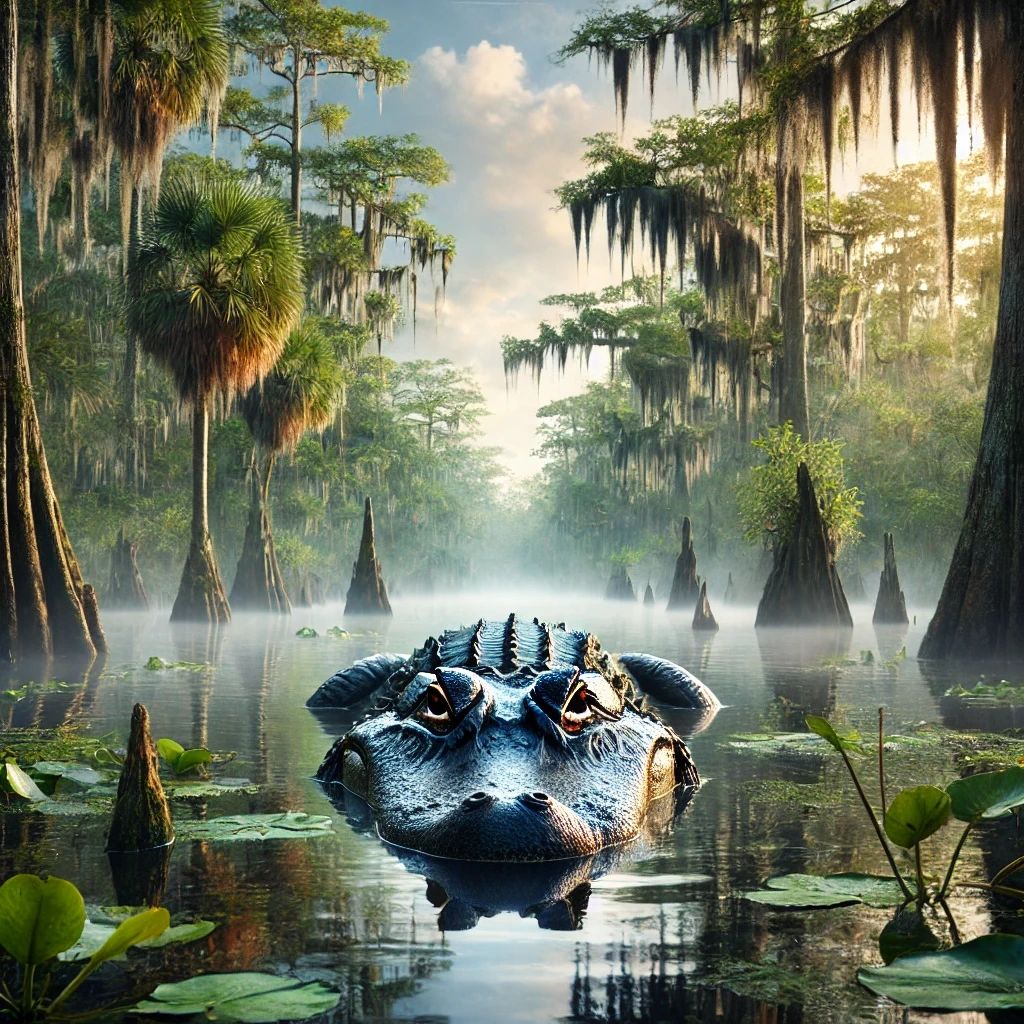
Alligators excel in the art of ambush. Hidden beneath the water’s surface, they remain nearly invisible. Just their nostrils and eyes peek above, waiting.
Their patience is unmatched. They can lie still for hours, burning little energy. When prey like fish, birds, or even deer stray too close, they strike with lightning speed and force.
Apex Predators with No Rivals
In the wild, adult alligators face almost no natural predators. This makes them apex predators, vital for keeping ecosystems balanced.
By controlling the populations of turtles, fish, and mammals, gators prevent overcrowding and maintain healthy biodiversity. They’re more than survivors—they’re shapers of their environment.
Amphibious Advantages: Built for Land and Water
Though primarily aquatic, gators aren’t limited to water. They move surprisingly well on land, even galloping short distances.
Their stealth is enhanced by evolutionary design: nostrils, eyes, and ears are positioned on top of their heads. This allows them to breathe, see, and hear while the rest of their body stays submerged—perfect for stalking prey.
Dietary Adaptability: Eating to Survive
Gators are opportunistic eaters. If it moves—and fits in their jaws—they’ll probably eat it.
From fish and frogs to birds and small mammals, their diet adjusts with the seasons and availability. Young gators start with insects and gradually move to larger prey as they grow.
This adaptability is one reason why gators dominate the waterways year after year.
Territorial Behavior and Mating Season Dominance
Male gators are incredibly territorial, especially during mating season. They use deep bellows that ripple through the water to warn off rivals and attract mates.
Fights can be brutal—clashes of strength that determine who rules the territory. Only the strongest gators secure the best spots, reinforcing their dominance.
Gator Holes: Ecosystem Engineers at Work
Alligators don’t just dominate—they create.
During dry periods, they dig out “gator holes” that trap water. These become safe havens for other animals—frogs, turtles, fish, and even birds.
This engineering helps entire wetland ecosystems survive droughts, proving that even apex predators play nurturing roles.
Survivors Through Environmental Change
Gators have outlasted ice ages, rising sea levels, and deforestation. In the 20th century, they nearly went extinct due to overhunting—but conservation laws saved them.
Now, they’re thriving across the Southeast—a living example of nature’s resilience and the power of protective legislation.
Cultural Symbolism and Human Perception
Few animals inspire both fear and fascination like the alligator. Though attacks on humans are rare, their presence demands respect.
In places like Florida and Louisiana, they’re more than just animals—they’re mascots, menu items, and cultural icons. Alligators symbolize toughness, survival, and untamed wilderness.
Conclusion: Nature’s Reptilian Powerhouse
So, why do gators dominate the waterways?
Because they were built for it. Their patience, power, adaptability, and ecological role make them unmatched rulers of their domain. These creatures aren’t just survivors—they’re architects and apex engineers of the wetland world.
FAQs About Why Gators Dominate the Waterways
1. What makes alligators apex predators? They sit atop the food chain with no natural predators and control population dynamics in their ecosystems.
2. How do gators hunt so effectively? They use stealth, patience, and explosive speed to ambush unsuspecting prey.
3. Why haven’t alligators evolved much over time? Their bodies are so well-designed for survival that evolutionary changes haven’t been necessary.
4. Do alligators help other species? Yes, especially during dry spells—gator holes provide refuge for many animals.
5. Are gators more dangerous on land or in water? They’re more agile in water, but can move quickly on land in short bursts.
6. How did conservation efforts save alligators? Through hunting bans, habitat protection, and awareness, populations have rebounded from near extinction.
Alligator Supremacy
When most people think of aquatic predators, sharks often steal the spotlight. But in the swamps, bayous, and freshwater rivers of the American Southeast, there’s one ruler: the alligator.
This prehistoric predator has reigned for millions of years. But why do gators dominate the waterways so thoroughly? The answer lies in their biology, behavior, and role in the ecosystem.
Ancient Survivors with Evolutionary Perfection
Alligators are evolutionary marvels. Their lineage stretches back 37 million years, with few changes needed. Their rugged bodies are covered in osteoderms—bony plates that double as armor. Their tails are muscular powerhouses, helping them glide through water silently.
Their bite? It’s a jaw-dropping 2,000+ pounds per square inch—strong enough to crush turtles and bones alike.
This ancient design has helped them outlast dinosaurs, ice ages, and human threats.
Stealth Hunters: Masters of the Ambush
Alligators excel in the art of ambush. Hidden beneath the water’s surface, they remain nearly invisible. Just their nostrils and eyes peek above, waiting.
Their patience is unmatched. They can lie still for hours, burning little energy. When prey like fish, birds, or even deer stray too close, they strike with lightning speed and force.
Apex Predators with No Rivals
In the wild, adult alligators face almost no natural predators. This makes them apex predators, vital for keeping ecosystems balanced.
By controlling the populations of turtles, fish, and mammals, gators prevent overcrowding and maintain healthy biodiversity. They’re more than survivors—they’re shapers of their environment.
Amphibious Advantages: Built for Land and Water
Though primarily aquatic, gators aren’t limited to water. They move surprisingly well on land, even galloping short distances.
Their stealth is enhanced by evolutionary design: nostrils, eyes, and ears are positioned on top of their heads. This allows them to breathe, see, and hear while the rest of their body stays submerged—perfect for stalking prey.
Dietary Adaptability: Eating to Survive
Gators are opportunistic eaters. If it moves—and fits in their jaws—they’ll probably eat it.
From fish and frogs to birds and small mammals, their diet adjusts with the seasons and availability. Young gators start with insects and gradually move to larger prey as they grow.
This adaptability is one reason why gators dominate the waterways year after year.
Territorial Behavior and Mating Season Dominance
Male gators are incredibly territorial, especially during mating season. They use deep bellows that ripple through the water to warn off rivals and attract mates.
Fights can be brutal clashes of strength that determine who rules the territory. Only the strongest gators secure the best spots, reinforcing their dominance.
Gator Holes: Ecosystem Engineers at Work
Alligators don’t just dominate—they create.
During dry periods, they dig out “gator holes” that trap water. These become safe havens for other animals—frogs, turtles, fish, and even birds.
This engineering helps entire wetland ecosystems survive droughts, proving that even apex predators play nurturing roles.
Survivors Through Environmental Change
Gators have outlasted ice ages, rising sea levels, and deforestation. In the 20th century, they nearly went extinct due to overhunting—but conservation laws saved them.
Now, they’re thriving across the Southeast—a living example of nature’s resilience and the power of protective legislation.
Cultural Symbolism and Human Perception
Few animals inspire both fear and fascination like the alligator. Though attacks on humans are rare, their presence demands respect.
In places like Florida and Louisiana, they’re more than just animals—they’re mascots, menu items, and cultural icons. Alligators symbolize toughness, survival, and untamed wilderness.
Conclusion: Nature’s Reptilian Powerhouse
So, why do gators dominate the waterways?
Because they were built for it. Their patience, power, adaptability, and ecological role make them unmatched rulers of their domain. These creatures aren’t just survivors—they’re architects and apex engineers of the wetland world.
FAQs About Why Gators Dominate the Waterways
1. What makes alligators apex predators? They sit atop the food chain with no natural predators and control population dynamics in their ecosystems.
2. How do gators hunt so effectively? They use stealth, patience, and explosive speed to ambush unsuspecting prey.
3. Why haven’t alligators evolved much over time? Their bodies are so well-designed for survival that evolutionary changes haven’t been necessary.
4. Do alligators help other species? Yes, especially during dry spells—gator holes provide refuge for many animals.
5. Are gators more dangerous on land or in water? They’re more agile in water but can move quickly on land in short bursts.
6. How did conservation efforts save alligators? Through hunting bans, habitat protection, and awareness, populations have rebounded from near extinction.
References:
- Erickson, G. M., Lappin, A. K., Vliet, K. A., & Inouye, B. D. (2003). The ontogeny of bite-force performance in American alligators (Alligator mississippiensis). Journal of Zoology, 260(3), 317–327. https://doi.org/10.1017/S0952836903003829
- Mazzotti, F. J., & Brandt, L. A. (1994). Ecology of the American Alligator in a Changing Environment. Everglades: The Ecosystem and Its Restoration, 485–505. https://www.nrs.fs.fed.us/pubs/46111
- University of Florida. (2023). Alligator mississippiensis – Florida Museum of Natural History. Retrieved from https://www.floridamuseum.ufl.edu/discover-fish/species-profiles/alligator-mississippiensis/
- Elsey, R. M., Joanen, T., McNease, L., & Kinler, N. (1992). Growth rates and body condition factors of American alligators in coastal Louisiana wetlands: A comparison of wild and farm-released juveniles. Proceedings of the Annual Conference of the Southeastern Association of Fish and Wildlife Agencies, 46, 276–286. https://www.seafwa.org/journal/1992/growth-rates-and-body-condition-factors-american-alligators-coastal-louisiana-wetlands
- Rosenblatt, A. E., & Heithaus, M. R. (2011). Does variation in movement tactics and trophic interactions among American alligators create habitat linkages? Journal of Animal Ecology, 80(4), 786–798. https://doi.org/10.1111/j.1365-2656.2011.01830.
- U.S. Fish and Wildlife Service. (2022). American Alligator (Alligator mississippiensis). Retrieved from https://www.fws.gov/species/american-alligator-alligator-mississippiensis
- Lance, V. A., & Elsey, R. M. (1999). Plasma catecholamines and plasma corticosterone following restraint stress in juvenile alligators. Journal of Experimental Zoology, 283(5), 566–574. https://doi.org/10.1002/(SICI)1097-010X(19990601)283:5<566::AID-JEZ13>3.0.CO;2-Y
- Kushlan, J. A., & Jacobsen, T. (1990). Environmental variability and the reproductive success of Everglades alligators. Journal of Herpetology, 24(2), 176–184. https://doi.org/10.2307/1564420
- Newsome, T. M., Ripple, W. J., & Wirsing, A. J. (2015). Mesopredator suppression revisited: A global meta‐analysis of coyote removal experiments. Biological Conservation, 187, 109–115. https://doi.org/10.1016/j.biocon.2015.04.003
- Brandt, L. A., & Mazzotti, F. J. (1990). The behavior of juvenile alligators in a seasonal habitat. American Midland Naturalist, 124(1), 61–72. https://doi.org/10.2307/2425750
About the AuthorRebecca Ryan** is a proud U.S. Navy veteran, devoted mother, and lifelong explorer of the skies. Her passion for aviation, military history, and the enduring power of music fuels her writing and storytelling. With years of service shaping her perspective, Rebecca offers a unique voice that blends personal experience, heartfelt reflection, and deep curiosity. Whether recounting stories from her time in uniform or connecting the dots between aviation and everyday life, she brings authenticity, insight, and warmth to every piece she writes. Her mission? To honor the legacy of service, inspire future generations, and keep the spirit of discovery alive—one story at a time.
Originally published at the live site .