
Maritime ·
A Shark's Sense of Smell: Nature's Ultimate Underwater Nose
Hello, fellow ocean explorers! 🦈 Today, we’re diving deep into one of the most fascinating superpowers in the animal kingdom—a shark’s sense of smell. Sharks aren’t just fierce predators because of their teeth or speed;...
By Rebecca "Madam Chronicler" Ryan
Hello, fellow ocean explorers! 🦈 Today, we’re diving deep into one of the most fascinating superpowers in the animal kingdom—a shark’s sense of smell. Sharks aren’t just fierce predators because of their teeth or speed; their noses play a huge role in making them some of the most successful hunters in the ocean.
In this friendly and fun blog, we’re going to explore how sharks use their amazing sense of smell, how strong it really is, and why it’s so important for their survival. Ready to take a swim through science? Let’s go!
🦈 How Does a Shark’s Nose Work?
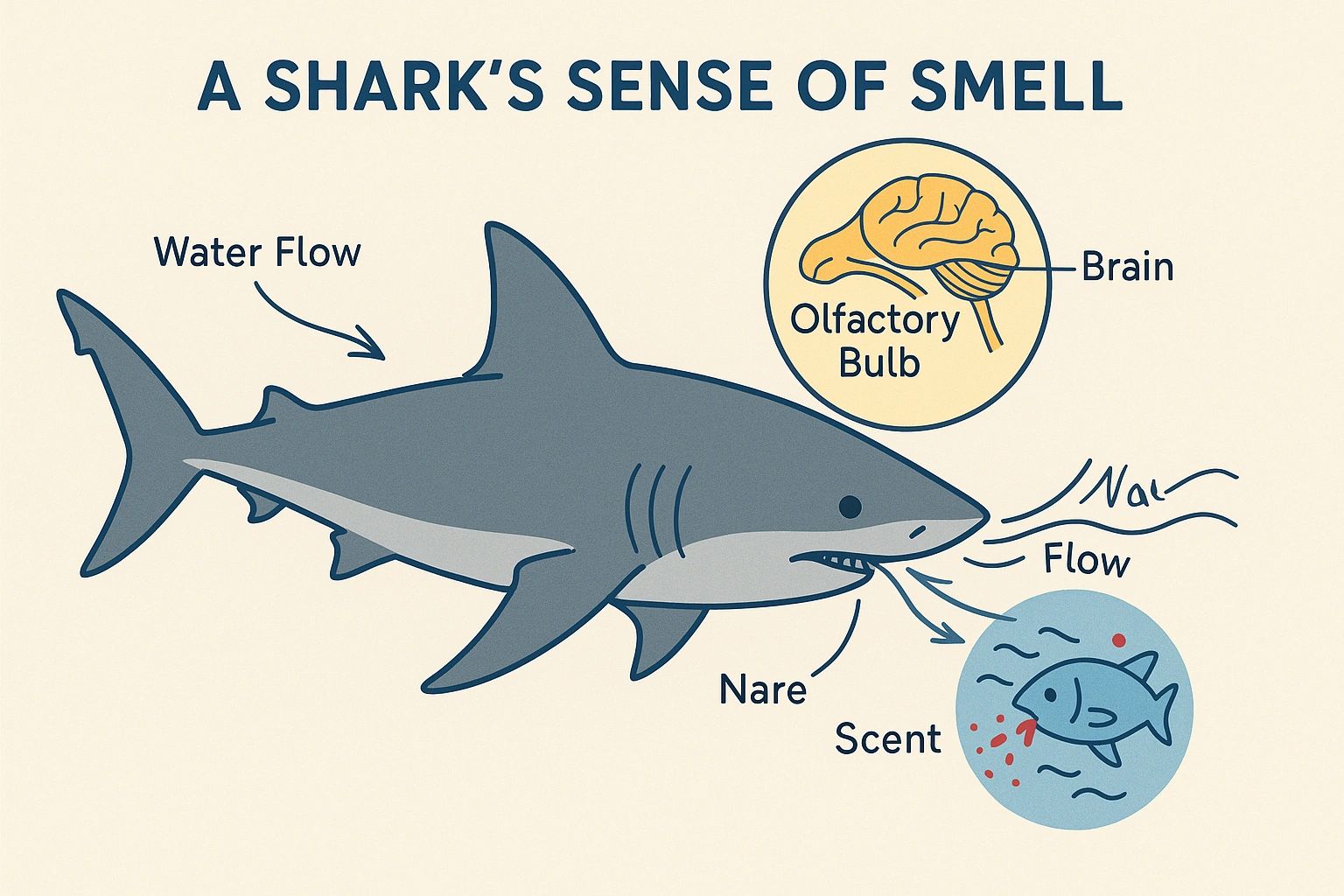
First things first—sharks have noses, but they don’t use them to breathe like we do. Instead, their noses, called nares, are strictly for smelling. These nares are located underneath their snouts and look like little holes, with two on each side of their head. Water flows through these holes as the shark swims.
Inside the nares, there are special tissues filled with sensory cells called olfactory lamellae. These cells detect chemicals in the water. When tiny particles of scent, like fish blood or oils, dissolve in the ocean, they drift through the water. As the shark swims, water carrying those scents moves into its nares, where the olfactory cells pick up the scent signals and send them to the shark’s brain.
Pretty cool, right? In a way, it’s like they’re “tasting” the water!
🧠 The Shark Brain: A Smelling Powerhouse
Sharks aren’t just good sniffers because of their noses—they also have big brain sections dedicated to smell. The part of the brain called the olfactory bulb is huge in sharks, sometimes making up over two-thirds of the entire brain in some species (Ferrando et al., 2016). That’s like if most of your brain was just for smelling pizza!
This large olfactory bulb processes scent signals and helps the shark figure out where the smell is coming from and what it is. That means sharks can not only smell something far away, but they can also follow the scent trail right to its source.
🦈 Just How Strong Is a Shark’s Sense of Smell?
You may have heard the old myth that sharks can smell a drop of blood in the ocean from miles away. While that’s a bit exaggerated, their sense of smell is still incredibly powerful.
Research shows that some sharks can detect certain chemicals at concentrations as low as one part per 10 billion (Meredith & Kajiura, 2010). That’s like detecting one drop of scent in a pool the size of an Olympic swimming pool!
Sharks don’t just smell blood, though. They’re sensitive to many kinds of chemical cues, including amino acids, oils, and other substances released by prey.
🧭 Smelling Their Way Through the Sea
Sharks use their sense of smell not just to find food, but also to navigate through the ocean. Studies show that sharks can detect the direction of a scent trail and follow it with amazing accuracy.
Sharks do this by comparing the strength of the scent in each nare. If the smell is stronger on the left side, the shark will turn left; if it’s stronger on the right, it’ll turn right. This is called stereo-olfaction, and it works kind of like how we use both our ears to locate sounds (Gardiner & Atema, 2007).
Some experiments even showed that sharks could follow a scent trail through complicated underwater environments, zigzagging through the water until they reached the source.
🍴 Smelling Isn’t Just for Hunting
While most people think sharks use their noses just to find food, their sense of smell has many other uses too.
🦈 Finding Mates
Many sharks use scent to find potential mates. Some species release special chemical signals, known as pheromones, to attract others during mating season (Wyffels et al., 2020).
🦈 Staying Safe
Sharks can also detect chemical cues from other animals, including those that might be a threat. Some studies suggest that certain smells can signal danger, like the presence of a larger predator or an injured shark nearby.
🌊 Which Shark Has the Best Sense of Smell?
Some sharks are better sniffers than others! Species that rely heavily on scent to hunt tend to have more developed olfactory systems.
Here are a few examples:
- Hammerhead sharks: Their wide heads (called cephalofoils) give them extra space for large nares, allowing them to detect smells even more effectively (Kajiura et al., 2005).
- Great white sharks: Known for tracking prey over long distances, great whites have an excellent sense of smell to detect seals and fish.
- Nurse sharks: These bottom-dwellers rely on their noses to find prey hidden under sand or rocks.
🔬 How Do Scientists Study Shark Smell?
It’s not easy to study how animals smell underwater, but scientists have come up with some clever experiments.
One common method is to create a scent trail in the water using substances like fish oil or amino acids. Researchers then watch how sharks react, often from boats or underwater cameras.
In some studies, scientists temporarily plug one nare to see if the shark can still follow the scent trail. These tests help confirm that sharks use both nares to find the direction of a smell (Gardiner & Atema, 2007).
Other researchers study shark brains and olfactory bulbs by scanning them with special imaging tools or examining them under a microscope.
⚖️ Why Smell Matters for Shark Conservation
Shark populations around the world are facing many threats, including overfishing, habitat destruction, and climate change. Understanding how sharks use their sense of smell is actually very important for protecting them.
🎣 Fishing and Bycatch
Many fishing operations accidentally catch sharks, even when they aren’t targeting them. By studying which scents attract sharks, scientists hope to develop “shark repellents” or scent-based deterrents to keep sharks away from fishing gear (Jordan et al., 2013).
🏝️ Protecting Habitats
Since sharks often use scent trails to navigate to feeding or breeding grounds, pollution that masks natural smells can confuse them or make it harder for them to survive. Learning more about shark olfaction helps scientists understand how pollution affects shark behavior.
🧪 New Research Frontiers
Some researchers are also exploring whether certain chemicals could be used to guide sharks away from danger zones like busy beaches or polluted areas.
🚨 Myth Busted: Do Sharks Go Crazy at the Smell of Blood?
We’ve all seen movies where a single drop of blood turns a group of sharks into a frenzied mob. While it’s true that sharks are drawn to the scent of blood, they don’t instantly go into a feeding frenzy.
Sharks are curious and cautious hunters. They often investigate a scent carefully before attacking. Many sharks will swim around for a while, testing the waters with their other senses before deciding to strike.
Also, not all blood is equally interesting to sharks. Human blood doesn’t always attract them the same way fish or marine mammal blood does. Sharks are especially sensitive to the amino acids found in their natural prey.
🏄 What Should You Do About Shark Smell in the Water?
If you’re swimming in the ocean, you don’t need to panic about your scent. Here are a few tips, though:
- Avoid swimming with open wounds, since sharks are more attracted to blood from marine species, but it’s best to play it safe.
- Don’t wear shiny jewelry in the water, as it can look like fish scales flashing in the sun.
- Swim in groups and avoid swimming at dawn or dusk, when some sharks are most active.
Remember, sharks don’t see humans as normal prey, and most are just curious!
🧠 Fun Facts About Shark Smell
Here are a few more amazing shark sniffing facts to share with your friends:
- The greenland shark may have a strong sense of smell, helping it hunt in the deep, dark Arctic waters.
- Some sharks can detect minute changes in water chemistry, even from hundreds of meters away.
- Scientists are studying shark smell to create better underwater robots that can track chemical leaks or pollutants in the ocean!
🌟 Conclusion: Nature’s Perfect Nose
Sharks are truly the masters of scent in the ocean. Their powerful sense of smell helps them hunt, find mates, navigate the seas, and stay safe from threats. Their noses and brains are built for detecting even the tiniest chemical clues in the water, making them some of the most successful animals in marine history.
While they sometimes get a bad reputation, sharks are incredibly intelligent and cautious creatures. Their sense of smell is just one of the many ways they help keep the ocean ecosystem healthy and balanced.
Next time you think about sharks, remember their amazing noses—and maybe give them a little respect for their super-powered sniffer!
📚 Bibliography
Ferrando, S., Gallus, L., Ghigliotti, L., Vacchi, M., & Mastrototaro, F. (2016). Olfactory system of the Mediterranean shark Scyliorhinus canicula: A morphological study. The Anatomical Record, 299(7), 934–948. https://doi.org/10.1002/ar.23368
Gardiner, J. M., & Atema, J. (2007). Sharks need the lateral line to locate odor sources: rheotaxis and eddy chemotaxis. Journal of Experimental Biology, 210(11), 1925-1934. https://doi.org/10.1242/jeb.02782
Jordan, L. K., Mandelman, J. W., & Kajiura, S. M. (2013). Behavioral responses to weak electric fields and a lanthanide metal in two shark species. Journal of Experimental Marine Biology and Ecology, 443, 110-116. https://doi.org/10.1016/j.jembe.2013.02.004
Kajiura, S. M., Forni, J. B., & Summers, A. P. (2005). Olfactory morphology of carcharhinid and sphyrnid sharks: does the cephalofoil confer a sensory advantage? Journal of Morphology, 264(2), 253–263. https://doi.org/10.1002/jmor.10214
Meredith, T. L., & Kajiura, S. M. (2010). Olfactory morphology and physiology of elasmobranchs. Journal of Experimental Biology, 213(20), 3449-3456. https://doi.org/10.1242/jeb.043489
Wyffels, J. T., Nichols, H. L., & Lowers, R. H. (2020). Evidence for pheromone communication in the reproductive behavior of blacktip sharks (Carcharhinus limbatus). Scientific Reports, 10(1), 4574. https://doi.org/10.1038/s41598-020-61275-w
Originally published at the live site .