
Places ·
Brown Pelicans at Merritt Island Wildlife Refuge
Brown pelicans (Pelecanus occidentalis) photographed at Merritt Island National Wildlife Refuge illustrate the deep ecological interdependence between coastal birds, mangrove ecosystems, and estuarine productivity. Once ...
By Rebecca "Madam Chronicler" Ryan
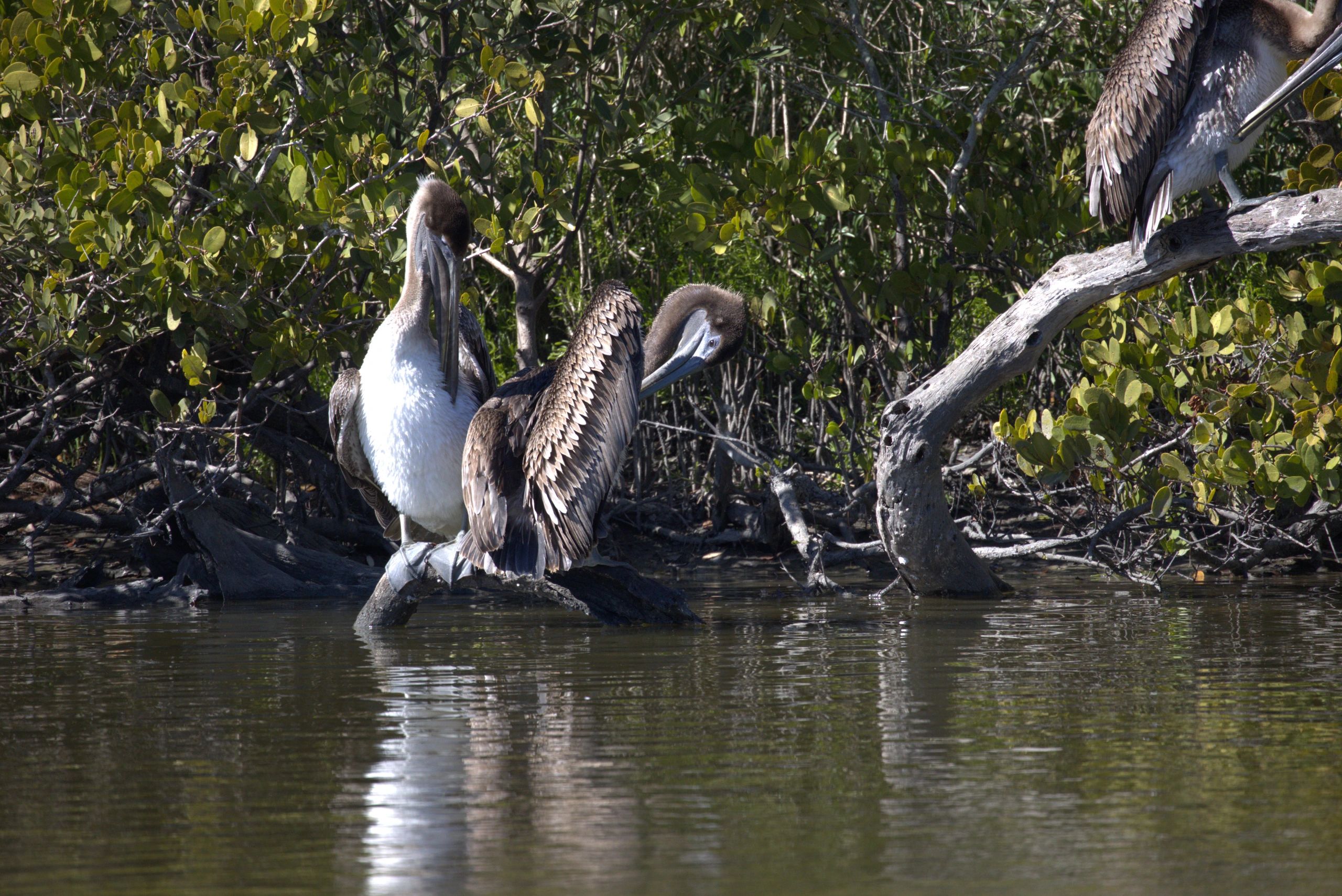
Brown pelicans (Pelecanus occidentalis) photographed at Merritt Island National Wildlife Refuge illustrate the deep ecological interdependence between coastal birds, mangrove ecosystems, and estuarine productivity. Once driven to regional collapse by DDT contamination, brown pelicans rebounded following regulatory reform and habitat protection. Today, populations in protected areas like Merritt Island reflect both the success of environmental policy and the continuing vulnerability of coastal ecosystems to development, pollution, and climate change. Understanding the pelican’s presence in this Florida refuge provides a localized lens into broader marine biodiversity and shoreline resilience.
A Coastal Refuge on Florida’s Space Coast
The brown pelicans perched quietly above the water at Merritt Island National Wildlife Refuge are part of a larger ecological story unfolding along Florida’s east-central coast. Established in 1963 and managed by the U.S. Fish and Wildlife Service, Merritt Island encompasses over 140,000 acres of protected habitat bordering the Indian River Lagoon. Salt marshes, mangrove shorelines, brackish impoundments, and coastal dunes form a mosaic of environments that sustain over 300 bird species.
The refuge’s proximity to the Kennedy Space Center has unintentionally restricted urban development, preserving extensive stretches of estuarine habitat that would likely have been fragmented otherwise. For brown pelicans, this protected landscape offers both feeding grounds and roosting sites within a relatively undisturbed coastal system.
The image of pelicans resting on mangrove branches above calm lagoon waters is not incidental; it represents a functional ecological relationship between the birds and their habitat.
The Indian River Lagoon: Productivity at the Edge of Land and Sea
Merritt Island borders the Indian River Lagoon, one of North America’s most biologically diverse estuaries. Estuaries are transitional systems where freshwater from rivers meets marine saltwater, creating nutrient gradients that fuel plankton growth. These microscopic organisms form the base of a food web that supports shrimp, crabs, and juvenile fish sheltered among submerged vegetation and mangrove roots.
Brown pelicans rely on small schooling fish, such as mullet and menhaden, which thrive in productive estuarine systems. Their plunge-diving feeding strategy necessitates relatively clear, shallow waters where fish schools are visible from above. The lagoon’s tidal creeks and open flats offer these ideal conditions.
However, the lagoon has experienced nutrient-driven algal blooms, seagrass loss, and periodic fish mortality events in recent decades. Because pelicans forage directly within this system, fluctuations in fish availability can influence breeding success and colony stability. As such, pelicans function as ecological indicators of estuarine health.
Mangrove Ecosystems: Structural Habitat and Ecological Engine
Mangrove forests line much of Merritt Island’s shoreline. Florida’s east coast supports three primary mangrove species—red (Rhizophora mangle), black (Avicennia germinans), and white (Laguncularia racemosa). Their interlaced root systems stabilize sediments, buffer storm surge, and create nursery habitat for juvenile marine species (Alongi 2002).
For brown pelicans, mangroves provide elevated nesting and roosting platforms, protecting them from tidal fluctuations. Their colonial nests, built from sticks, are typically located in upper branches, out of reach of most terrestrial predators. The surrounding water also limits predator access.
Mangroves also moderate microclimatic conditions by reducing wind exposure and temperature extremes, which increases the likelihood of successful breeding in subtropical climates. Therefore, habitat loss in mangrove systems affects not only shoreline stability but also avian reproductive success.
Globally, mangrove forests have declined significantly due to aquaculture expansion and coastal development (Friess et al. 2019). Protected refuges, like Merritt Island, play an essential role in preserving intact stands.
Adaptations of a Coastal Hunter
The brown pelican is uniquely adapted to this environment. With a wingspan exceeding two meters and reinforced air sacs beneath the skin, it can dive from heights of up to 20 meters without injury. Upon impact, its elastic throat pouch expands to capture fish and water, which is then drained before swallowing prey.
Unlike white pelicans, which forage cooperatively while swimming, brown pelicans are solitary plunge-divers. This strategy allows them to exploit dense fish schools in the shallow estuarine waters, such as those found in the Indian River Lagoon.
Their aerodynamic efficiency is also remarkable. Pelicans glide just inches above the water’s surface, using ground effect to conserve energy. This efficiency allows them to travel between feeding areas and mangrove roosts with minimal metabolic cost.
The DDT Crisis and the Path to Recovery
Although brown pelicans appear stable today at Merritt Island, their mid-20th-century history was marked by severe decline. Widespread DDT use led to bioaccumulation of its derivative, DDE, within marine food chains. When pelicans consumed contaminated fish, eggshell thinning occurred due to impaired calcium metabolism (Hickey and Anderson 1968).
Eggs frequently broke under incubation pressure, leading to reproductive failure. By the late 1960s, brown pelicans had disappeared from Louisiana and were in steep decline in California (Anderson et al. 1975).
The 1972 U.S. ban on DDT, along with protections under the Endangered Species Act, proved to be a turning point. Eggshell thickness gradually returned to normal, and breeding success improved. By 2009, the U.S. Fish and Wildlife Service formally removed the species from the federal endangered list (USFWS 2009).
Protected landscapes, like Merritt Island, supplied secure breeding and roosting grounds during recovery, underscoring the importance of habitat preservation in conjunction with chemical regulations.
Contemporary Pressures on Florida’s Coast
Despite their recovery, brown pelicans are still facing challenges from modern stressors. Rising sea levels threaten low-lying mangrove forests and barrier islands. More intense storms can destroy nests during breeding season, and coastal armoring restricts the inland migration of mangroves, compressing their habitat between rising seas and existing infrastructure.
The 2010 Deepwater Horizon oil spill demonstrated pelicans’ susceptibility to hydrocarbon contamination, affecting plumage insulation and reproductive health (Haney et al. 2014). Overfishing of forage species can also reduce food availability.
In Florida’s Indian River Lagoon, nutrient enrichment and harmful algal blooms have periodically disrupted fish populations, potentially leading to indirect impacts on pelicans through prey scarcity.
Blue Carbon and Coastal Climate Resilience
Mangrove ecosystems sequester significant amounts of carbon in both biomass and sediments, making them critical “blue carbon” reservoirs (McLeod et al. 2011). Protecting mangroves at Merritt Island, therefore, contributes to climate mitigation while preserving wildlife habitat.
This dual benefit underscores the interconnectedness of coastal conservation efforts. Habitat protection simultaneously supports biodiversity, stabilizes shorelines, and facilitates carbon storage.
Cultural and Conservation Significance
The brown pelican is the state bird of Louisiana and an enduring symbol of the Gulf and Atlantic coastlines. Its return from the brink of regional extinction is one of the most visible conservation successes of the 20th century.
At Merritt Island, visitors observing pelicans along the Black Point Wildlife Drive or from lagoon overlooks witness a species whose survival is a testament to decades of scientific research, environmental advocacy, and policy reform.
Conclusion: A Living Measure of Coastal Health
The brown pelicans photographed at Merritt Island National Wildlife Refuge embody the ecological interdependence of mangroves, estuaries, fisheries, and environmental regulations. Their presence signals a functioning coastal ecosystem—one capable of sustaining complex food webs and recovering from chemical contamination.
While resilience is not permanence, ongoing management and scientific vigilance are needed to address climate change, habitat compression, pollution, and fisheries pressure. Protecting mangrove forests, restoring lagoon water quality, and maintaining sustainable fish populations are essential to ensure pelicans continue to thrive in Florida’s coastal waters.
The story unfolding at Merritt Island transcends local boundaries. It serves as a case study demonstrating how protected landscapes, science-based regulations, and ecological awareness work together to sustain coastal biodiversity.
Bibliography
Alongi DM. 2002. Present state and future of the world’s mangrove forests. Environmental Conservation. 29(3):331–349. https://doi.org/10.1017/S0376892902000231
Anderson DW, Jehl JR Jr, Risebrough RW, Woods LA Jr, DeWeese LR, Edgecomb WG. 1975. Brown pelicans: improved reproduction off the southern California coast. Science. 190(4216):806–808. https://doi.org/10.1126/science.1188363
Friess DA, Rogers K, Lovelock CE, Krauss KW, Hamilton SE, Lee SY, Lucas R, Primavera J, Rajkaran A, Shi S. 2019. The state of the world’s mangrove forests: past, present, and future. Annual Review of Environment and Resources. 44:89–115. https://doi.org/10.1146/annurev-environ-101718-033302
Haney JC, Geiger HJ, Short JW. 2014. Bird mortality from the Deepwater Horizon oil spill. Marine Ecology Progress Series. 513:1–14. https://doi.org/10.3354/meps10963
Hickey JJ, Anderson DW. 1968. Chlorinated hydrocarbons and eggshell changes in raptorial and fish-eating birds. Science. 162(3850):271–273. https://doi.org/10.1126/science.162.3850.271
McLeod E, Chmura GL, Bouillon S, Salm R, Björk M, Duarte CM, Lovelock CE, Schlesinger WH, Silliman BR. 2011. A blueprint for blue carbon. Frontiers in Ecology and the Environment. 9(10):552–560. https://doi.org/10.1890/110004
U.S. Fish and Wildlife Service (USFWS). 2009. Removal of the brown pelican (Pelecanus occidentalis) from the Federal List of Endangered and Threatened Wildlife. Federal Register. 74(220):59444–59472.
Originally published at the live site .