
Places ·
Castillo de San Marcos: The Oldest Masonry Fort in the US
Introduction: Why Castillo de San Marcos Still Matters
By Rebecca "Madam Chronicler" Ryan
Introduction: Why Castillo de San Marcos Still Matters
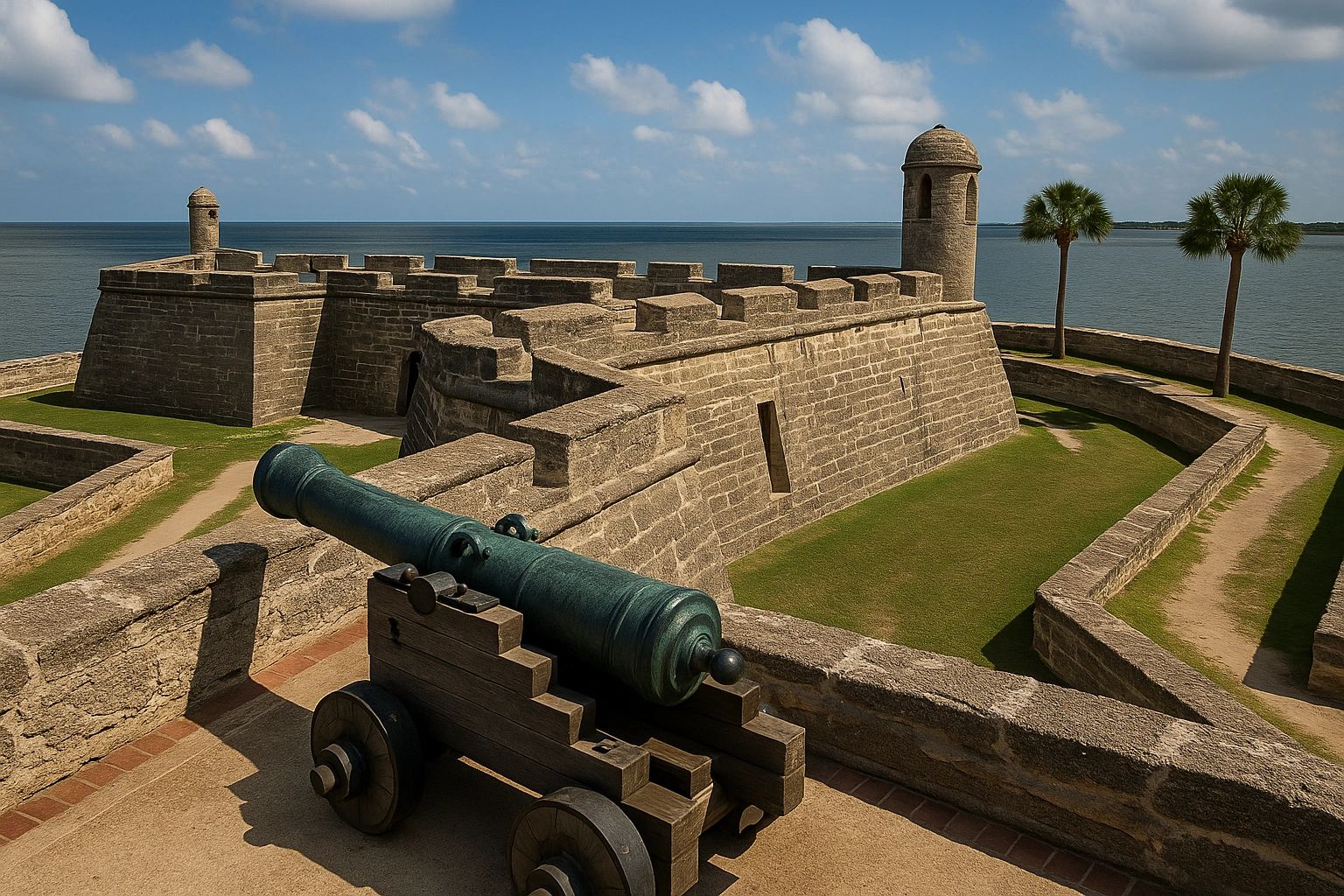
If you’ve ever visited St. Augustine, Florida, you’ve probably seen the Castillo de San Marcos National Monument standing guard over Matanzas Bay. Built by the Spanish in the 17th century, this coquina fortress is the oldest masonry fort in the continental United States. It has survived pirate raids, colonial wars, and centuries of cultural change. Today, it remains one of the most iconic and best-preserved historic landmarks in America.
In this blog, we’ll dive deep into the fort’s history, architecture, battles, legends, and cultural impact. By the end, you’ll understand why Castillo de San Marcos is not just a stone fort—but a living story of resilience and heritage.
The Founding of St. Augustine and Spain’s Struggle for Control
- 1565: St. Augustine was founded by Pedro Menéndez de Avilés, making it the oldest continuously occupied European settlement in the U.S.
- Early wooden forts proved inadequate, as English raids and pirate attacks repeatedly destroyed them.
- After Sir Francis Drake’s devastating raid in 1586, Spain realized the need for a permanent stone fort to defend its foothold in Florida.
By 1672, the Spanish crown ordered construction of a fortress that would withstand the test of time: the Castillo de San Marcos.
Coquina: The Secret Weapon of the Castillo
One of the most fascinating aspects of the Castillo is its unique building material: coquina, a type of limestone made from compressed seashells.
- Absorbs cannon fire: Instead of shattering, coquina walls absorbed cannonballs, preventing major breaches.
- Local resource: Quarried from Anastasia Island, it was readily available and became the fort’s greatest defense.
- Durability: Over centuries, coquina hardened further, ensuring the fort’s survival.
This natural advantage set the Castillo apart from many European-style stone forts, which often crumbled under sustained attack.
Star Fort Design: A Masterpiece of Military Engineering
The Castillo de San Marcos wasn’t just strong—it was also brilliantly designed. Based on the Renaissance bastion system (also known as a star fort), its structure minimized blind spots and maximized firepower.
Key features include:
- Four bastions: San Pedro, San Agustín, San Carlos, and San Pablo.
- A dry moat for added protection.
- A ravelin (triangular outwork) to guard the main gate.
- Casemates (arched rooms) that served as barracks, storerooms, and powder magazines.
This design ensured overlapping fields of fire, making the fort nearly impossible to storm directly.
The Siege of 1702: The Fort’s First Great Test
In 1702, English forces under Governor James Moore of Carolina attacked St. Augustine during Queen Anne’s War.
- The town was burned, but over 1,500 residents and soldiers took refuge inside the Castillo.
- English cannons battered the fort for two months—but the coquina walls absorbed every shot.
- Spanish reinforcements from Havana forced the English to retreat in defeat.
This victory proved the Castillo’s worth and cemented its reputation as a fortress that could not be conquered.
Castillo de San Marcos Through Changing Empires
The Castillo’s history reflects the turbulent shifts in control of Florida:
- Spanish Rule (1672–1763): The original builders and defenders.
- British Rule (1763–1783): Renamed Fort St. Mark after the Treaty of Paris.
- Return to Spain (1783–1821): Spain regained Florida following the American Revolution.
- U.S. Control (1821–1861): Renamed Fort Marion, used by the U.S. Army.
- Civil War (1861–1865): Briefly held by Confederate troops before Union forces reclaimed it.
- 19th Century Prison: Used to hold Seminole prisoners and later Apache captives, including Geronimo’s band.
Finally, in 1924, it was declared a National Monument, preserving its legacy for generations.
The Human Stories Behind the Fort
Beyond its military role, the Castillo was a place where cultures collided and histories intertwined.
- Refuge During Sieges: Civilians sought safety within its walls during attacks.
- Prison for Native Americans: Seminole leaders, Plains Indians, and even Geronimo’s people were held here.
- Cultural Exchange: Spanish, African, Native American, and later British and American presences left layers of cultural influence still visible today.
These human stories remind us that the fort was not just stone and strategy—it was a stage where lives unfolded.
Castillo de San Marcos Today: A Living Monument
Now managed by the National Park Service, the fort is open to millions of visitors each year. You can:
- Walk along its ramparts overlooking the bay.
- Explore the casemates where soldiers once slept and prisoners were kept.
- Attend cannon-firing demonstrations and reenactments.
- Learn about colonial warfare, Native American history, and architectural innovations.
As both a historical site and a cultural symbol, the Castillo continues to inspire awe and curiosity.
Why Castillo de San Marcos is Important Today
The Castillo is not only a tourist attraction—it’s a symbol of:
- Endurance: Surviving centuries of war and weather.
- Colonial Struggles: Reflecting the rivalry between Spain, Britain, and the U.S.
- Cultural Intersection: A reminder of the Native, African, and European peoples whose lives intertwined here.
- Preservation: Showcasing how heritage can be protected for future generations.
For students of history, architecture enthusiasts, or curious travelers, Castillo de San Marcos offers a rare opportunity to step back into a living past.
Conclusion: The Legacy of the Castillo de San Marcos
From the first shovel of coquina in 1672 to its modern role as a protected national monument, Castillo de San Marcos has stood as a silent witness to history. It endured pirate raids, colonial wars, empire transfers, and civil conflicts, yet remains as solid today as when it was built.
Walking through its gates, you feel the presence of centuries—the footsteps of Spanish soldiers, the cries of imprisoned Seminoles, the echo of cannons across the bay. More than a fort, the Castillo is a story carved in stone, one that continues to shape how we understand America’s colonial past.
Bibliography
- Arana, Luis Rafael. The Building of the Castillo de San Marcos. Eastern National Park and Monument Association, 1977.
- Chatelain, Verne E. The Defenses of Spanish Florida, 1565–1763. Carnegie Institution of Washington, 1941.
- Manucy, Albert. The History of Castillo de San Marcos and Fort Matanzas: From Contemporary Narratives and Letters. National Park Service, 1947.
- Manucy, Albert. Castillo de San Marcos: Spanish Stronghold at St. Augustine. National Park Service, revised edition, 1991.
- Milanich, Jerald T. Florida Indians and the Invasion from Europe. University Press of Florida, 1995.
- Parker, Susan R. The Oldest City: St. Augustine, Saga of Survival. St. Augustine Historical Society, 2010.
- Schein, Richard H. Landscape and Race in the United States. Routledge, 2006.
- Tepaske, John J. The Governorship of Spanish Florida, 1700–1763. Duke University Press, 1964.
- U.S. National Park Service. “Castillo de San Marcos National Monument.” https://www.nps.gov/casa.
Originally published at the live site .