Rivers ·
Cocoa’s History as a Bustling River Town on the Indian River
When you hear the name Cocoa, Florida, you might picture beaches, rockets launching from nearby Cape Canaveral, or the charming historic streets that today welcome visitors from all over the world. But long before touris...
By Rebecca "Madam Chronicler" Ryan
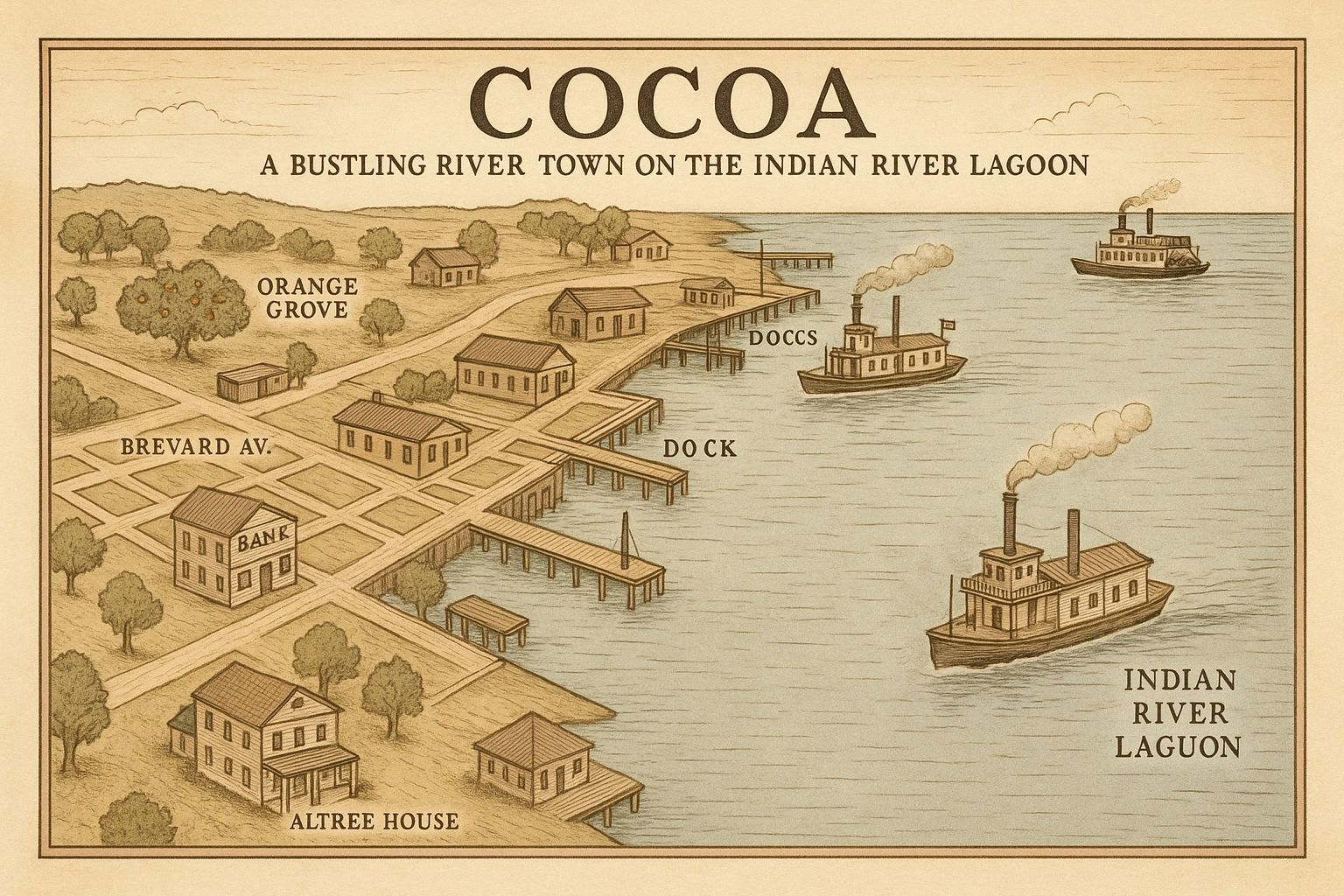
When you hear the name Cocoa, Florida, you might picture beaches, rockets launching from nearby Cape Canaveral, or the charming historic streets that today welcome visitors from all over the world. But long before tourists strolled down Brevard Avenue, Cocoa thrived as a bustling river town perched on the edge of the Indian River Lagoon. The lagoon shaped Cocoa’s identity, fueling trade, fishing, and community life in ways that made it one of Florida’s early coastal hubs.
This blog takes you through the fascinating history of Cocoa—from its beginnings as a river-dependent settlement, to its golden years as a thriving shipping town, and into the modern era where its riverside charm still flows strong.
Life Along the Indian River Lagoon
The Indian River Lagoon is one of the most biodiverse estuaries in North America, stretching for 156 miles along Florida’s east coast. Its brackish waters once provided early settlers and Indigenous peoples with abundant fish, oysters, and manatees, while also serving as a vital waterway for transportation. Long before highways crisscrossed the state, rivers and lagoons were Florida’s “roads.”
For Cocoa, the Indian River Lagoon was both a lifeline and a stage where its history unfolded. By the mid-1800s, settlers began to carve out small communities along the water, clearing land, planting crops, and using the river as their primary connection to the outside world. Steamboats and schooners became the lifeblood of trade, carrying goods like fish, citrus, and timber up and down the coast.
The Birth of Cocoa
Cocoa’s official founding is often traced to the 1860s and 1870s, when pioneers began to settle in the area. One story suggests the town got its name from a box of Baker’s Cocoa that washed ashore, while another claims it came from a popular drink served at the local riverside hotel. Regardless of the legend, Cocoa grew around the lagoon and the riverbank, with wooden docks stretching into the water to accommodate the steady flow of boats.
By the 1880s, Cocoa was more than a cluster of homesteads—it was a thriving settlement with a post office, small shops, and growing neighborhoods. The Indian River Lagoon became its Main Street, with the river carrying everything from mail to groceries to lumber.
Steamboats and River Commerce
If there was one engine that drove Cocoa’s rise as a river town, it was the steamboat. By the late 19th century, steamboats carried cargo and passengers up and down the lagoon, stopping at Cocoa to load and unload. These riverboats connected Cocoa to Jacksonville in the north and Miami in the south, making the town an important stop on Florida’s coastal trade network.
The docks along the lagoon were always busy. Citrus growers brought their harvests down to the water, where fruit was packed into wooden crates and loaded onto boats. Fishermen hauled in mullet, oysters, and clams, which were quickly shipped out to larger cities. General stores filled with goods arriving by riverboat made Cocoa a hub for surrounding farming communities.
Steamboats also brought tourists. In the late 1800s, the Indian River Lagoon was famous for its beauty, and visitors from northern states came to enjoy fishing, hunting, and warm winters. Cocoa became known as a gateway to adventure, where steamboats carried wealthy travelers to riverside hotels and resorts.
The Role of Citrus in Cocoa’s Growth
Citrus was Florida’s golden crop, and Cocoa was no exception. Orange groves flourished along the lagoon, and the fruit was shipped north in massive quantities. The Indian River brand became a name of quality, with “Indian River oranges” gaining fame across the country.
Citrus packing houses sprang up along Cocoa’s riverfront, filling the air with the smell of fresh oranges. Steamboats loaded with crates of citrus left the docks daily during harvest season, making Cocoa one of the region’s busiest shipping points.
Cocoa’s Social Life on the Lagoon
Beyond business, the Indian River Lagoon was central to everyday life in Cocoa. Families gathered at the river’s edge to fish, swim, and socialize. Churches and schools were built near the waterfront, and the river served as a gathering place for community celebrations.
One famous landmark was the Altree House, a riverside hotel that welcomed guests arriving by boat. Other establishments, like the Bank of Cocoa and general stores, added to the feeling of a lively town square—all centered around the lagoon.
The Arrival of the Railroad
While the river powered Cocoa’s early growth, the arrival of the Florida East Coast Railway in the 1890s marked a turning point. Henry Flagler’s railroad stretched down Florida’s coast, linking Cocoa to the wider world in ways the river never could. Suddenly, goods could travel faster and more reliably by rail than by steamboat.
The riverfront remained busy, but the railroad slowly shifted commerce away from the lagoon. Steamboats began to disappear, and some businesses that had thrived on river traffic closed their doors. Still, Cocoa adapted, using its riverside charm and central location to remain a hub for trade and community life.
Cocoa in the Early 20th Century
By the early 1900s, Cocoa was firmly established as a bustling town. Its riverfront district included banks, shops, packing houses, and homes, many of which still stand today as part of the Cocoa Village Historic District.
During World War II, the Indian River Lagoon played a strategic role as military installations popped up along Florida’s east coast. Cocoa’s riverfront saw naval patrol boats and military supply ships pass by, adding to its legacy as a working waterway.
The Decline of River Commerce
As highways expanded and cars became common, river commerce declined further. By the mid-20th century, most shipping had moved to railroads and highways. The once-busy steamboat docks grew quiet, and the lagoon shifted from a commercial hub to more of a recreational and scenic feature.
Still, Cocoa never lost its riverside identity. Fishing, boating, and waterfront gatherings continued, and the historic buildings of Cocoa Village kept the memory of its river-town past alive.
Cocoa Village and Historic Preservation
Today, Cocoa Village is a charming district where the past and present meet. Many of the original buildings from the late 1800s and early 1900s have been restored, housing boutiques, cafes, and galleries. Walking through the village feels like stepping back into the days when steamboats tied up at the docks and the riverfront bustled with life.
The historic preservation of Cocoa Village ensures that the story of Cocoa as a river town remains central to the city’s identity. Festivals, farmers markets, and community events continue to gather people by the lagoon, just as they did more than a century ago.
Cocoa and the Space Age
Cocoa’s history also took a cosmic turn with the rise of the Space Age in the 1950s and 60s. Just across the lagoon, Cape Canaveral and the Kennedy Space Center transformed Brevard County into the launching point for America’s journey to the stars. Cocoa’s riverfront once again became a stage, this time for locals and tourists gathering to watch rockets rise over the horizon.
Though space exploration pulled attention toward the skies, the lagoon remained a constant—reminding Cocoa of its roots as a river town.
The Indian River Lagoon Today
Today, the Indian River Lagoon continues to shape Cocoa’s identity. The river is no longer lined with steamboats or citrus crates, but it remains a place of recreation, beauty, and community pride. Waterfront parks, boat ramps, and marinas keep the tradition of river life alive.
Yet the lagoon also faces challenges, including pollution, algal blooms, and habitat loss. Just as the lagoon once fueled Cocoa’s rise, its future depends on the health of these waters. Conservation efforts are underway to restore seagrass beds, protect manatees, and reduce pollution—ensuring that the lagoon remains a vibrant part of Cocoa’s story.
Conclusion: A Town Shaped by the River
Cocoa’s history cannot be told without the Indian River Lagoon. The river gave birth to the town, powered its commerce, and shaped its culture. From steamboats to citrus groves, from bustling docks to historic Cocoa Village, the lagoon has always been at the heart of Cocoa’s identity.
Even as rockets soar into the sky and highways stretch across the land, Cocoa’s soul remains tied to the river. Walking along the waterfront today, you can almost hear the echoes of steamboat whistles and the laughter of families gathered on the docks—a reminder that Cocoa will always be, at its heart, a river town.
Bibliography
Colburn, D. R., & Landers, J. (1991). The African American heritage of Florida. University Press of Florida.
Griffin, P. A. (2001). Along the Florida shore: Some glimpses of picturesque water life and scenes. University Press of Florida.
Mahon, J. K. (1991). History of the Second Seminole War, 1835–1842. University Press of Florida.
Mormino, G. R. (2005). Land of sunshine, state of dreams: A social history of modern Florida. University Press of Florida.
Proctor, S. (1996). Citrus and steamboats: Commerce along the Indian River Lagoon. Florida Historical Quarterly, 75(2), 201–225.
Rivers, L. (2000). Life on Florida’s Indian River Lagoon. Florida Historical Society Press.
Weisman, B. R. (2007). Unconquered people: Florida’s Seminole and Miccosukee Indians. University Press of Florida.
Williams, J. (2017). Citrus in Florida. University Press of Florida.
Originally published at the live site .