
Maritime ·
How Do Sharks Navigate? The Amazing Secrets of Nature’s Top Trave
Sharks are some of the most fascinating creatures in the ocean. From the mysterious deep-sea lanternshark to the mighty great white, these incredible animals roam far and wide. But how do they know where they are going? ...
By Rebecca "Madam Chronicler" Ryan
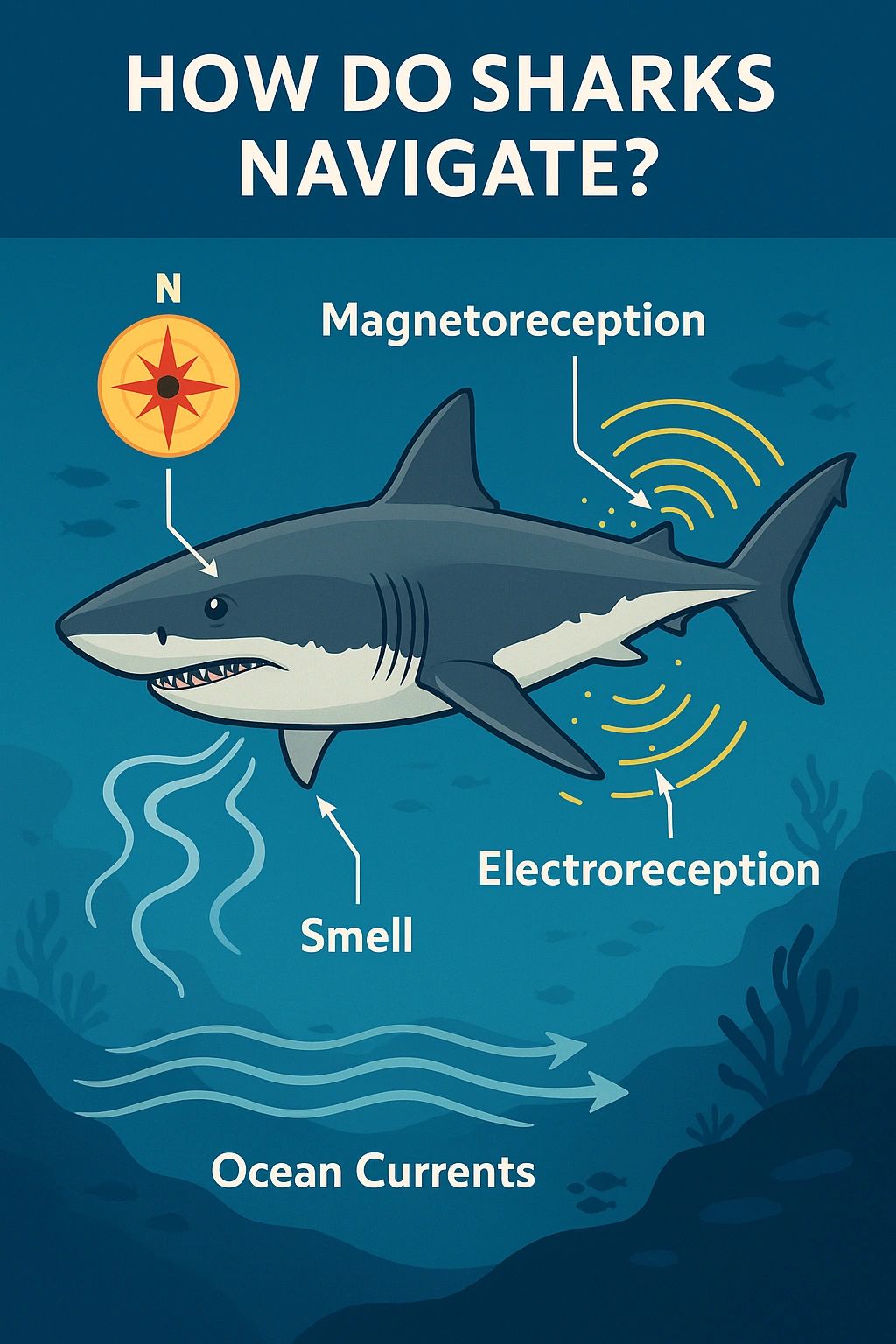
Sharks are some of the most fascinating creatures in the ocean. From the mysterious deep-sea lanternshark to the mighty great white, these incredible animals roam far and wide. But how do they know where they are going? How do sharks navigate through the vast, open waters where there are no signs, no roads, and no GPS? Today, we’re diving deep into the science behind how sharks find their way in the ocean!
Get ready to be amazed as we explore the incredible tools sharks use to navigate the seas, including their senses, the Earth’s magnetic field, and even their memory!
Sharks: Born to Roam
Sharks are natural-born travelers. Many species migrate long distances every year. Great white sharks, for example, can travel thousands of miles across oceans. Some tiger sharks are known to cross entire ocean basins. Even the whale shark—the largest fish in the sea—travels thousands of miles to follow food.
But oceans are tricky places. They have no landmarks, no street signs, and they look almost the same in every direction. Yet, somehow, sharks can navigate these open waters with incredible precision. Scientists have been studying sharks for decades to understand how they do it, and what they’ve discovered is mind-blowing!
The Super Senses of Sharks
Sharks have some of the most powerful senses in the animal kingdom. These senses help them find food, detect danger, and even navigate.
1. Smell: The Ocean’s Bloodhound
Sharks are famous for their incredible sense of smell. They can detect tiny amounts of substances like fish oil or blood from miles away. But smell isn’t just for hunting—it can also help with navigation.
Some sharks use their sense of smell to follow scent trails left by prey or even by other sharks. Scientists believe certain species may even use ocean scents to help them find their way back to familiar places, such as breeding grounds or feeding areas.
2. Vision: Seeing Beyond the Surface
Sharks also have excellent vision, especially in low light. Their eyes are adapted to see in murky waters or deep-sea darkness. While vision is helpful for hunting, it also plays a role in navigation near coastal areas, where landmarks like reefs or rocks might help guide them.
However, vision isn’t their most powerful navigation tool. The real magic lies in other, more mysterious senses.
Sharks and the Earth’s Magnetic Field
Here’s where it gets really interesting! Scientists have discovered that sharks can sense the Earth’s magnetic field—a natural force that wraps around the planet. This field helps animals like birds and sea turtles navigate during migrations, and sharks use it too.
1. The Magnetic Map Sense
In a study published in Current Biology in 2021, researchers placed bonnethead sharks (a smaller relative of hammerheads) in a special tank that could mimic different magnetic fields from around the world (Keller et al., 2021). Amazingly, the sharks responded by swimming in the direction they would need to go to return to their home location.
This suggests that sharks have a “magnetic map sense,” allowing them to detect their position based on the Earth’s magnetic field, like a built-in compass and map combined!
2. Magnetoreception: A Hidden Power
This ability to sense magnetic fields is called magnetoreception. Scientists believe that special cells in sharks’ bodies may contain magnetic particles that respond to the Earth’s field. These cells might work like tiny compasses inside their bodies.
Though we’re still learning about exactly how it works, this sense seems to help sharks travel huge distances without getting lost. It’s a superpower that few animals have!
Electroreception: Detecting Electrical Fields
If magnetoreception wasn’t impressive enough, sharks also have another amazing sense called electroreception.
1. The Ampullae of Lorenzini
Sharks have small jelly-filled pores on their faces called the ampullae of Lorenzini. These pores can detect tiny electric fields in the water. Originally, scientists thought sharks only used this sense for hunting prey, since all living animals produce weak electric signals.
However, some experts now believe this sense may also help with navigation. The ocean itself generates electric fields as water moves through the Earth’s magnetic field. Sharks may detect these fields and use them like underwater road signs to help guide their movements.
Memory and Learning: Sharks Remember the Way
While senses like smell and magnetoreception help sharks find their way, memory plays an important role too.
Many shark species have excellent memories. Studies show that sharks can remember locations where they’ve found food or safe shelter in the past (Mourier et al., 2017). This helps them return to the same spots year after year, especially during long migrations.
1. Site Fidelity: The Homing Instinct
This ability is called site fidelity. Some sharks are known to return to the same reefs or coastal areas every year, even after traveling thousands of miles. It’s a bit like how salmon return to the same rivers to spawn.
By combining their senses with their memory, sharks can develop personal maps of their environment over time, becoming expert navigators of their territory.
Following Ocean Currents
Sharks also use the natural flow of ocean currents to their advantage. Currents can act like underwater highways, helping sharks travel long distances with less effort.
By riding these currents and sensing water temperatures, sharks can migrate more efficiently. Satellite tagging studies have shown that many shark species follow specific currents during their journeys, often moving between areas with specific temperatures or food sources.
Shark Tagging: How Scientists Know Where Sharks Go
One of the coolest ways scientists have learned about shark navigation is through satellite tagging.
Researchers attach small tracking devices to sharks. These tags collect data on the shark’s location, depth, and even body temperature. When the shark swims near the surface, the tag transmits the data to satellites, allowing scientists to track the shark’s movement in near real-time.
1. Amazing Migrations Revealed
Through tagging, we’ve discovered jaw-dropping shark migrations. For example:
- Great white sharks have been tracked traveling between California and Hawaii, a journey of more than 2,500 miles!
- Whale sharks have been tracked moving across entire oceans to visit feeding areas.
- Tiger sharks have shown a clear preference for certain warm areas of the ocean, returning year after year.
These studies prove that sharks are not just random wanderers. They follow specific, often predictable routes, guided by their amazing navigation abilities.
Shark Navigation: A Combination of Superpowers
So, how do sharks navigate?
In short, they use a combination of:
- Smell to follow scents in the water.
- Vision to recognize landmarks near coastlines.
- Magnetoreception to detect their position using Earth’s magnetic field.
- Electroreception to sense electric signals in the ocean.
- Memory to remember successful routes and locations.
- Ocean Currents to help move efficiently through the sea.
By blending these senses and abilities, sharks can navigate the ocean like true masters of the sea.
Why Shark Navigation Matters
Understanding how sharks navigate isn’t just fascinating—it’s also important for conservation.
Many shark species are at risk due to overfishing, habitat loss, and climate change. By learning about their migration routes and navigation tools, scientists can better protect key habitats such as:
- Breeding grounds
- Feeding sites
- Migration corridors
In fact, some marine protected areas are now designed based on shark tagging studies, helping to protect these incredible travelers where they need it most.
The Future of Shark Navigation Research
Even though we’ve learned a lot, there’s still so much more to discover!
Scientists are now exploring:
- The exact structures in sharks that detect magnetic fields.
- Whether pollution or climate change affects shark navigation.
- How young sharks learn to navigate.
New technologies like better satellite tags and underwater robots are making it easier than ever to study sharks in their natural environments.
Final Thoughts: Nature’s Ultimate Navigators
Sharks are truly amazing creatures. Their ability to navigate the oceans—combining super senses, memory, and Earth’s natural forces—shows just how incredible nature can be.
Next time you think about sharks, remember: they’re not just fearsome predators. They’re also expert travelers, gliding across the seas with a built-in navigation system that rivals anything humans have ever invented.
The more we understand about these mysterious creatures, the better we can protect them—and the incredible oceans they call home.
Bibliography
Keller, B. A., Klimley, A. P., & Putman, N. F. (2021). Map-like navigation from a magnetic sense in elasmobranch fishes. Current Biology, 31(13), 2881-2886.e3. https://doi.org/10.1016/j.cub.2021.04.066
Mourier, J., Planes, S., & Buray, N. (2017). Coastal shark movements and behavioral ecology: Lessons from a pristine environment. Marine Ecology Progress Series, 585, 193-208. https://doi.org/10.3354/meps12412
Papastamatiou, Y. P., Watanabe, Y. Y., Bradley, D., Dee, L. E., Weng, K., Lowe, C. G., & Caselle, J. E. (2018). Drivers of daily routines in an ectothermic marine predator: Hunt warm, rest warmer? PLoS ONE, 13(7), e0199397. https://doi.org/10.1371/journal.pone.0199397
Payne, N. L., et al. (2018). Combining fishers’ knowledge and tagging data to map shark migration corridors in the ocean’s twilight zone. Proceedings of the Royal Society B: Biological Sciences, 285(1888), 20180568. https://doi.org/10.1098/rspb.2018.0568
Putman, N. F., Scanlan, M. M., Billman, E. J., O’Neil, J. P., Couture, R. B., Clements, S., … & Noakes, D. L. (2014). An inherited magnetic map guides ocean navigation in juvenile Pacific salmon. Current Biology, 24(4), 446-450. https://doi.org/10.1016/j.cub.2014.01.017
Originally published at the live site .