
Stories ·
Inside the Excavation: Scientists Reveal Techniques Used at Porta
Far beneath Antarctica's frozen surface lies a treasure trove of secrets—ones that have been locked away for hundreds of millions of years. At Portal Mountain, a remote and icy ridge in the Transantarctic Mountains, scie...
By Rebecca "Madam Chronicler" Ryan
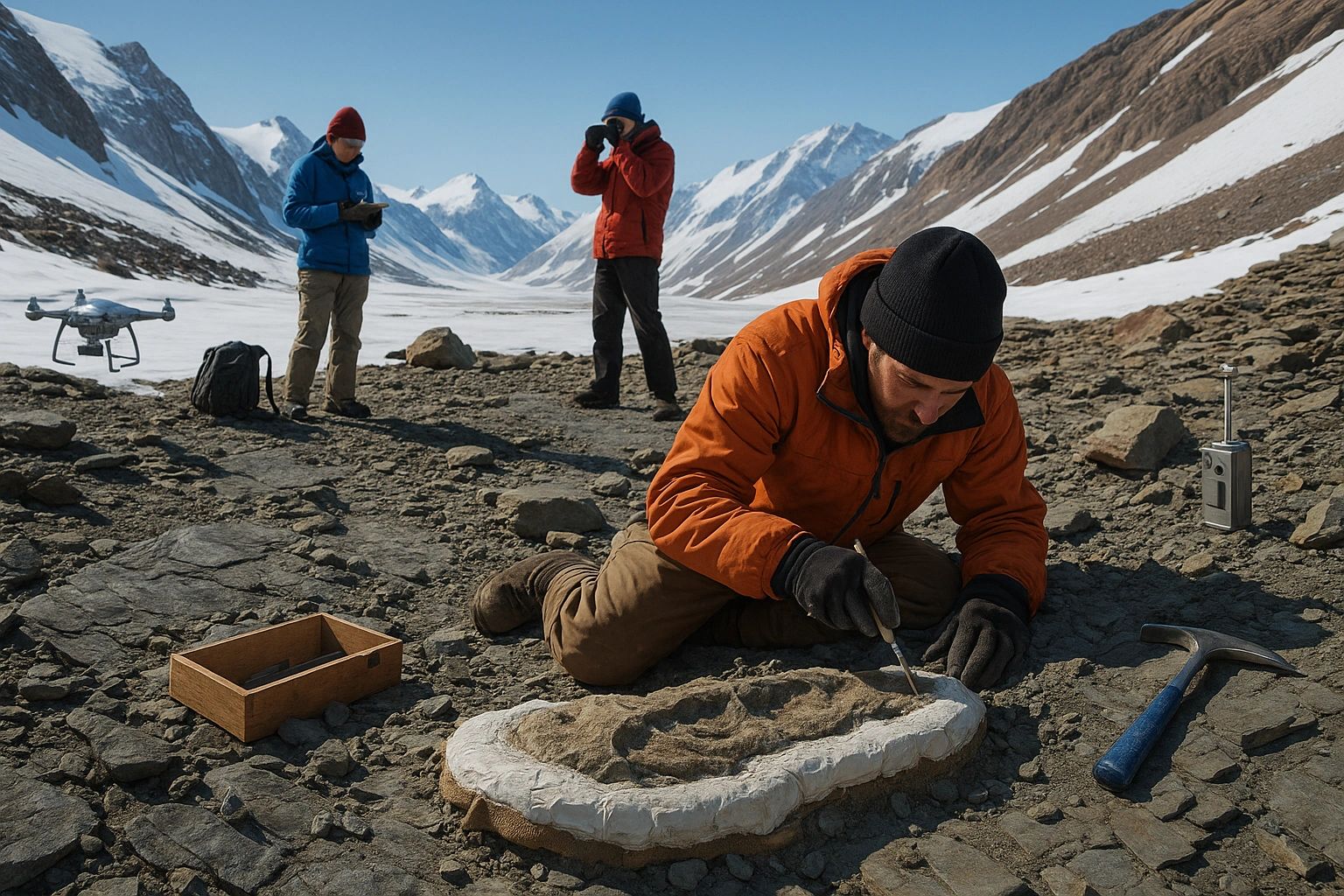
Far beneath Antarctica’s frozen surface lies a treasure trove of secrets—ones that have been locked away for hundreds of millions of years. At Portal Mountain, a remote and icy ridge in the Transantarctic Mountains, scientists have made groundbreaking discoveries that are helping us understand ancient oceans, prehistoric animals, and Earth’s changing climate. But how do scientists dig through solid ice, rock, and time to uncover these buried clues?
Welcome to the icy world of paleontology and geology in Antarctica. In this blog, we’ll take you behind the scenes to explore how scientists conduct excavations at Portal Mountain, reveal the tools they use, the challenges they face, and how these methods are transforming what we know about the planet’s past.
What Is Portal Mountain?
Portal Mountain is located near the Shackleton Glacier in the Transantarctic Mountains of Antarctica. This region is especially exciting to scientists because it holds some of the oldest rocks on the continent. Some rock layers date back to the Devonian and Carboniferous periods—about 360 to 400 million years ago!
That’s around the time when the first forests appeared and strange, jawless fish swam in ancient seas. Even more fascinating, recent digs at Portal Mountain revealed shark fossils—yes, sharks in Antarctica! These fossil finds are incredibly rare and have opened up a new chapter in our understanding of marine life in prehistoric polar regions.
But how exactly do scientists find fossils like ancient sharks in such an extreme place?
Step 1: Planning the Expedition
Before anyone sets foot on the mountain, there’s months (sometimes years!) of planning. Scientists don’t just grab a shovel and go. They begin with satellite images and digital maps to study the region’s geology. These tools help them find areas where rock layers are exposed—especially those from periods known to hold fossils.
Researchers also review past scientific studies, journals, and field notes to figure out the best places to dig. They coordinate with the National Science Foundation and other international programs to get permits, transportation, safety gear, and even food rations.
Once everything is ready, the expedition begins—usually during the Antarctic summer (November through January), when the sun never sets and temperatures are slightly more bearable (around -10°C or 14°F).
Step 2: Getting to Portal Mountain
Reaching Portal Mountain is an adventure all on its own. Since there are no roads or towns nearby, scientists use ski-equipped planes and helicopters to reach a temporary field camp near the mountain.
Gear is often hauled in sleds pulled by snowmobiles, and team members sleep in insulated tents. Even simple things like cooking food or washing hands can be difficult in this frozen world. Every movement is planned carefully to avoid frostbite or exhaustion.
Step 3: Spotting the Rocks and Fossils
Once on-site, scientists begin surveying the area. Portal Mountain has exposed layers of sedimentary rock—rock that formed from ancient mud, sand, or shells that settled on the bottom of oceans or lakes. These are the best types of rock to search for fossils.
Geologists use tools like:
- Geological hammers to chip away at rocks
- Hand lenses to study small features up close
- Field notebooks and GPS units to mark exact locations
- Drones and ground-penetrating radar to scan the terrain
One key technique used is stratigraphy, the study of rock layers (called strata). By identifying the order and age of layers, scientists can figure out the right spots to search for specific fossils.
Step 4: Excavating Fossils—Slow and Steady
Finding a fossil is exciting, but excavating it takes patience and care. Fossils are fragile, especially when buried in rock that’s been frozen and thawed many times over millions of years.
Here’s how scientists do it:
1. Careful Chiseling
Paleontologists use small tools like dental picks, chisels, and brushes to carefully remove the rock around a fossil. Sometimes, they only expose part of it to avoid damage.
2. Field Jackets
If the fossil is large or needs to be moved, it’s wrapped in a plaster “field jacket.” This protective layer, made from plaster and burlap, helps keep the fossil safe during transport.
3. Labeling and Mapping
Every fossil is labeled with a number, and its exact position is recorded in notebooks and digital maps. This helps scientists study the fossil later and understand the environment it came from.
4. Sample Collection
In addition to fossils, scientists collect rock samples, fossilized plants, and even chemical data from the soil. These help tell the bigger story of what life and climate were like millions of years ago.
Step 5: Coping with Harsh Conditions
Portal Mountain isn’t a place for the faint of heart. Wind chills can drop to -40°F, and sudden storms can trap teams in their tents for days. Scientists have to battle high-altitude sickness, snow blindness, and frostbite—all while doing delicate fossil work!
To stay safe, they follow strict protocols:
- Wearing multiple layers of clothing and protective gear
- Working in pairs or small teams
- Using radios to stay in contact
- Keeping emergency kits on hand at all times
Despite the challenges, these scientists say the rewards are worth it—especially when they find something extraordinary.
Step 6: Back to the Lab
After weeks of digging, the fossils are flown back to research labs in the U.S., New Zealand, or Europe. There, the real detective work begins.
What happens next?
- CT Scanning: Scientists use high-resolution scanners to see inside fossils without breaking them. This helps them study bones, teeth, and soft tissue imprints.
- Carbon Dating and Radiometric Dating: These tests help determine how old a fossil is.
- Comparative Anatomy: Researchers compare the fossil to modern animals or other known fossils.
- Digital Modeling: Using 3D software, they recreate how these creatures looked and moved.
All of this leads to published research that gets shared with the world—and sometimes changes what we thought we knew about prehistoric life!
Portal Mountain Shark Fossils: A Major Discovery
In 2024, scientists announced they had found fossilized remains of sharks at Portal Mountain. The fossils included cartilage fragments, teeth, and dermal denticles (tiny tooth-like scales). This is huge because cartilage doesn’t usually fossilize well—so these finds are incredibly rare.
The species they uncovered likely lived during the Devonian period, when much of Antarctica was underwater and covered by warm, shallow seas. These shark fossils prove that marine life once thrived here in a completely different climate.
What makes this dig extra special is that some of the fossils show traits similar to modern-day sharks—offering a link between ancient and present-day ocean predators.
Tools of the Trade: What Scientists Use
Let’s take a closer look at some of the most important tools scientists bring on a Portal Mountain dig:
Tool Use
Geological Hammer Breaking rocks and exposing fossils
GPS Device Recording exact fossil locations
Plaster and Burlap Making protective jackets for fossils
Brushes Cleaning fragile bones and teeth
Drones Mapping the terrain from above
Hand Lens Studying small fossil details
CT Scanner (lab) Looking inside fossils in 3D
Notebook Logging daily finds and conditions
Even though technology has improved, many tools haven’t changed much in 100 years. That’s because careful, hands-on work is still the best way to uncover delicate fossils.
Why Portal Mountain Matters
Portal Mountain is more than just a fossil site—it’s a time machine. By studying its rock layers and ancient fossils, scientists are learning:
- What kinds of animals lived in Antarctica before it froze over
- How ocean life evolved after mass extinctions
- What Earth’s climate was like hundreds of millions of years ago
These discoveries help us understand today’s world too. For example, by studying how climate changes affected ancient ecosystems, scientists can make better predictions about how current climate change might affect modern animals.
Looking Ahead: What’s Next?
More excavations are planned for Portal Mountain and other Antarctic sites. Scientists are excited to keep digging—literally and figuratively—for more clues about the prehistoric world.
They’re also hoping to find:
- Early marine reptiles
- Fossilized plants and ancient forests
- More shark species
- Signs of ancient weather patterns
With better tools like satellite imaging, autonomous drones, and improved dating methods, the next big discovery might just be around the corner—or under the ice.
Final Thoughts
The excavation at Portal Mountain isn’t just about digging in the dirt. It’s about solving ancient mysteries, surviving extreme conditions, and using science to uncover the distant past.
Thanks to a combination of old-school tools and cutting-edge technology, scientists are revealing a world that once flourished in what is now one of the coldest places on Earth. From ancient sharks to prehistoric seas, Portal Mountain continues to surprise and inspire.
And who knows? The next time you see a shark, you might be looking at the living descendant of a species that once swam through Antarctica’s ancient waters.
Bibliography
Clarke, J. A., Cantrill, D. J., & Truswell, E. M. (2011). The Antarctic fossil record and the evolution of biodiversity. Paleogeography, Paleoclimatology, Paleoecology, 299(1-2), 1–3. https://doi.org/10.1016/j.palaeo.2010.10.003
Miller, M. F., & Isbell, J. L. (2015). The Transantarctic Mountains sedimentary record: Tectonic evolution of the Antarctic margin. Gondwana Research, 27(1), 118–138. https://doi.org/10.1016/j.gr.2014.06.015
Rich, T. H., Vickers-Rich, P., & Fordyce, R. E. (2014). The vertebrate fossil record of Antarctica. Earth-Science Reviews, 125, 169–179. https://doi.org/10.1016/j.earscirev.2013.06.005
Schubert, B. A., Jahren, A. H., & Eberle, J. J. (2012). A greenhouse paradox in the Paleocene–Eocene thermal maximum: Atmospheric carbon dioxide and body size. Paleobiology, 38(3), 536–548. https://doi.org/10.1666/11042.1
Tobin, T. S., Ward, P. D., Steig, E. J., & Montanari, A. (2012). Extinction patterns, volcanic activity, and isotope anomalies in Antarctica around the Cretaceous–Paleogene boundary. Journal of Geophysical Research: Biogeosciences, 117(G1). https://doi.org/10.1029/2011JG001786
Originally published at the live site .