Maritime ·
Sharks and Coastal Erosion: An Unexpected Connection
When most people think about coastal erosion, they picture waves smashing against the shore, storms pushing the sea farther inland, and beaches slowly disappearing. And when they think of sharks, they imagine powerful pr...
By Rebecca "Madam Chronicler" Ryan
When most people think about coastal erosion, they picture waves smashing against the shore, storms pushing the sea farther inland, and beaches slowly disappearing. And when they think of sharks, they imagine powerful predators slicing through the ocean in search of prey. On the surface, these two topics seem completely unrelated. But if we take a closer look, we can discover a fascinating link between healthy shark populations and the stability of our coasts.
This connection isn’t direct—sharks aren’t patrolling the beach to keep sand in place—but they play an important role in the coastal ecosystems that help protect our shorelines. Understanding this link can help us appreciate just how important sharks are to the health of our oceans and our coasts.
Sharks in Coastal Ecosystems
Sharks are apex predators. This means they are at the top of the food chain and help regulate the balance of marine life below them. By preying on mid-level predators and herbivores, sharks prevent any single species from becoming too dominant. This balance allows a wide variety of marine species to thrive, from tiny fish to massive coral structures.
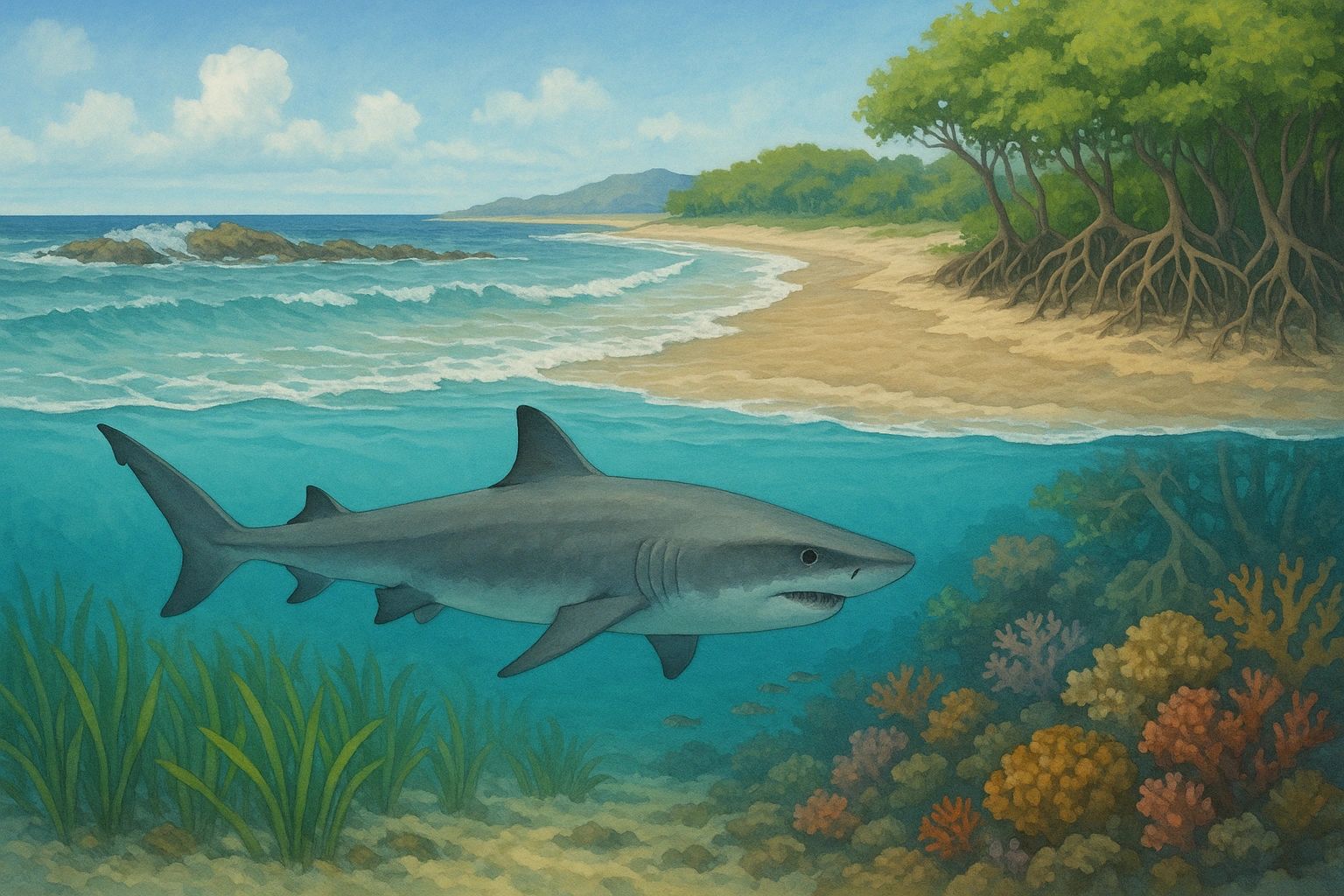
Many shark species are closely tied to coastal habitats. Bull sharks, for example, are known to travel up rivers and into estuaries, while lemon sharks and blacktip sharks often rely on shallow coastal nurseries. These habitats aren’t just “shark hangouts”—they are also home to mangroves, seagrass beds, and coral reefs, which are natural barriers against coastal erosion.
Unfortunately, many shark populations are in decline. Overfishing, habitat destruction, and climate change have reduced their numbers dramatically. Since 1970, global populations of oceanic sharks and rays have dropped by more than 70%. This loss not only impacts sharks themselves but also the ecosystems they help regulate.
What Is Coastal Erosion?
Coastal erosion is the gradual loss of land along the shoreline, mainly due to wave action, tides, currents, wind, and storms. In some cases, erosion is a natural and balanced process—sand may wash away in one area and build up in another. However, human activities and climate change are tipping the scales. When erosion outpaces the natural replacement of sand and sediment, beaches shrink, cliffs collapse, and wetlands disappear.
Sea-level rise is one of the biggest drivers of modern coastal erosion. As the ocean warms and polar ice melts, higher water levels allow waves to reach farther inland. Strong storms, which are becoming more frequent and intense with climate change, can strip away years’ worth of beach sand in a matter of hours.
Erosion doesn’t just impact the environment. Coastal communities face the loss of homes, roads, and infrastructure. Tourism can suffer when beaches vanish, and ecosystems like marshes and dunes—which protect against flooding—are destroyed.
How Nature Fights Erosion
Before we get to how sharks fit into the picture, it’s important to understand how coastal ecosystems naturally defend against erosion.
Coral Reefs Coral reefs act like underwater breakwaters. They absorb and scatter wave energy, reducing its force before it reaches the shore. Studies show that healthy reefs can reduce wave energy by up to 97%, making them a crucial defense against erosion.
Seagrass Meadows Seagrasses are underwater plants that grow in shallow coastal areas. Their roots anchor sediment to the seafloor, while their leaves slow water movement, allowing more sediment to settle. This keeps the seabed stable and helps protect nearby shorelines.
Mangroves Mangrove forests grow along tropical and subtropical coastlines. Their tangled roots trap sediment, reduce wave impact, and prevent the shoreline from washing away. They also provide essential nurseries for many fish species, including some sharks.
Salt Marshes and Wetlands These habitats work much like mangroves, absorbing wave energy and trapping sediment. They are particularly important in temperate climates and provide habitat for countless species.
When these habitats are healthy, they protect coasts naturally. When they are degraded, the shoreline is more vulnerable to erosion.
How Sharks Indirectly Help Protect Shores
Now we can connect the dots: sharks help maintain the balance of marine ecosystems, which in turn keeps habitats like reefs, seagrass meadows, and mangroves healthy. These habitats are the frontline defense against erosion.
Here’s an example. If shark populations drop, mid-level predators like certain fish and rays can increase in number. Some of these species feed heavily on herbivores that graze algae off coral reefs. Without enough herbivores, algae can overgrow and smother corals, leading to reef decline. A weakened or dead reef loses its ability to protect the shoreline from waves.
Similarly, if sharks aren’t present to keep ray populations in check, rays may over-graze seagrass meadows. Without seagrass to stabilize sediment, coastal waters become cloudier, and more sediment is washed away, speeding up erosion.
In short: Healthy shark populations → Balanced food web → Healthy coastal habitats → Stronger shoreline protection
Shark Declines and the Risk to Coasts
Around the world, shark numbers are dropping because of overfishing, accidental bycatch, habitat loss, and climate change. The disappearance of sharks isn’t just a loss for biodiversity—it can cause ripple effects that reach all the way to the beach.
When coral reefs, seagrasses, and mangroves lose their natural balance, they become less effective at protecting shorelines. The result? Increased coastal erosion, greater flood risk, and more damage from storms.
In areas already facing sea-level rise, these losses can be devastating. Without the natural protection of healthy ecosystems, communities must rely more on costly man-made defenses like seawalls and breakwaters, which often have their own environmental drawbacks.
Climate Change: A Double Threat
Climate change is a double threat to the shark–coastal erosion connection. It not only accelerates erosion through rising seas and stronger storms but also affects shark populations directly. Warmer waters can shift shark migration patterns, reduce prey availability, and stress coastal habitats.
For example, coral bleaching—a result of rising ocean temperatures—can weaken reef systems even without direct human damage. When combined with the ecological imbalance caused by declining sharks, the result is a rapid decline in coastal defenses.
Protecting Sharks to Protect Shores
If we want to strengthen our coastlines against erosion, we can’t just focus on building seawalls or adding more sand to beaches. We also need to protect the ecosystems that provide natural defenses—and that means protecting sharks.
Here are some ways conservation efforts can help:
Marine Protected Areas (MPAs) Designating MPAs where fishing is limited or banned can help shark populations recover and keep coastal ecosystems intact.
Sustainable Fishing Practices Reducing bycatch through better fishing gear and techniques helps prevent accidental shark deaths.
Habitat Restoration Rebuilding coral reefs, replanting seagrass beds, and restoring mangroves can give sharks healthy habitats and help fight erosion.
Climate Action Reducing greenhouse gas emissions slows sea-level rise and helps maintain the conditions that sharks and coastal habitats need to survive.
The Need for More Research
While the link between sharks and coastal erosion is largely indirect, it’s a connection worth exploring further. Scientists are beginning to study how predator loss affects the physical stability of coastlines, but there’s still much to learn.
By combining marine biology, coastal engineering, and climate science, researchers can better understand how protecting sharks might help protect our shores. This interdisciplinary approach could be key to building coastal resilience in a warming world.
A Shared Future for Sharks and Coasts
Coastal erosion and shark conservation might seem like separate environmental issues, but they are deeply connected through the web of life in our oceans. Sharks help keep marine ecosystems in balance. Balanced ecosystems support habitats that defend our shores from the forces of the sea.
Losing sharks doesn’t just mean losing a top predator—it means risking the collapse of the natural systems that protect us from erosion and flooding. By protecting sharks, we are also protecting ourselves, our homes, and the beautiful coastlines we love.
Sharks have been shaping ocean ecosystems for over 400 million years. If we give them a chance, they can continue to help shape a future where both marine life and coastal communities can thrive.
Bibliography
Conel, S. (2023). Coastal erosion: Causes, consequences, and mitigation strategies. Journal of Marine Science Research and Development, 13(5), 414. https://doi.org/10.4172/2155-9910.1000414
Koch, E. W., Ackerman, J. D., Verduin, J., & van Keulen, M. (2007). Fluid dynamics in seagrass ecology—from molecules to ecosystems. In A. W. D. Larkum, R. J. Orth, & C. M. Duarte (Eds.), Seagrasses: Biology, ecology and conservation (pp. 193–225). Springer. https://doi.org/10.1007/978-1-4020-2983-7_8
Pacoureau, N., Rigby, C. L., Kyne, P. M., Sherley, R. B., Winker, H., Carlson, J. K., … & Dulvy, N. K. (2021). Half a century of global decline in oceanic sharks and rays. Nature, 589(7843), 567–571. https://doi.org/10.1038/s41586-020-03173-9
Pollom, R. A., Cheok, J., Pacoureau, N., Gledhill, K. S., Kyne, P. M., Ebert, D. A., et al. (2024). Overfishing and climate change elevate extinction risk of endemic sharks and rays in the southwest Indian Ocean hotspot. PLOS ONE, 19(9), e0306813. https://doi.org/10.1371/journal.pone.0306813
USGS. (n.d.). Coral reef seafloor erosion and coastal hazards. U.S. Geological Survey. https://www.usgs.gov/centers/spcmsc/science/coral-reef-seafloor-erosion-and-coastal-hazards
Woods Hole Oceanographic Institution. (n.d.). Changing shorelines & erosion. Ocean Learning Hub. https://www.whoi.edu/ocean-learning-hub/ocean-topics/how-the-ocean-works/coastal-science/changing-shorelines-erosion/
Originally published at the live site .