
Rivers ·
The Alligator Gar in Bayou Lafourche
Introduction: A Living Dinosaur in Louisiana Waters
By Rebecca "Madam Chronicler" Ryan
Introduction: A Living Dinosaur in Louisiana Waters
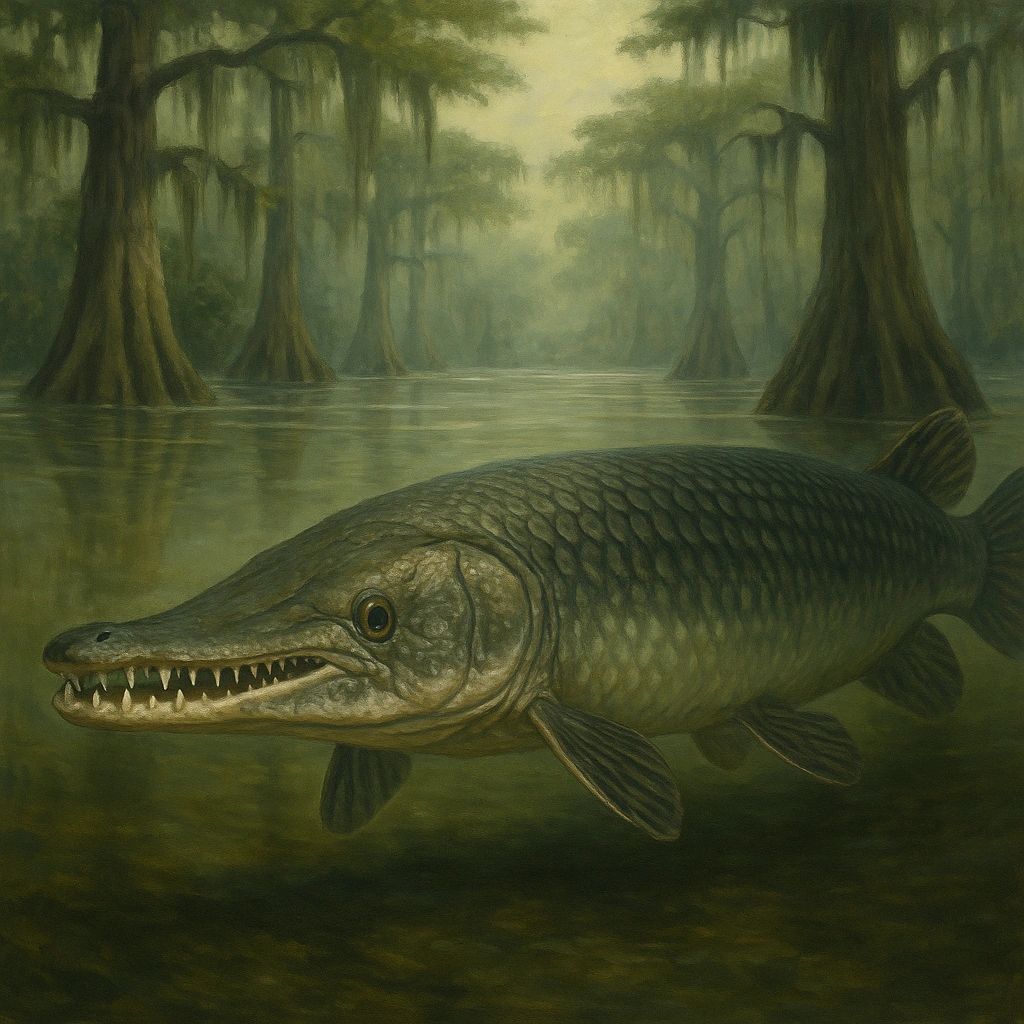
If you’ve ever cast a line in the twisting waters of Bayou Lafourche in Louisiana, you might have come face to face with one of the most ancient and fascinating fish in North America—the alligator gar (Atractosteus spatula). With its broad, armored body, double row of razor-sharp teeth, and striking resemblance to an alligator’s snout, this massive fish has earned a reputation as both a legend and a mystery.
The alligator gar is no ordinary fish. Reaching lengths over 10 feet and weighing more than 300 pounds, it is the largest species in the gar family and one of the oldest lineages of freshwater fish alive today. Fossil records show that gar have been around for more than 100 million years, surviving the extinction events that wiped out the dinosaurs (Grande, 2010). In many ways, the gar is a living relic of prehistoric times, thriving in the slow-moving bayous, oxbow lakes, and marshes of the Gulf Coast.
Bayou Lafourche, a waterway with deep historical and cultural importance in Louisiana, offers prime habitat for these giants. The slow current, backwater swamps, and abundance of fish make it an ideal home for a predator that is equal parts fierce and fascinating. Yet, despite their size and ancient origins, alligator gar have long been misunderstood—sometimes feared as dangerous monsters, sometimes dismissed as “trash fish.” In truth, they play an essential role in the ecosystem and carry a cultural legacy as rich as the bayou itself.
In this blog, we’ll dive deep into the story of the alligator gar in Bayou Lafourche—from its biology and behavior, to its cultural impact, conservation challenges, and why this ancient predator continues to capture the imagination of locals and scientists alike.
The Ancient Anatomy of an Apex Predator
One glance at the alligator gar tells you that this is no ordinary fish. Its long, torpedo-shaped body is covered in hard, diamond-shaped scales known as ganoid scales. Unlike the smooth scales of most modern fish, these interlocking plates form an armor so tough that even knives struggle to cut through them (Grande, 2010). Early Native American tribes even used gar scales as arrowheads and tools.
But the gar’s most striking feature is its snout. Shaped like that of an alligator, it houses a double row of sharp teeth perfectly designed to grasp slippery prey. Unlike sharks or pike that slash through prey, the gar grabs and holds fish before swallowing them whole. Their ambush-hunting style makes them efficient predators in the bayou’s murky waters.
Another unique trait is their ability to breathe both in water and air. Alligator gar possess a highly vascularized swim bladder that functions like a lung (Uhrin et al., 2022). This adaptation allows them to gulp air from the surface, surviving in oxygen-poor waters where most fish would perish. It’s one reason why gar thrive in warm, slow-moving Louisiana bayous like Bayou Lafourche.
In terms of size, the alligator gar reigns supreme among North America’s freshwater fish. The world record stands at a staggering 327 pounds, caught in Mississippi’s Lake Chotard (Ferrara, 2001). While most gar in Bayou Lafourche are smaller, locals still tell stories of 7-foot, 200-pound giants cruising just beneath their boats.
The Role of the Alligator Gar in Bayou Lafourche’s Ecosystem
Far from being a menace, the alligator gar is a keystone predator. Its diet consists mainly of rough fish like buffalo, carp, and shad, which helps maintain balance in aquatic ecosystems (Kelley, 2012). Contrary to myths, gar rarely prey on gamefish such as bass or crappie in significant numbers. Instead, they control populations of species that, if unchecked, could destabilize food webs.
Bayou Lafourche provides a near-perfect environment for these hunters. The bayou, which stretches over 100 miles through southeastern Louisiana, is connected to marshes and swamps that host diverse fish communities. Gar patrol these waters, using stealth to ambush prey. They often lie motionless near the surface, blending into floating vegetation, before striking with explosive speed.
This ecological role is vital. By feeding on overabundant fish, gar help maintain biodiversity and prevent population explosions of less desirable species. Recent research has even suggested that restoring gar populations can benefit entire ecosystems by curbing invasive species such as Asian carp (Kluender et al., 2016).
Legends and Lore: The Alligator Gar in Cajun Culture
In the bayous of Louisiana, the alligator gar is more than just a fish—it’s part of the cultural fabric. Generations of Cajun fishers have encountered these armored giants while setting trotlines or casting nets. Some tell tales of gar so big they flipped boats, while others describe the eerie sight of their prehistoric silhouettes gliding beneath the surface at night.
For centuries, gar have been both feared and respected. Early settlers saw them as dangerous competitors for fish, and rumors spread that they attacked humans (though this has never been documented scientifically). In truth, gar are shy around people and pose no threat unless provoked.
In Cajun cuisine, gar have a unique place. Though their meat is firm and boneless, preparing it requires skill due to the tough scales and bony structure. Still, dishes like “gar balls”—fried patties made from minced gar meat mixed with spices and breadcrumbs—remain a local favorite. For many families along Bayou Lafourche, catching gar was a rite of passage, a connection to tradition, and a reminder of the bayou’s abundance.
Fishing for Giants: The Sport of Gar Hunting
Beyond cultural tradition, the alligator gar has become a prized catch among sport anglers. Their immense size and fighting strength make them legendary targets. Fishing for gar in Bayou Lafourche often involves specialized techniques. Bowfishing, where anglers shoot arrows attached to lines, is particularly popular. Others prefer rod-and-reel fishing using cut bait or live mullet.
Hooking a gar is only the beginning. Once on the line, these fish thrash violently, using their armored bodies to resist capture. Landing one often requires teamwork, strength, and patience. For many anglers, it’s the closest thing to battling a prehistoric beast.
However, modern sportfishing has raised conservation concerns. Because alligator gar grow slowly and reproduce infrequently—females may not spawn until 10 years old and then only in flood conditions (Buckmeier, 2008)—they are highly vulnerable to overfishing. In some areas of the U.S., gar populations have sharply declined due to unregulated harvest. Louisiana has since enacted protective regulations, including size and creel limits, to ensure that gar remain part of the bayou’s future.
Conservation Challenges in Bayou Lafourche
Despite their resilience over millions of years, alligator gar now face threats largely created by humans. Habitat loss is a major issue. Bayou Lafourche was once a distributary of the Mississippi River, providing natural floodplains essential for gar spawning. But after the river was leveed off in the early 20th century, water flow diminished, and flood pulses critical for reproduction became rare (Kluender et al., 2016).
Pollution also takes a toll. Agricultural runoff, industrial waste, and nutrient loading can degrade water quality, impacting both gar and their prey. Additionally, invasive species such as Asian carp compete with native fish, altering food webs in ways that may affect gar populations.
Overfishing remains a lingering concern. While Louisiana now manages gar more carefully, the species is still vulnerable to bowfishing tournaments and heavy harvest in some areas. Unlike fast-breeding fish, gar cannot quickly rebound from population declines.
Fortunately, conservation efforts are gaining momentum. Biologists and local agencies are working to restore natural flood pulses, improve water quality, and monitor gar populations. Educational outreach is also helping shift public perception—from viewing gar as “trash fish” to recognizing them as vital parts of Louisiana’s natural heritage.
Why the Alligator Gar Still Matters Today
So why should we care about the alligator gar in Bayou Lafourche? First, it’s an irreplaceable part of the ecosystem. Without apex predators like gar, fish populations could spiral out of balance, harming both biodiversity and fisheries.
Second, the gar represents a cultural treasure. For Cajun communities along Bayou Lafourche, the gar is a living link to heritage—a reminder of resilience, survival, and the deep bond between people and the bayou.
Third, the gar is a symbol of survival itself. This fish has lived through mass extinctions, climate shifts, and the rise and fall of empires. Its continued presence in Bayou Lafourche is a testament to nature’s adaptability. By protecting the gar, we safeguard not just a fish but a piece of evolutionary history that predates humanity.
Conclusion: The Dinosaur That Swims Among Us
Next time you drift along Bayou Lafourche, remember that beneath the cypress shadows and still waters lurks a creature as old as the dinosaurs. The alligator gar, with its armored scales, toothy snout, and ancient lineage, is more than a curiosity—it’s a cornerstone of the bayou’s ecosystem and culture.
Far from being a monster, the gar is a survivor, a guardian of balance, and a living piece of history. In a world where so much of nature is disappearing, the alligator gar reminds us that some giants still endure, right here in Louisiana’s waters.
Protecting this remarkable fish ensures that future generations can marvel at the same prehistoric silhouette gliding through the waters of Bayou Lafourche—a reminder that the past still swims among us.
Bibliography
- Buckmeier, D. L. (2008). Life history and status of alligator gar Atractosteus spatula, with recommendations for management. Proceedings of the Annual Conference of the Southeastern Association of Fish and Wildlife Agencies, 62, 62–67.
- Ferrara, A. M. (2001). Life-history strategy of Lepisosteidae: implications for the conservation and management of alligator gar. Ph.D. Dissertation, Auburn University.
- Grande, L. (2010). An empirical synthetic pattern study of gars (Lepisosteiformes) and closely related species, based mostly on skeletal anatomy. The Resurrection of Holostei. American Society of Ichthyologists and Herpetologists.
- Kelley, D. W. (2012). The role of alligator gar (Atractosteus spatula) in structuring fish communities. Transactions of the American Fisheries Society, 141(5), 1351–1361. https://doi.org/10.1080/00028487.2012.692401
- Kluender, E. R., Peterson, D. C., & Krogman, R. M. (2016). The status of alligator gar and need for management across their range. Fisheries, 41(8), 442–450. https://doi.org/10.1080/03632415.2016.1196419
- Uhrin, A. V., Herbig, J. L., & Dell, A. I. (2022). Breathing both ways: physiological adaptations of alligator gar (Atractosteus spatula) for dual air-water respiration. Journal of Fish Biology, 101(3), 522–535. https://doi.org/10.1111/jfb.15163
Originally published at the live site .