
Maritime ·
The American Robin: The Familiar Bird That Still Holds Surprises
The morning I used the Merlin Bird ID app to listen more closely to the hidden life in my Florida backyard, one of the first birds it identified was the American Robin.
By Rebecca "Madam Chronicler" Ryan
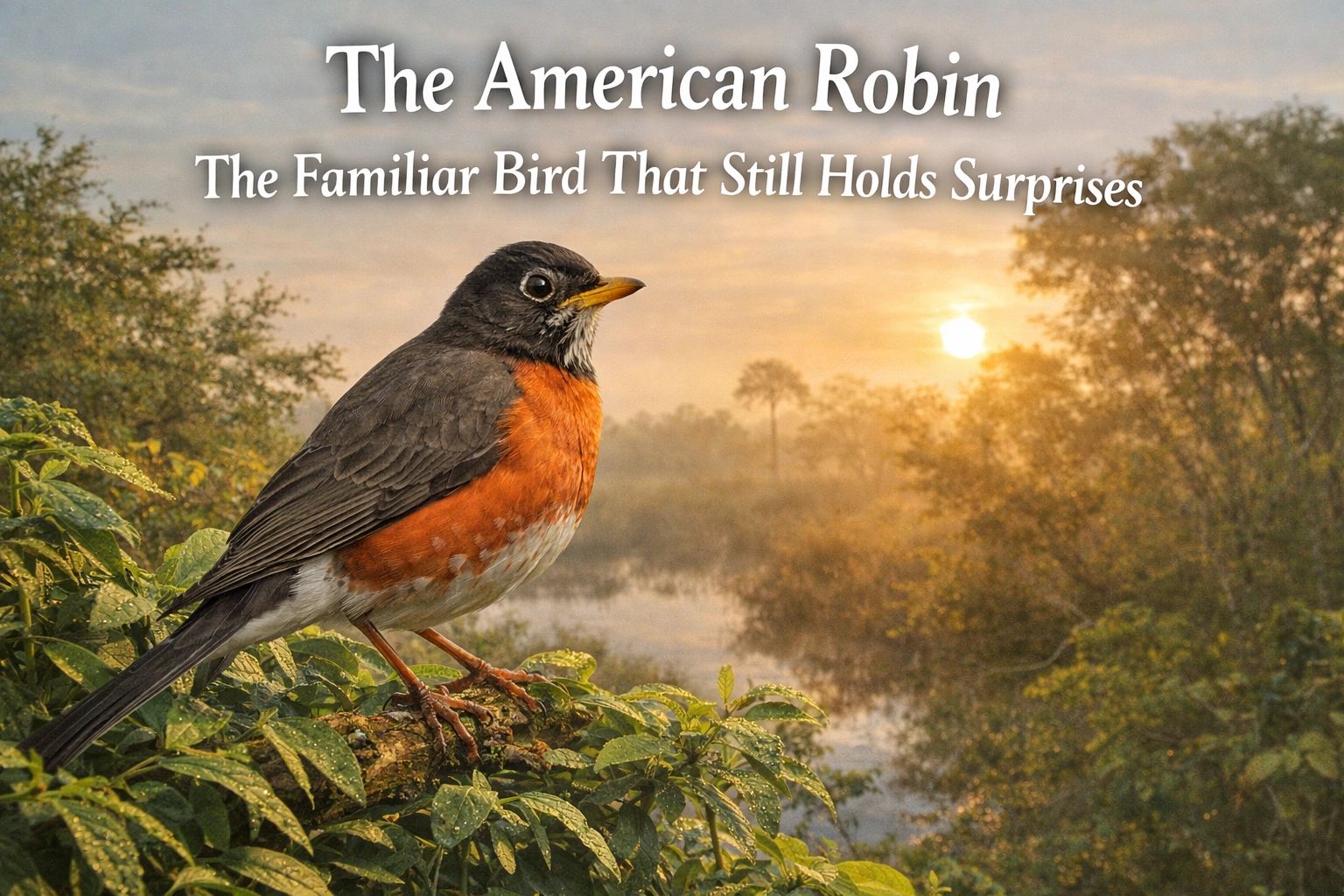
The morning I used the Merlin Bird ID app to listen more closely to the hidden life in my Florida backyard, one of the first birds it identified was the American Robin.
At first, the result felt almost too ordinary.
The robin is one of the most recognizable birds in North America. It’s the bird people expect to see hopping across lawns, tugging worms from the soil, or perched in a tree delivering its cheerful song. For many, it’s a symbol of spring, a familiar presence that hardly seems mysterious.
But standing there, listening to its voice drift through the trees, I realized something that often goes unnoticed. Even the most familiar birds are full of complexity. They are not just background noise or routine sightings. They are active participants in a world that continues whether we notice it or not.
And in that moment, the American robin became something more than just a common bird. It became a doorway into understanding the life unfolding just outside my door.
A Song That Starts the Day
The robin’s voice carried clearly through the morning air, rising above the softer and more scattered sounds of other birds. Its song came in steady, repeating phrases that felt almost deliberate, as if each note had a purpose.
There is something unmistakable about the robin’s call. It is structured, confident, and easy to follow, which is why so many people recognize it even without seeing the bird itself. The sound often arrives early, sometimes before the sun has fully risen, making the robin one of the first voices to announce the start of the day.
That timing is not accidental. Early morning offers ideal conditions for sound to travel. The air is calmer, and fewer competing noises interfere. For the robin, this is the perfect time to make its presence known.
Its song serves several purposes at once. It establishes territory, warning other robins that the area is already claimed. It also plays a role in attracting a mate, signaling strength and vitality. At the same time, it functions as a form of communication, a way of maintaining connection within its environment.
Listening to it, there is a sense that the robin is not simply singing, but actively participating in a network of signals that shape the behavior of other birds around it.
Seeing the Robin With New Eyes
Although the robin is easy to recognize, taking a closer look reveals details that are often overlooked. Its bright orange-red chest stands out against its darker back, creating a striking contrast that catches the eye even from a distance. The white ring around its eye gives it a sharp, alert expression, while its yellow bill adds a final touch of color.
Its movements are just as distinctive. Watching a robin move across a lawn, there is a rhythm to its behavior. It hops forward, pauses, tilts its head, and then suddenly strikes. Each motion feels purposeful, part of a strategy refined through instinct and experience.
It is in those quiet pauses that one of the robin’s most fascinating abilities becomes apparent.
Listening Beneath the Surface
At first glance, it might seem as though the robin is simply looking for food. But in reality, it is doing something far more subtle.
It is listening.
Beneath the surface of the soil, earthworms move slowly through the ground, creating tiny vibrations. These movements are nearly impossible for humans to detect, but the robin is tuned into them. When it tilts its head, it is not just adjusting its view. It is focusing its attention, isolating the faint signals coming from below.
When the moment is right, the robin reacts instantly, pulling a worm from the ground with surprising precision.
This behavior highlights a level of sensitivity that often goes unnoticed. The robin is not just a passive observer of its environment. It is actively interpreting it, responding to cues that exist beyond what we can easily perceive.
A Changing Diet Through the Seasons
The robin’s relationship with its environment shifts as the seasons change. During warmer months, it relies heavily on insects and worms, taking advantage of their abundance. Lawns, fields, and open spaces become ideal feeding grounds, offering easy access to prey.
As temperatures drop and insects become harder to find, the robin adapts. Its diet shifts toward berries and fruits, allowing it to continue feeding even when the ground is less active. This flexibility is one of the reasons robins are able to thrive across such a wide range of environments.
It also plays an important role in the ecosystem. By consuming fruits, robins help disperse seeds, contributing to plant growth in new areas. In this way, their feeding habits influence not just their own survival, but the health of the landscape around them.
The Robin in Florida
Although many people associate robins with northern regions, they are a regular presence in Florida as well. Their appearance here is often tied to seasonal movement rather than year-round residency.
During cooler months, robins migrate south in search of food and more favorable conditions. Florida becomes a temporary home, offering the resources they need to sustain themselves.
In this setting, their behavior changes. Instead of defending territories as they do during breeding season, robins often gather in groups. These flocks can move quietly through an area, sometimes going unnoticed until their numbers become apparent all at once.
Seeing a single robin is common. Seeing dozens together can feel unexpected, revealing a side of their behavior that many people rarely consider.
A Social Side Revealed
This shift toward group behavior highlights another dimension of the robin’s life. While they are often thought of as solitary birds, their social dynamics are more complex.
In winter, gathering in flocks provides advantages. It increases awareness of potential threats and improves the chances of locating food. It also creates a shared rhythm, as birds move and feed together across the landscape.
These gatherings are temporary, dissolving as breeding season approaches. At that point, robins return to a more territorial way of life, focusing on nesting and raising young.
Building a Future: Nesting and Raising Young
When the time comes to nest, the robin’s behavior changes once again. The female takes on the task of building the nest, selecting a location that offers both stability and protection. Trees, shrubs, and even human-made structures can serve as suitable sites.
The nest itself is carefully constructed using grass, twigs, and mud. The mud plays a crucial role, helping to hold the structure together and create a secure space for eggs.
The eggs, with their distinctive blue color, are one of the robin’s most recognizable features. They represent the beginning of a new generation, a continuation of the cycle that brings robins back year after year.
Once the chicks hatch, both parents take part in feeding them, making frequent trips to gather food. This period is intense and demanding, but it is also a critical stage in the robin’s life.
A Bird That Lives Alongside Us
One of the reasons robins are so familiar is their ability to live alongside humans. They are comfortable in suburban environments, where lawns, gardens, and parks provide ample food and shelter.
This adaptability allows them to thrive in places where other species might struggle. It also creates opportunities for people to observe them up close, often without realizing how much there is to see.
The robin’s presence in everyday spaces serves as a reminder that wildlife is not confined to distant or untouched areas. It exists all around us, woven into the environments we move through every day.
Returning to the Moment
As the Merlin app continued to identify birds that morning, the robin’s song remained a steady presence in the background. It was one of the first voices I heard, and in many ways, it set the tone for everything that followed.
What began as a simple attempt to identify bird calls became something more. It became a way of paying attention, of recognizing patterns and behaviors that might otherwise go unnoticed.
The robin, so familiar and often overlooked, became a starting point for that awareness.
The Value of Familiar Wildlife
There is a tendency to focus on the rare and the unusual when thinking about wildlife. Those species often capture attention because they are unexpected.
But there is something equally important about understanding the common species that share our space.
The American robin is a perfect example. It is widespread, recognizable, and easy to find. Yet within that familiarity lies a depth of behavior and interaction that is easy to miss.
Taking the time to notice it—to really observe it—reveals a level of complexity that changes how we see the natural world.
Listening as a Way of Seeing
One of the most powerful aspects of using Merlin is how it shifts attention toward sound. Instead of relying only on sight, it encourages listening as a way of understanding.
The robin’s song becomes more than just a pleasant background noise. It becomes a clue, a signal, a piece of a larger puzzle.
Through that process, the backyard transforms. What once felt like a quiet, ordinary space becomes active and layered, filled with voices that each have their own role.
More Than Just a Backyard Bird
The American robin may be one of the most familiar birds in North America, but it is far from simple.
Its song, its behavior, its adaptability, and its role in the ecosystem all contribute to a story that continues every day, often without notice.
That morning in the backyard, it was the first bird Merlin identified. But it also became something more than just a name on a screen.
It became a reminder that even the most familiar parts of nature still have the power to surprise us—if we take the time to listen.
Bibliography
Cornell Lab of Ornithology. All About Birds: American Robin.
Cornell Lab of Ornithology. Merlin Bird ID App. Cornell University.
National Audubon Society. American Robin.
Sibley, David Allen. The Sibley Guide to Birds. Alfred A. Knopf.
Florida Fish and Wildlife Conservation Commission. Florida Bird Species Information.
Originally published at the live site .