
Stories ·
The Anhinga: The Bird That Swims Like a Snake
Some birds are easy to recognize the moment you see them.
By Rebecca "Madam Chronicler" Ryan
Some birds are easy to recognize the moment you see them.
Others take a second look.
And then there are birds that don’t look like birds at all, at least not at first.
The Anhinga belongs to that last group.
A Shape That Doesn’t Quite Make Sense
The first time I noticed it, I wasn’t even sure what I was looking at.
The water behind the lake was still, almost glass-like, reflecting the sky in a way that made everything feel quiet and undisturbed. It was the kind of stillness you don’t expect to change.
But then something did.
At first, it wasn’t even a full shape—just a line breaking the surface. Long, narrow, and steady. It didn’t splash or ripple outward the way you’d expect. It simply moved forward, cutting through the water with almost no resistance.
For a moment, it didn’t look like a bird at all.
It looked like a snake.
Just a thin neck rising above the surface, gliding forward without any sign of a body beneath it. The longer I watched, the stranger it felt—too controlled to be random, too deliberate to ignore.
That’s when I reached for my phone and opened the Merlin Bird ID app.
Within moments, it gave me the answer.
Anhinga.
And just like that, the shape started to make sense.
The “Snakebird” Right in Front of You
Once I had a name for it, I understood why people call it the snakebird.
It wasn’t just the shape. It was the movement. There was something almost quiet about the way it moved through the water, as if it wasn’t disturbing the space so much as becoming part of it.
Its body stayed completely submerged, hidden beneath the surface, leaving only that long neck visible. It didn’t push against the water. It slipped through it.
If you didn’t know what you were looking at, it would be easy to mistake it for something else entirely.
And for a moment, I almost did.
What You Don’t See Matters Most
The longer I stood there, the more I realized that most of what made this bird unique wasn’t visible at all.
Unlike ducks or other water birds that float high, the anhinga stays low, its body submerged to the point of disappearance. It’s built that way—designed for movement beneath the surface rather than on top of it.
Field guides, including the Smithsonian Handbooks: Birds of North America (Eastern Region), describe the anhinga as a specialized diving bird, and watching it made that description feel real in a way that words alone don’t quite capture.
Everything about it pointed downward.
Toward what couldn’t be seen.
Movement That Feels Almost Invisible
What stood out most wasn’t just how it looked, but how it moved.
There was no urgency to it.
No splashing.
No sudden bursts of motion.
It simply glided forward, its neck shifting slightly to guide direction while the rest of its body remained hidden. The surface barely reacted, as if it had accepted the bird’s presence rather than resisting it.
It didn’t feel like swimming.
It felt like drifting—with purpose.
And the longer I watched, the clearer it became that this quiet movement wasn’t passive.
It was focused.
Hunting Beneath the Surface
At some point, without warning, it disappeared.
One moment it was there.
The next, it was gone.
No splash. No ripple. Just absence.
That was when it became clear that what I had been watching wasn’t the full story. Most of what the anhinga does happens beneath the surface, out of sight.
According to Smithsonian descriptions, it hunts underwater, using its long, pointed bill to spear fish with precision. It doesn’t chase wildly. It moves with control, striking when the moment is right.
Standing there, looking at the empty water where it had been, it was easy to forget it was still there at all.
Until it returned.
The Moment It Returns
When it resurfaced, it did so quietly, almost as if nothing had happened.
But this time, it brought something with it.
A fish.
Held sideways at first, shifting slightly as the bird adjusted its grip. Then, with a quick motion, it tossed the fish into the air and caught it again, this time headfirst.
It was a small detail, but a precise one.
Everything about the movement felt practiced.
Efficient.
Nothing wasted.
The “Water Turkey” on the Shore
When the Anhinga finally left the water, it revealed a completely different side of itself.
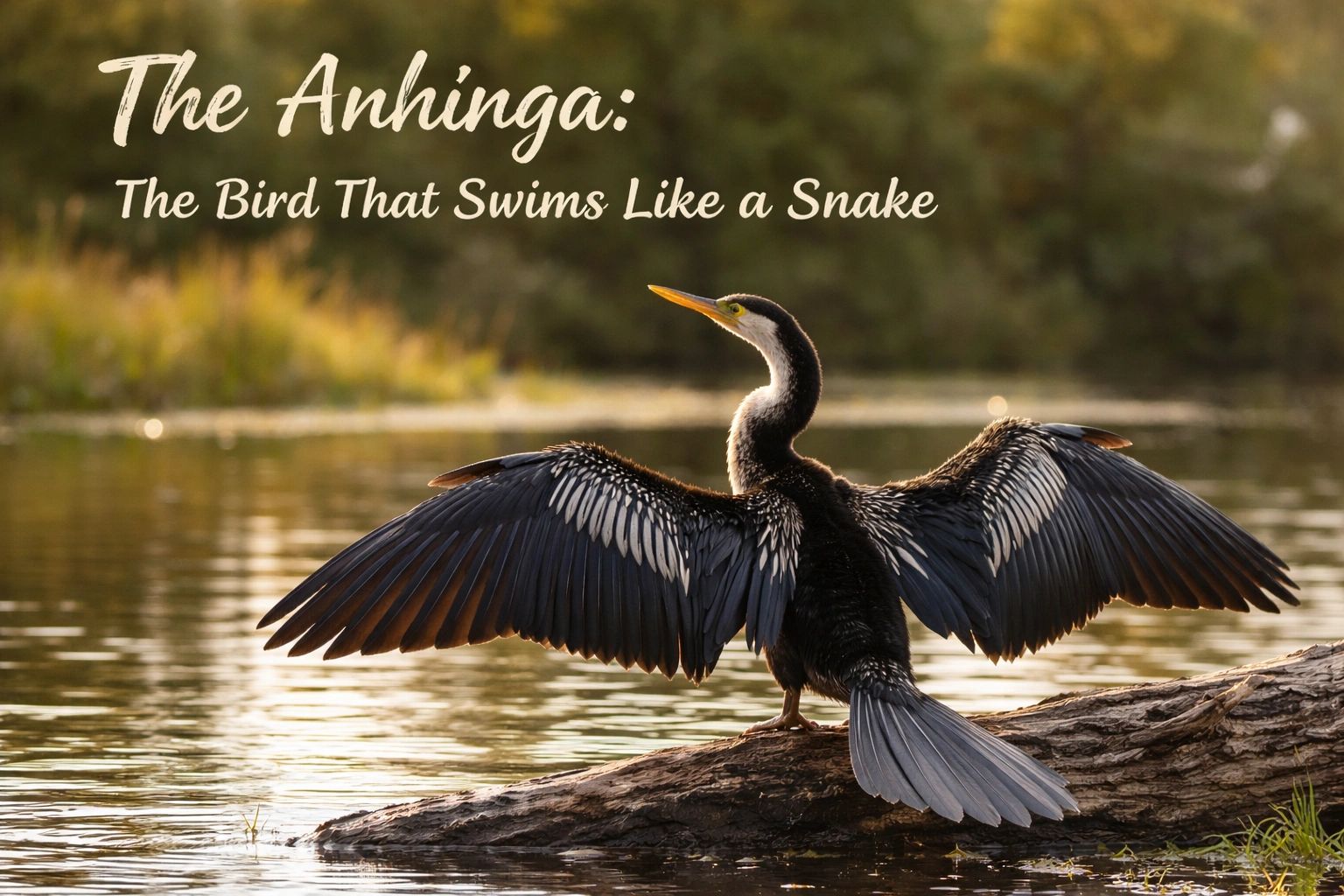
It moved to a nearby branch and settled in, and for a moment, it simply stayed there. Then, slowly, it opened its wings.
Wide.
Fully extended.
Held in place without movement.
And just like that, the shape changed again.
From the sleek, almost snake-like figure in the water, it became something broader, more grounded. Its body looked heavier, its presence more solid.
This is where another name begins to make sense—the water turkey.
From a distance, with its wings spread and body still, it carries a resemblance to a wild turkey. The posture, the silhouette, the way it holds itself—it all fits.
It’s the same bird.
But it feels completely different.
Why It Has to Stop and Wait
That moment on the branch isn’t just for appearance.
It’s necessary.
Unlike many water birds, the anhinga’s feathers are not fully waterproof. This allows it to dive more easily, reducing buoyancy and helping it stay submerged while hunting.
But it also means its wings absorb water.
So after hunting, it has to stop.
It has to wait.
Wings open, completely still, letting the air dry them before it can take flight again.
It’s a pause that feels built into its entire rhythm.
A Stillness That Changes the Scene
There is something about that stillness that stands out.
After watching it move so fluidly through the water, seeing it completely motionless feels like a shift in everything around it.
It becomes less about movement and more about presence.
Perched there with wings spread, it almost looks like part of the landscape—something fixed rather than passing through.
And for the first time, it feels easy to see.
Living Between Water and Air
The more I watched, the more it became clear that the anhinga doesn’t fully belong to one place.
In the water, it becomes something hidden.
Out of the water, it becomes something fully visible.
It moves between those states without hesitation.
Water and air.
Motion and stillness.
Seen and unseen.
And that balance is what makes it so easy to overlook—at least at first.
The Moment Everything Changes
Once I knew what I was looking at, the entire scene shifted.
The water no longer felt empty.
The surface wasn’t just still.
There was always the possibility that something was moving just beneath it, just out of sight.
The same way the osprey changed how the sky felt.
The same way the ibis changed how the shoreline looked.
The anhinga changed how I saw the water itself.
Conclusion: The Bird Beneath the Surface
The Anhinga is not the loudest bird.
It is not the most colorful.
It is not the easiest to spot.
But it is one of the most unique.
It moves through the water in a way that challenges expectations.
It disappears completely, then returns without warning.
It carries names like snakebird and water turkey, each one capturing a different part of what it is.
And once you recognize it—once you understand what you’re seeing—the water changes.
It’s no longer just a reflection.
It becomes something deeper.
Something active.
Something alive.
And you realize something simple.
It was never just a ripple.
It was always there.
Bibliography
Cornell Lab of Ornithology. All About Birds: Anhinga.
Smithsonian Institution. Smithsonian Handbooks: Birds of North America (Eastern Region).
National Audubon Society. Anhinga.
Sibley, David Allen. The Sibley Guide to Birds.
Florida Fish and Wildlife Conservation Commission. Florida Bird Species Information.
Originally published at the live site .