
Maritime ·
The Belted Kingfisher: The Bird That Breaks the Surface
Some birds move quietly.
By Rebecca "Madam Chronicler" Ryan
Some birds move quietly.
They wait.
They blend into the environment and act only when the moment is right.
But not all birds are built that way.
Some birds don’t wait for stillness.
They break it.
The belted kingfisher is one of those birds.
A Sound That Comes Before the Movement
The first time I noticed it, it wasn’t the bird.
It was the sound.
A sharp, rattling call that cut across the water—fast, mechanical, and impossible to ignore. It didn’t flow like a song. It didn’t feel soft or distant.
It sounded urgent.
Almost like something warning you before you even knew what to look for.
I paused, scanning the water, the shoreline, the trees above it—but nothing stood out at first.
Then the sound came again.
Closer.
Faster.
So I opened the Merlin Bird ID app and let it listen.
Within seconds, it gave me the answer.
Belted Kingfisher.
And suddenly, everything about that sound made sense.
Looking Above the Water
This time, I knew where to focus.
Not deep in the trees.
Not on the ground.
But somewhere between.
Above the water.
And that’s where I saw it.
A Shape That Feels Built for Action
The kingfisher didn’t perch the way most birds do.
It sat forward.
Alert.
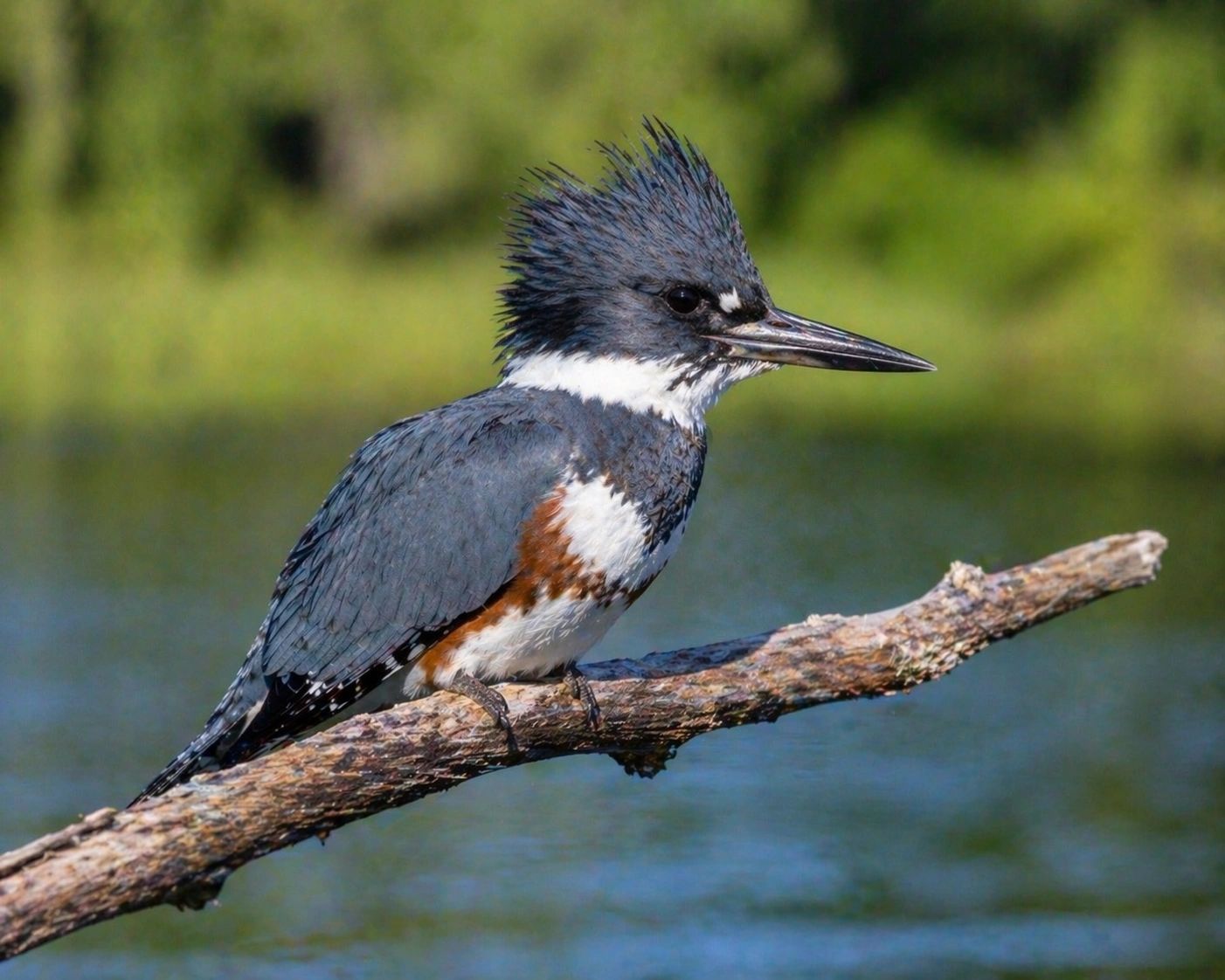
Its body angled slightly downward, as if it was already thinking about its next move. A shaggy crest sat on top of its head, giving it a slightly unpolished look—less refined than the egret, more raw.
Blue-gray feathers.
A white collar.
And a band across the chest that stood out clearly against the lighter underside.
According to the Smithsonian Handbooks: Birds of North America (Eastern Region), the belted kingfisher is built for hunting fish, with strong eyesight and a body designed for sudden, direct movement.
And watching it, that purpose was obvious.
A Bird That Doesn’t Wait Long
Unlike the egret, which relies on patience, the kingfisher doesn’t stay still for long.
It watches.
But only briefly.
Then it moves.
A quick shift.
A sudden flight.
Then back to a perch.
It doesn’t settle into stillness.
It stays ready.
The Moment Everything Changes
And then it happens.
Without warning, the kingfisher dives.
Straight down.
No hesitation.
No gradual movement.
Just a direct, powerful drop into the water.
For a moment, it disappears completely beneath the surface.
Then it emerges.
Back into the air.
Sometimes with nothing.
Sometimes with something small held firmly in its beak.
Either way, it returns to its perch.
And the process starts again.
Hunting Through Impact
The kingfisher doesn’t ease into its environment.
It interrupts it.
It breaks the surface.
It creates motion where there was none.
According to Smithsonian references, belted kingfishers hunt primarily by diving into the water to catch fish, relying on speed and precision rather than patience.
It’s the opposite of stillness.
It’s action.
A Sound That Matches Its Behavior
The rattling call comes again.
Sharp.
Repeated.
Almost like a continuation of the movement itself.
Field guides describe the kingfisher’s call as a loud, rapid rattle, and hearing it in person makes that description feel exact.
It doesn’t soften.
It doesn’t fade.
It carries.
A Bird That Claims Its Space
Unlike quieter birds, the kingfisher feels territorial.
It moves along the waterline, calling as it goes, making its presence known in a way that feels deliberate.
It doesn’t blend in.
It defines the space around it.
A Presence That Feels Different
What stood out most was how different the kingfisher felt from everything else.
It wasn’t calm like the egret.
It wasn’t hidden like the vireo.
It wasn’t subtle like the ground dove.
It was direct.
Clear in its purpose.
Focused on what it needed to do.
The Moment Merlin Made It Clear
Like the other birds in this series, everything started with recognition.
Before Merlin, the sound felt sharp but undefined.
After Merlin, it became something I could follow.
Something I could expect.
Something I could recognize the moment it returned.
A Bird That Changes the Water
The kingfisher doesn’t just exist near the water.
It changes it.
It turns stillness into motion.
It adds energy to a space that might otherwise feel quiet.
And once it’s there, that space doesn’t feel the same.
A Different Kind of Awareness
Watching the kingfisher shifts your focus.
You stop looking for stillness.
You start anticipating movement.
You listen for that call.
You watch for that sudden drop.
And that anticipation becomes part of the experience.
Conclusion: The Bird That Breaks the Surface
The belted kingfisher is not the quietest bird.
It is not the most patient.
It does not wait for the perfect moment to arrive.
It creates it.
Through movement.
Through sound.
Through that sudden dive that breaks the surface of the water and changes everything around it.
And once you recognize it—once you connect that sharp, rattling call with the bird perched above the water—you realize something simple.
Some birds don’t wait for the moment.
They make it happen.
Bibliography
Cornell Lab of Ornithology. All About Birds: Belted Kingfisher.
Smithsonian Institution. Smithsonian Handbooks: Birds of North America (Eastern Region).
National Audubon Society. Belted Kingfisher.
Sibley, David Allen. The Sibley Guide to Birds.
Florida Fish and Wildlife Conservation Commission. Florida Bird Species Information.
Originally published at the live site .