
Maritime ·
The Black-bellied Whistling Duck: The Duck With a Different Sound
Some birds are easy to recognize by sound.
By Rebecca "Madam Chronicler" Ryan
Some birds are easy to recognize by sound.
A cardinal whistles.
A crow caws.
A dove coos.
You hear them, and you already know what to expect.
But every once in a while, there’s a sound that doesn’t match anything you think you understand.
The Black-Bellied Whistling Duck is one of those moments.
A Sound That Didn’t Fit
It started the same way many of these moments have started.
Not with sight.
With sound.
I stepped outside expecting the usual rhythm of the yard—the layered mix of calls that had slowly become familiar over time. Some loud, some soft, some easy to place, others fading into the background.
But this one stood out immediately.
It was high-pitched.
Clear.
Almost sharp—but not in a harsh way.
It didn’t sound like a duck.
That was the first thing I noticed.
It didn’t quack. It didn’t have that low, familiar tone you expect from something near water. Instead, it sounded more like a whistle—quick, almost playful, echoing across the space in a way that felt out of place.
I paused.
Listened again.
Still didn’t match anything.
So I opened the Merlin Bird ID app and let it listen.
Within seconds, it gave me the answer.
Black-bellied Whistling Duck.
And that’s when the moment shifted.
Hearing Before Understanding
Even after Merlin identified it, the sound didn’t immediately make sense.
A duck?
That sound belonged to a duck?
It didn’t line up with what I thought I knew.
And that’s what made it interesting.
Because it wasn’t just about identifying a bird—it was about realizing that what I expected didn’t always match reality.
The sound continued, repeating in short bursts, carrying farther than I expected. It didn’t feel tied to one direction. Like the purple martin, it seemed to move through the space rather than come from a single point.
But this time, I wasn’t looking up.
I was looking outward.
Finding the Source
It didn’t take long before I saw them.
Not one.
Several.
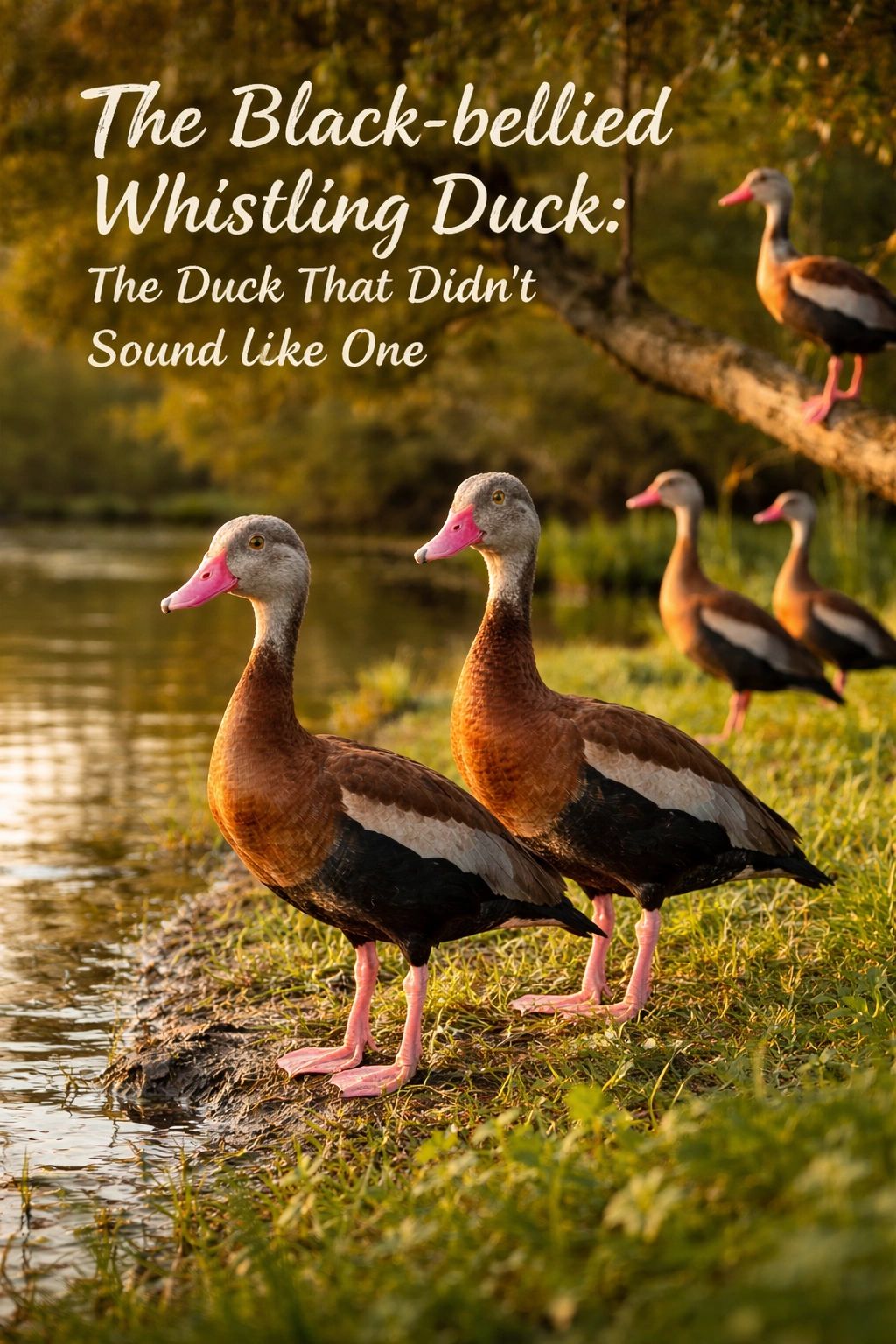
They stood near the water’s edge, but not in the way I expected. They weren’t low and rounded like most ducks. They stood taller, their bodies more upright, their posture almost giving them a different presence entirely.
At first glance, they didn’t even feel like typical ducks.
Their legs were long.
Their stance was elevated.
And the longer I watched, the more it became clear—this was something different.
A Duck That Doesn’t Move Like a Duck
There is something noticeably different about how black-bellied whistling ducks carry themselves.
They don’t waddle in the same way.
They don’t stay low to the ground.
They move with a kind of balance that feels more upright, more controlled.
Their long pink legs lift them higher than you expect, giving them a silhouette that feels closer to a wading bird than a traditional duck.
And that changes how you see them.
They don’t blend into the category you’ve already created in your mind.
They stand apart from it.
Color That Reveals Itself Slowly
At a distance, their colors don’t immediately stand out.
But the closer you look, the more detail emerges.
A rich chestnut body.
A darker belly that gives the bird its name.
A pale face with a soft contrast against the darker tones.
And then, when they move or stretch their wings, a flash of something brighter—white, bold, and unmistakable.
According to the Smithsonian Handbooks: Birds of North America (Eastern Region), the black-bellied whistling duck is known for this striking contrast, especially in flight, where the white wing patches become highly visible.
But standing there, watching them, it wasn’t just the colors that stood out.
It was how they held themselves.
A Social Presence
Unlike some of the birds I had been watching, these ducks weren’t alone.
They stayed together.
Close.
Moving as a group, not in tight formation, but with a clear awareness of each other’s presence. When one shifted, the others followed. When one called, the others responded.
Their sound wasn’t isolated.
It was shared.
That whistling call moved between them, creating a kind of conversation that felt continuous rather than occasional.
A Sound That Carries
The more I listened, the more I understood why the sound stood out so much.
It wasn’t just different.
It carried.
Their whistles traveled farther than expected, cutting across space in a way that made them easy to hear even when they weren’t immediately visible.
Field guides often describe their call as a clear, high-pitched whistle, and hearing it in person makes that description feel exact.
It doesn’t blend in.
It stands apart.
A Bird That Perches Where You Don’t Expect
One of the more surprising things about the black-bellied whistling duck isn’t just how it sounds or how it looks.
It’s where it goes.
At some point, one of them lifted off—not with urgency, but with a smooth, steady motion—and moved toward a nearby tree.
A tree.
Not the water.
Not the ground.
It landed on a branch, balancing with ease.
And suddenly, the idea of what a duck is supposed to do shifted again.
According to Smithsonian references, black-bellied whistling ducks are known to perch in trees, often nesting in cavities or elevated spaces rather than building ground nests like many other ducks.
And seeing it happen makes that detail unforgettable.
Living Between Expectations
The more time I spent watching them, the more it became clear that this bird exists in a space between expectations.
It sounds different.
Moves differently.
Perches differently.
Even gathers differently.
It doesn’t fully match the image most people have when they think of a duck.
And that’s what makes it stand out.
The Role of Merlin in the Moment
Like the other birds in this series, everything came back to that first moment.
Before Merlin, the sound didn’t make sense.
It didn’t fit.
It felt out of place.
After Merlin, everything aligned.
The sound had a name.
The bird had context.
And the moment had meaning.
A Different Kind of Awareness
What changed most wasn’t just identifying the bird.
It was realizing how easy it is to overlook something simply because it doesn’t match expectations.
If I had ignored the sound, if I had assumed it was something familiar, I might never have looked for it.
And that realization stayed.
A Bird That Changes What You Expect
The black-bellied whistling duck doesn’t just add another species to the list.
It changes how you think about the ones you already know.
It reminds you that categories aren’t always fixed.
That what you expect isn’t always accurate.
And that sometimes, the most interesting moments come from things that don’t quite fit.
Conclusion: The Sound That Didn’t Match the Bird
The Black-Bellied Whistling Duck is not what you expect.
It doesn’t sound like a duck.
It doesn’t move like a duck.
It doesn’t stay where you think a duck should be.
But it is one.
And once you hear it—once you connect that clear, whistling sound to the bird standing upright near the water or perched quietly in a tree—you realize something simple.
Not everything fits the pattern you expect.
Some things are meant to stand apart.
You just have to listen closely enough to notice.
Bibliography
Cornell Lab of Ornithology. All About Birds: Black-bellied Whistling Duck.
Smithsonian Institution. Smithsonian Handbooks: Birds of North America (Eastern Region).
National Audubon Society. Black-bellied Whistling Duck.
Sibley, David Allen. The Sibley Guide to Birds.
Florida Fish and Wildlife Conservation Commission. Florida Bird Species Information.
Originally published at the live site .