
Maritime ·
The Black Mako of the Abyss: Truth or Terror of the Deep?
Beneath the waves of the world’s oceans, hidden in the darkest places, tales swirl of a mysterious predator that few have seen and lived to tell the tale. It’s called the Black Mako of the Abyss—a name that sends chills ...
By Rebecca "Madam Chronicler" Ryan
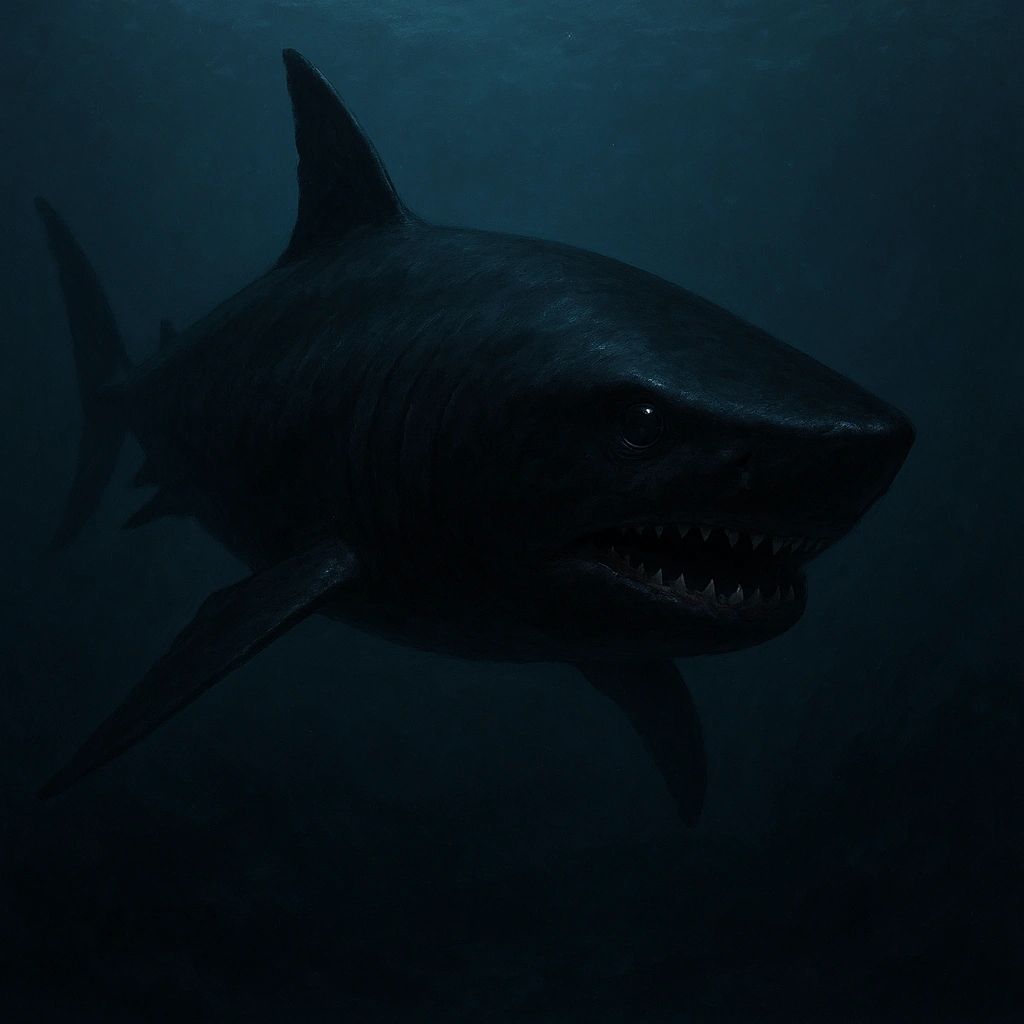
Beneath the waves of the world’s oceans, hidden in the darkest places, tales swirl of a mysterious predator that few have seen and lived to tell the tale. It’s called the Black Mako of the Abyss—a name that sends chills down the spines of sailors and scientists alike!
But is this shark just an old legend? Or could it be a very real, undiscovered predator lurking in the deep?
In this post, we’ll dive deep (pun intended!) into the facts, the science, and the possibilities behind the Black Mako. Get ready for a thrilling journey through shark biology, deep-sea mysteries, and the chilling accounts that fuel this legend.
Chapter 1: Meet the Mako Shark
Before we get to the mysterious “Black Mako,” let’s learn about the mako shark itself.
Fastest Shark in the Sea
The shortfin mako shark (Isurus oxyrinchus) is famous for being the fastest shark in the ocean. It can reach speeds of up to 45 miles per hour (Compagno, 2001)! This shark isn’t just fast—it’s sleek, built for bursts of speed to catch prey like tuna and swordfish.
Looks That Kill
Makos are striking. They have a pointy snout, sharp teeth that stick out even when their mouths are closed, and a metallic blue color on their backs. Their bellies are bright white, helping them blend into the shimmering water above and below.
Super Swimmer
Makos are known for their incredible stamina. They are “endothermic,” which means they can heat parts of their body, especially their muscles and brain, allowing them to hunt in colder waters (Carey & Teal, 1969).
Deep-Diving Cousin
There’s also the longfin mako shark (Isurus paucus), which isn’t as well-known. Longfin makos prefer deeper waters and are rare. They look similar to shortfin makos but with larger fins and bigger eyes for seeing in dim light (Compagno, 2001).
Chapter 2: A Legend Born—The Black Mako of the Abyss
Here’s where the mystery begins! Stories of the Black Mako of the Abyss have circled through coastal towns, especially near deep trenches like the Puerto Rico Trench and parts of the Pacific. According to these tales, the Black Mako is much larger and darker than any known mako shark.
Features of the Black Mako (According to Witnesses)
- Jet-black skin that absorbs all light.
- Massive size—some claim over 20 feet long.
- Huge eyes, adapted for darkness.
- Thick, heavy body, built for the deep.
- Scars and ragged fins, suggesting it survives fierce battles.
The First Famous Sighting
One of the earliest widely told stories comes from a deep-sea fishing vessel off the coast of Chile in 1987. Crew members reported a “shadow bigger than the boat” rising from below before vanishing in an instant. They described the creature as a giant black shark with glowing eyes.
While no physical evidence was collected, these kinds of stories became more common near deep-sea ridges and trenches.
Chapter 3: Is the Black Mako Real? Deep-Sea Mysteries Explained
So, could the Black Mako of the Abyss really exist? Scientists have debated this idea, and here’s what we know from deep-sea research.
Gigantism in the Deep Sea
The deep ocean is home to some truly gigantic creatures. For example, the giant squid (Architeuthis dux) can grow over 40 feet long, yet was only officially photographed alive in 2004 (Kubodera & Mori, 2005).
Scientists also know about a phenomenon called deep-sea gigantism. In the deep ocean, some species grow much larger than their shallow-water relatives, possibly due to colder temperatures, slower metabolism, and less predation (McClain et al., 2015).
Could there be a giant mako adapted to the deep sea?
Black Coloration in Deep Species
Many deep-sea creatures have pitch-black coloration. This helps them stay hidden in the dark. Some fish even have skin so black it absorbs nearly all light—like the black dragonfish (Idiacanthus atlanticus) and the ultra-black Pacific snailfish (Johnsen et al., 2020).
A mako shark that lived in deep water could evolve this trait too. Pitch-black skin isn’t impossible.
Chapter 4: The Science of Hypothetical Deep Mako Sharks
If there were a deep-sea mako, it would likely need to be very different from the ones we know.
Adaptations It Would Need:
- Big Eyes: To see in low-light environments. Many deep-sea fish and sharks have huge eyes.
- Slow Movement: Deep-sea creatures often move slowly because there’s little food, although bursts of speed may be possible.
- High Pressure Resistance: The deep sea has crushing pressure. Its body would need special adaptations to survive these conditions.
- Dark Coloration: Black skin would help it stay hidden.
- Large Size: Some deep-sea predators grow large for energy storage and hunting.
These traits wouldn’t be unheard of. In fact, many deep-sea sharks, like the Pacific sleeper shark (Somniosus pacificus), already show some of these features (Drazen & Haedrich, 2012).
Chapter 5: DNA Clues—Could It Be a New Species?
Sharks have been around for over 400 million years. That’s older than dinosaurs! They’ve evolved into hundreds of species, many of which are still undiscovered, especially in the deep sea.
Undiscovered Sharks Still Being Found
- In 2019, researchers described a new species of deep-sea catshark in the Gulf of Mexico (Ebert et al., 2019).
- New deep-sea sharks, like the Ninja Lanternshark (Etmopterus benchleyi), have been found in the past decade—this one is also jet black and glows under certain lights (Vega et al., 2015).
If a deep-sea mako exists, it could have gone unnoticed because:
- It lives far below where most fishing gear can reach.
- It might resemble other sharks on the outside.
- It may only rise to the surface under rare conditions.
DNA testing of shark tissues collected from deep-sea fisheries sometimes reveals surprises, hinting that more discoveries await.
Chapter 6: Are There Any Real “Black” Sharks?
Yes! The ocean already hides some black sharks that are quite mysterious.
Ninja Lanternshark (Etmopterus benchleyi)
- Discovered off Central America.
- Jet-black body with special glowing patches.
- Lives deep below 800 meters (2,600 feet).
- Tiny—only about 20 inches long—but its existence proves black deep-sea sharks are real.
Black Dogfish (Centroscyllium fabricii)
- Found in the deep North Atlantic.
- Very dark-colored with large eyes.
- Lives around 180 to 2,200 meters deep (600 to 7,200 feet).
While these species aren’t related to makos, they show that black sharks adapted to the abyss do exist.
Chapter 7: Could a Mako Survive in the Abyss?
Some scientists suggest it’s unlikely that shortfin makos could live in deep-sea trenches.
Here’s why:
- Shortfin makos prefer warmer waters near the surface (Francis et al., 2015).
- They have high oxygen needs due to their speed.
- The deep sea has very little oxygen, making it difficult for fast-moving predators to survive there.
However, longfin makos may already be adapted for deeper waters. They’ve been found down to depths of around 220 meters (720 feet) (Compagno, 2001). That’s not the abyss—but it’s deep compared to most makos.
Could a relative of the mako have evolved to go deeper? Possibly!
Chapter 8: Final Verdict—Myth or Mystery?
So, is the Black Mako of the Abyss real?
✅ It’s scientifically possible for a deep-sea shark to be large and black. ✅ Sharks are often discovered in deep water unexpectedly. ✅ Gigantism in the deep sea is a real phenomenon. ✅ Deep-sea sharks with big eyes and dark skin exist today.
BUT…
❌ No scientific records exist of a giant black mako. ❌ Makos we know today prefer shallower, warmer waters. ❌ No physical evidence (like teeth or tissue) has been found yet.
For now, the Black Mako remains in the realm of mystery and legend. But many scientists agree—we know more about the surface of Mars than our own deep sea (Ramirez-Llodra et al., 2010).
It’s possible that somewhere, lurking far below, a new species of shark—maybe even a black relative of the mako—waits to be discovered.
Closing Thoughts: Keep Exploring!
Whether it’s fact or fiction, the Black Mako of the Abyss reminds us how little we truly know about the deep ocean.
Every year, new species are found. Perhaps one day soon, a deep-sea expedition will capture video or bring back proof of this mysterious shark. Until then, it swims through our imaginations—and maybe through the abyss itself.
So, the next time you visit the ocean, remember: beneath the waves, there’s still so much left to discover!
Bibliography (APA Format)
Carey, F. G., & Teal, J. M. (1969). Mako and porbeagle: Warm-bodied sharks. Comparative Biochemistry and Physiology, 28(3), 199–204. https://doi.org/10.1016/0010-406X(69)90685-8
Compagno, L. J. V. (2001). Sharks of the World: An Annotated and Illustrated Catalogue of Shark Species Known to Date. Volume 2. Bullhead, Mackerel and Carpet Sharks (Heterodontiformes, Lamniformes and Orectolobiformes). FAO Species Catalogue for Fishery Purposes No. 1. Rome, FAO.
Drazen, J. C., & Haedrich, R. L. (2012). A continuum of life histories in deep-sea demersal fishes. Deep-Sea Research Part I: Oceanographic Research Papers, 61, 34–42. https://doi.org/10.1016/j.dsr.2011.11.002
Ebert, D. A., White, W. T., & Ho, H.-C. (2019). A new species of deep-water catshark (Parmaturus) from the Gulf of Mexico. Zootaxa, 4683(1), 77–88. https://doi.org/10.11646/zootaxa.4683.1.3
Francis, M. P., Duffy, C. A., & Bonfil, R. (2015). Habitat use and population structure of shortfin mako sharks (Isurus oxyrinchus) in the Southwest Pacific Ocean. Marine and Freshwater Research, 66(5), 455–469. https://doi.org/10.1071/MF14076
Johnsen, S., et al. (2020). Ultra-black camouflage in deep-sea fishes. Current Biology, 30(18), 3470–3476.e3. https://doi.org/10.1016/j.cub.2020.06.044
Kubodera, T., & Mori, K. (2005). First-ever observations of a live giant squid in the wild. Proceedings of the Royal Society B: Biological Sciences, 272(1581), 2583–2586. https://doi.org/10.1098/rspb.2005.3158
McClain, C. R., et al. (2015). Sizing ocean giants: patterns of intraspecific size variation in marine megafauna. PeerJ, 3, e715. https://doi.org/10.7717/peerj.715
Ramirez-Llodra, E., et al. (2010). Deep, diverse and definitely different: unique attributes of the world’s largest ecosystem. Biogeosciences, 7(9), 2851–2899. https://doi.org/10.5194/bg-7-2851-2010
Vega, F., et al. (2015). Etmopterus benchleyi sp. nov.: A new species of lanternshark from the Pacific Ocean. Journal of the Ocean Science Foundation, 14, 1–9.
Originally published at the live site .