
Stories ·
The Blue Jay: The Loud Guardian of the Backyard
Some birds introduce themselves gently.
By Rebecca "Madam Chronicler" Ryan
Some birds introduce themselves gently.
A soft song from a hidden branch. A quiet movement through leaves. A presence you might not notice unless you’re paying close attention.
The Blue Jay is not one of those birds.
You don’t discover a Blue Jay.
It announces itself.
A Sound That Demands Attention
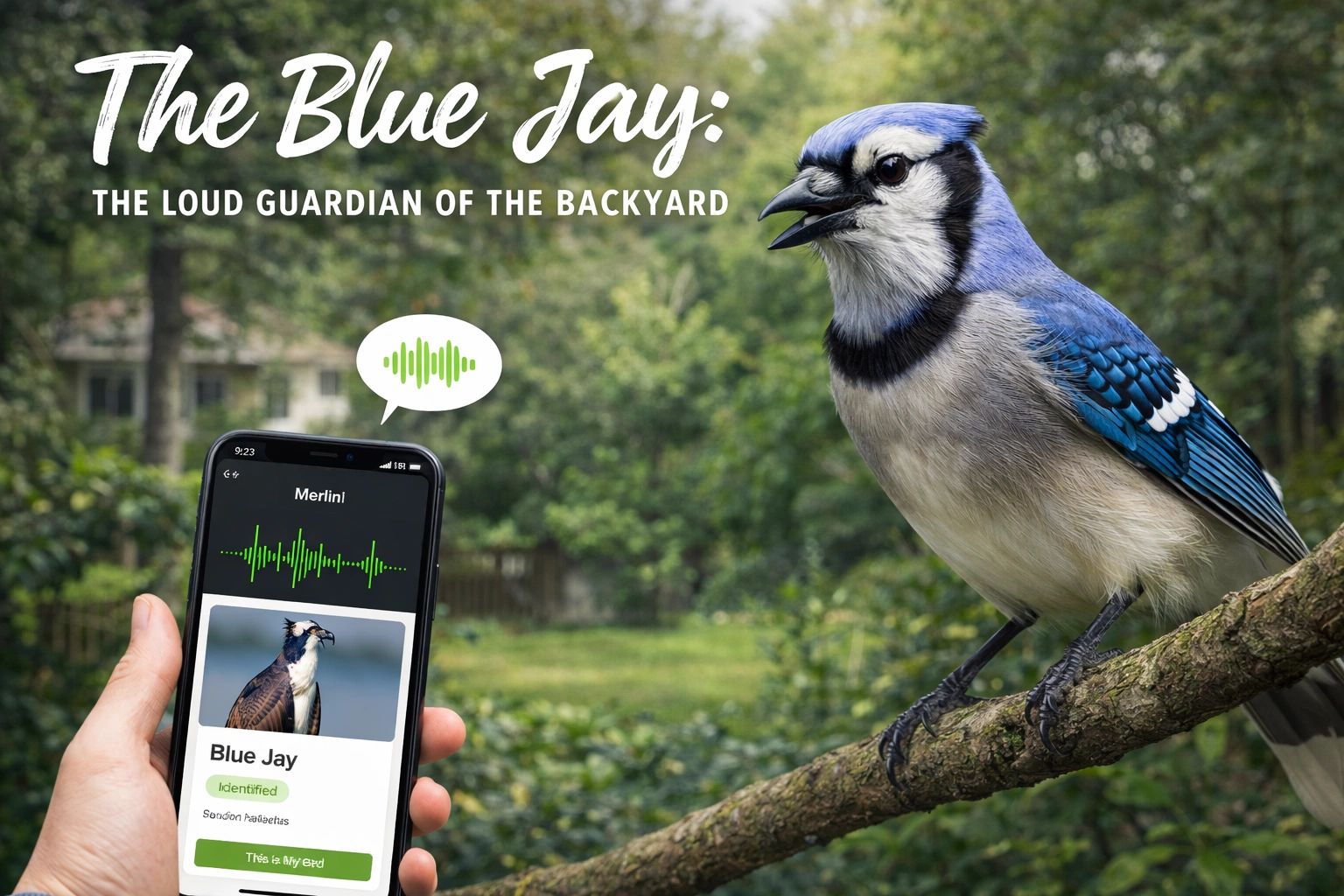
The first time the Merlin Bird ID app picked up a Blue Jay in my yard, I didn’t need to look at my phone to know something was there.
I heard it.
A loud, sharp call that cut through everything else.
It wasn’t musical in the way a cardinal or mockingbird might be. It didn’t blend into the background like the softer voices of warblers. It stood out—clear, direct, and impossible to ignore.
Even before Merlin confirmed it, I had a sense of what it might be.
Blue Jay.
Once you hear that call, you don’t forget it.
A Flash of Blue
When I looked up, it didn’t take long to spot it.
Unlike some birds that hide in dense branches, the Blue Jay often chooses to be seen. It perched in a place where it had a clear view of the yard, its body upright, its crest slightly raised.
The color stood out immediately.
Bright blue feathers contrasted sharply against the green of the trees and the neutral tones of the yard. Its wings and tail showed a pattern of black bars and white patches, while its chest and underside were a softer gray.
But it wasn’t just the color.
It was the posture.
The Blue Jay doesn’t look uncertain. It doesn’t hesitate.
It looks aware.
A Bird That Watches Everything
There is a constant sense of alertness in a Blue Jay.
Even while perched, it seems to be scanning its surroundings—watching movement, listening for changes, responding to anything that might matter.
This isn’t accidental.
Blue Jays are part of the corvid family, which includes crows and ravens, birds known for their intelligence and awareness. That intelligence shows up in subtle ways.
The way they pause before moving.
The way they react quickly to sound.
The way they seem to evaluate their environment rather than simply exist in it.
Watching one for more than a few moments, it becomes clear that this is not a passive bird.
It is engaged.
The Voice of the Neighborhood
If there is one thing that defines the Blue Jay, it’s its voice.
Its calls are loud, varied, and often surprising.
The most recognizable is the classic “jay! jay!” call—sharp, repetitive, and attention-grabbing. But that’s only part of its vocal range.
Blue jays are also capable of mimicry.
They can imitate the calls of hawks, especially red-shouldered and red-tailed hawks. Hearing this for the first time can be confusing. It sounds like a predator is nearby, causing other birds to scatter.
But sometimes, it’s just the Blue Jay.
Why it does this isn’t fully understood, but it may serve multiple purposes—warning other birds, testing reactions, or even clearing an area of competition.
Whatever the reason, it adds another layer to the bird’s already strong presence.
A Complex Personality
It would be easy to describe the Blue Jay as loud or aggressive.
And in some ways, it is.
It will chase away other birds, defend its territory, and make its presence known without hesitation. Around feeders, it can dominate the space, pushing smaller birds aside.
But that’s only part of the story.
Blue Jays are also highly social and capable of complex behavior. They form family groups, communicate with one another, and show signs of memory and learning that go beyond simple instinct.
They are bold, but they are also aware.
Assertive, but not without reason.
Movement With Purpose
Unlike smaller birds that dart quickly between branches, the Blue Jay moves with a sense of intention.
Its flights are steady and direct, with strong wingbeats followed by brief glides. When it lands, it does so confidently, often choosing a visible perch.
On the ground, it hops deliberately, pausing frequently to look around before continuing.
There is very little randomness in its movement.
Everything feels considered.
Feeding and Adaptation
Blue Jays have a varied diet, which contributes to their success in a wide range of environments.
They eat nuts, seeds, fruits, insects, and occasionally small animals. Acorns are a particular favorite, and they play an important role in oak tree ecosystems by carrying and burying acorns, some of which are never retrieved.
This behavior helps spread trees across landscapes, making the blue jay an important part of its environment in ways that are not immediately obvious.
In suburban areas, they adapt easily to feeders, learning quickly where food is available and returning regularly.
A Bird That Remembers
One of the more fascinating aspects of Blue Jay behavior is memory.
Like other corvids, they are known to remember locations where they have stored food. They can return later, sometimes days or weeks after hiding it, and retrieve it with surprising accuracy.
They also seem to remember patterns.
Where food is regularly placed.
Which areas are safe.
Where threats have appeared before.
This ability gives them an advantage, allowing them to navigate their environment with a level of awareness that feels almost calculated.
A Presence Through the Seasons
In Florida, Blue Jays are year-round residents.
They do not migrate in the same way many other birds do, which means their presence is consistent. They become part of the daily soundscape, part of the rhythm of the environment.
This consistency makes them familiar.
But familiarity can sometimes lead to being overlooked.
Because they are always there, it’s easy to stop noticing them.
Until something draws your attention back.
Returning to That Moment
That day, as Merlin picked up the Blue Jay’s call, it shifted my focus in a way that felt similar to the Osprey and the Ibis before it.
It wasn’t just about identifying a bird.
It was about recognizing what had already been there.
The Blue Jay wasn’t new to the yard.
I had heard it before.
Seen flashes of blue in the trees.
But this time was different.
This time, I knew what I was hearing.
The Role of Sound in Discovery
Using Merlin changes how you experience birds.
It starts with sound.
A call that stands out.
A pattern that repeats.
Something that feels different from everything else.
Then comes identification.
And with that, understanding.
The Blue Jay is a perfect example of this process.
It is loud enough to be noticed, distinct enough to be identified, and complex enough to keep your attention once you begin to understand it.
More Than Just Noise
At first, the Blue Jay’s call might seem like noise.
Too loud.
Too sharp.
Too disruptive.
But once you begin to recognize it, it becomes something else.
A signal.
A warning.
A presence.
It tells you something about what is happening in the environment.
It lets you know that something has changed.
A Guardian of the Space
There is a reason the Blue Jay feels like a “guardian” of the backyard.
It reacts quickly to threats.
It calls out when something is out of place.
It doesn’t ignore changes—it responds to them.
In this way, it becomes more than just a bird moving through the space.
It becomes part of how the space functions.
The Beauty in Boldness
Not all beauty in nature is quiet or subtle.
Some of it is bold.
Bright.
Unapologetic.
The Blue Jay is one of those examples.
Its color stands out.
Its voice carries.
Its behavior demands attention.
And in doing so, it challenges the idea that nature is always calm or gentle.
Sometimes, it’s loud.
Sometimes, it’s assertive.
Sometimes, it wants to be noticed.
A Bird You Learn Over Time
The more time you spend observing Blue Jays, the more they reveal.
At first, they are loud and obvious.
But over time, patterns begin to emerge.
You notice how they move.
How they interact.
How they respond to different situations.
They become less of a disturbance and more of a presence.
Something you begin to understand rather than just hear.
Conclusion: The Voice That Defines the Yard
The Blue Jay is not a bird that fades into the background.
It defines it.
Its call shapes the sound of the environment. Its presence influences how other birds behave. Its movements add energy to the space.
It is not subtle.
It is not quiet.
And it is not meant to be.
That day, when Merlin identified it, it wasn’t introducing me to something new.
It was giving a name to something that had already been part of the yard.
Something I had heard before, but never fully understood.
And once you recognize the Blue Jay, you realize something simple.
The yard was never quiet.
You just hadn’t been listening.
Bibliography
Cornell Lab of Ornithology. All About Birds: Blue Jay.
Smithsonian Institution. Smithsonian Handbooks: Birds of North America (Eastern Region).
National Audubon Society. Blue Jay.
Sibley, David Allen. The Sibley Guide to Birds.
Florida Fish and Wildlife Conservation Commission. Florida Bird Species Information.
Originally published at the live site .