
Maritime ·
The Common Ground Dove: The Bird You Almost Miss
Some birds announce themselves.
By Rebecca "Madam Chronicler" Ryan
Some birds announce themselves.
They call loudly.
They move quickly.
They demand attention the moment they arrive.
But not all birds do that.
Some exist quietly.
So quietly, in fact, that you could see them every day and never fully notice them.
The common ground dove is one of those birds.
A Sound That Feels Like It’s Already There
The first time I noticed it, I wasn’t looking for anything new.
I was just standing outside, listening the way I had been learning to do—letting the sounds settle in instead of trying to chase them.
At first, it didn’t stand out.
It didn’t interrupt anything.
It was soft.
Low.
A quiet, repeated coo that blended into the background in a way that made it feel like it had always been there.
Not like the fuller, more familiar coo of a mourning dove.
This was lighter.
Shorter.
Almost tucked into the edges of the soundscape instead of sitting at the center.
I paused.
Listened again.
Still subtle.
Still easy to overlook.
So I opened the Merlin Bird ID app and let it listen.
Within seconds, it gave me the answer.
Common Ground Dove.
And just like that, something that had felt like background noise became something specific.
Looking Down Instead of Out
After identifying it, I did what I had done so many times before.
I started looking.
At the trees.
Along the fence line.
Toward the places where birds usually reveal themselves.
But nothing moved.
Nothing stood out.
The sound came again—soft, steady, still easy to miss.
And that’s when I realized I was looking in the wrong place.
I wasn’t supposed to be looking up.
I was supposed to be looking down.
A Bird That Blends Into the Ground
When I finally saw it, it didn’t feel like spotting something new.
It felt like noticing something that had been there all along.
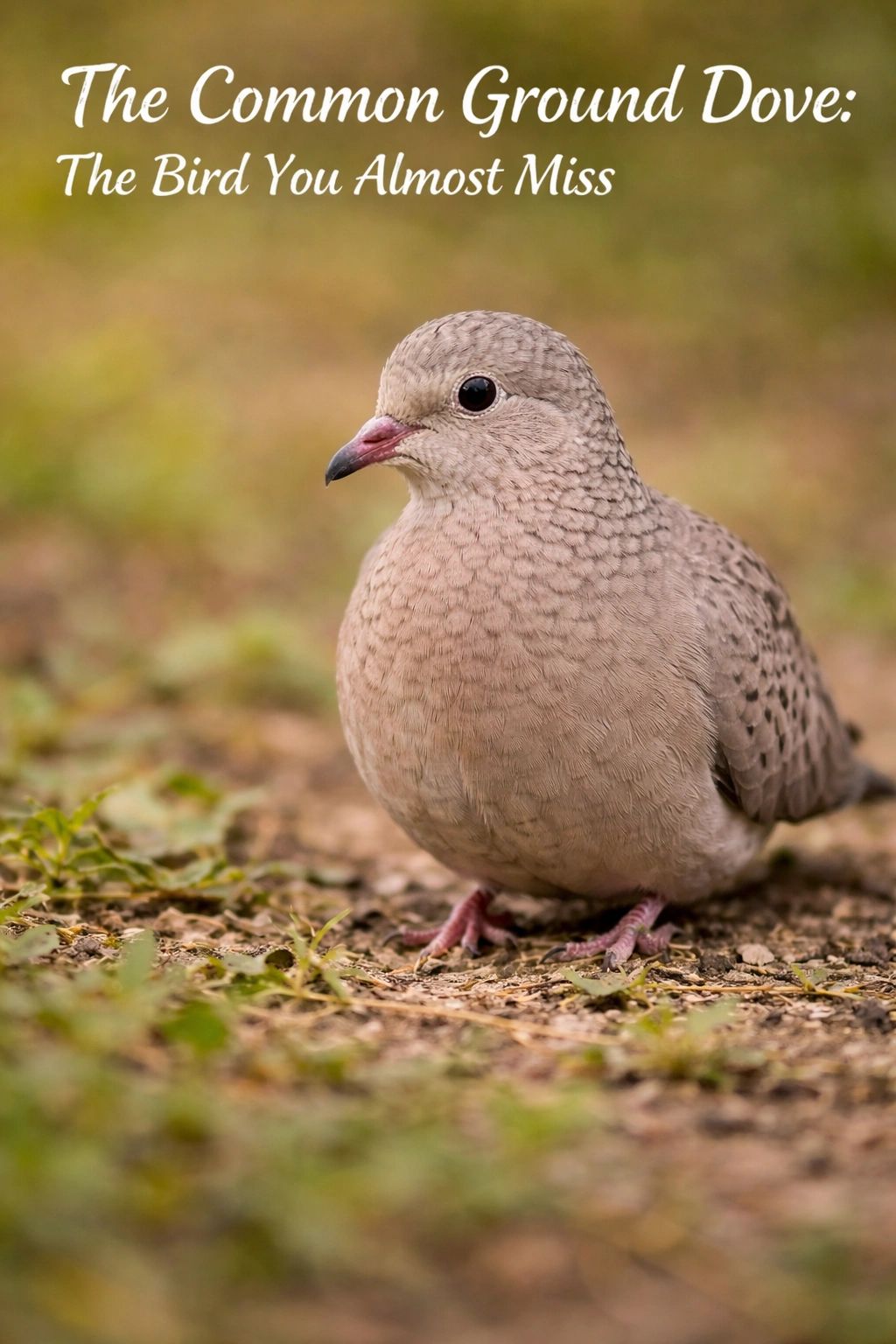
The bird stood on the ground, small and still, its coloring blending almost perfectly with the dirt and grass around it. Soft browns, muted tones, a pattern that didn’t draw attention but instead helped it disappear into its surroundings.
If it hadn’t moved slightly, I might have missed it again.
That’s what made it different.
It didn’t stand out.
It fit in.
Movement That Feels Careful
The common ground dove doesn’t move quickly.
It doesn’t dart or hop in sharp bursts.
It walks.
Slowly.
Deliberately.
Each step measured, as if it’s aware of how easily it can disappear if it doesn’t draw attention to itself.
There’s no urgency in its movement.
No sudden shifts.
Just a quiet, steady presence moving across the ground.
A Presence That Feels Fragile
There is something about the common ground dove that feels delicate.
Not weak.
But careful.
Its size alone sets it apart—it’s one of the smallest doves, noticeably more compact than the mourning dove. Its posture is low, its movements controlled, its entire presence understated.
According to the Smithsonian Handbooks: Birds of North America (Eastern Region), the common ground dove is known for its small size and subtle coloring, traits that help it remain unnoticed in open environments.
And watching it, that makes complete sense.
Feeding Without Drawing Attention
When it feeds, the same pattern continues.
It stays low to the ground, moving slowly, picking at small seeds and bits of plant material. It doesn’t rush. It doesn’t compete for space.
It simply exists within it.
Unlike birds that claim a feeder or dominate a space, the ground dove feels like it moves through the edges—present, but never overwhelming.
A Sound That Matches Its Nature
The call of the common ground dove reflects everything about it.
Soft.
Low.
Repeated in a way that feels steady but never intrusive.
Field guides often describe its call as a gentle, rhythmic coo, and hearing it in person makes that description feel exact.
It doesn’t carry far.
It doesn’t echo.
It stays close—just like the bird itself.
A Bird That Lives Close—but Unnoticed
What makes the common ground dove so interesting is how close it lives to everyday life.
It doesn’t stay deep in forests or far from people.
It’s often right there.
In yards.
Along paths.
Near open spaces you pass through without thinking.
And yet, it’s easy to miss.
Not because it hides.
But because it doesn’t demand to be seen.
The Moment Merlin Made It Clear
Like the other birds in this series, everything changed with recognition.
Before Merlin, the sound blended in.
The bird disappeared into its surroundings.
After Merlin, both became clear.
The call stood out.
The movement became noticeable.
And the bird that had once been invisible became something I could find again.
A Different Way of Paying Attention
What the common ground dove changes most is how you observe.
It teaches you to slow down.
To look more carefully.
To notice what isn’t immediately obvious.
Because sometimes, the most interesting things aren’t the ones that stand out.
They’re the ones that almost don’t.
A Quiet Kind of Presence
The common ground dove doesn’t fill the space.
It doesn’t shape the environment in a bold way.
But it adds something subtle.
A quiet layer.
A presence that exists just beneath the surface of everything else.
And once you notice it, that layer doesn’t disappear.
A Bird That Changes What You Overlook
There’s something about noticing a bird like this that shifts your perspective.
It makes you realize how much can exist right in front of you without being fully seen.
How much can blend in.
How much can be present without demanding attention.
And that changes how you look at everything else.
Conclusion: The Bird You Almost Miss
The common ground dove is not the loudest bird.
It is not the most colorful.
It is not the easiest to find.
But it is one of the most revealing.
Because it shows you something simple.
Not everything that matters stands out.
Some things stay quiet.
Some things stay hidden in plain sight.
And sometimes, the difference between seeing something and missing it entirely…
Is just paying a little more attention.
Bibliography
Cornell Lab of Ornithology. All About Birds: Common Ground Dove.
Smithsonian Institution. Smithsonian Handbooks: Birds of North America (Eastern Region).
National Audubon Society. Common Ground Dove.
Sibley, David Allen. The Sibley Guide to Birds.
Florida Fish and Wildlife Conservation Commission. Florida Bird Species Information.
Originally published at the live site .