
Maritime ·
The Eastern Bluebird: The Color That Changes the Day
Some birds are hard to find.
By Rebecca "Madam Chronicler" Ryan
Some birds are hard to find.
You hear them first.
You search for them.
You wait for them to reveal themselves.
And when they finally do, it feels like something earned.
But not all birds work that way.
Some don’t hide.
Some don’t make you search.
Some simply appear.
And when they do, everything feels a little different.
The eastern bluebird is one of those birds.
A Moment That Starts With Sight
The first time I noticed it, it wasn’t because of a sound.
It was because of color.
A flash of blue that didn’t belong to the sky.
It moved across the yard and landed somewhere in plain view, not hidden, not tucked away—just there, as if it had always been part of the scene.
I didn’t need to search for it.
I didn’t need to listen first.
I saw it.
And that was enough to stop me.
A Color That Feels Out of Place
Blue isn’t a color you expect to see often in the natural world at this scale.
Not like this.
Not this clear.
Not this soft but still vivid tone that catches your attention without overwhelming everything else around it.
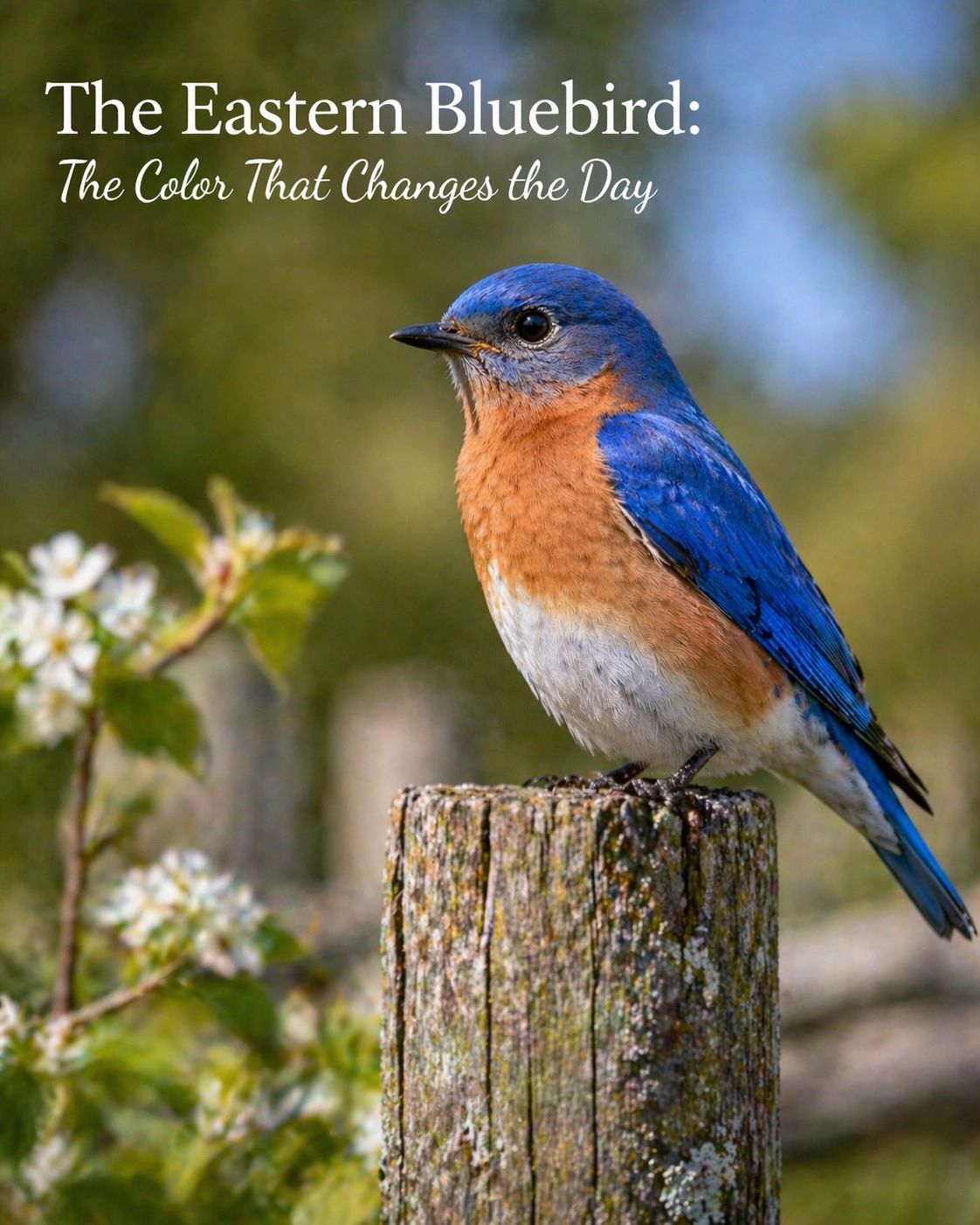
The bird held that color across its back and wings, balanced by a warm, rusty orange across its chest and a pale underside that softened the contrast.
According to the Smithsonian Handbooks: Birds of North America (Eastern Region), the eastern bluebird’s coloration is one of its most recognizable features, especially in open, sunlit environments where the blue stands out even more clearly.
And seeing it in person, it feels almost unreal for a moment.
A Bird That Doesn’t Rush
Unlike many of the birds in this series, the eastern bluebird doesn’t move quickly.
It perches.
Waits.
Observes.
Its posture is upright but relaxed, its head turning slightly as it takes in its surroundings. There’s no urgency in its movement, no sense of constant motion.
It stays long enough for you to notice it.
And that changes the experience.
A Presence That Feels Calm
There is something about the eastern bluebird that feels different.
Not just visually.
Emotionally.
It doesn’t create tension the way the white-eyed vireo does, hiding just out of sight. It doesn’t demand attention with sound like the sandhill crane.
It simply exists.
And that presence feels calm.
Almost grounding.
A Voice That Matches the Moment
When it finally calls, the sound matches the feeling.
Soft.
Gentle.
A series of low, musical notes that don’t travel far but feel complete within the space they occupy.
Field guides describe the eastern bluebird’s call as a soft, warbling song, and hearing it in person reinforces that description.
It doesn’t interrupt the moment.
It adds to it.
A Bird That Lives in Open Space
The eastern bluebird prefers open areas—yards, fields, spaces where it can perch and observe before moving.
It doesn’t stay deep in dense cover.
It stays visible.
Often on fence posts, low branches, or anything that gives it a clear view of the ground below.
From there, it watches.
And waits.
A Hunter That Doesn’t Feel Like One
When the bluebird moves, it does so with purpose.
A quick flight downward.
A small adjustment.
Then back to a perch.
It feeds on insects and small prey, but unlike birds that feel aggressive in their hunting, the bluebird’s movement feels controlled.
Measured.
Almost quiet in its precision.
A Bird That Returns
One of the things that stood out most was how often it came back.
Not constantly.
Not in a way that felt repetitive.
But enough to feel familiar.
It didn’t just pass through.
It revisited.
And that created a different kind of connection.
The Moment Merlin Confirmed It
Even though I already knew what I was looking at, I still opened Merlin.
Not because I needed confirmation—but because that had become part of the process.
And just like before, it matched.
Eastern Bluebird.
Simple.
Clear.
Exactly what I expected.
A Different Kind of Recognition
What made this moment different wasn’t the search.
It was the immediacy.
There was no delay between noticing and understanding.
No time spent trying to locate the source.
It was there.
Visible.
Clear from the start.
And that made it stand out in a completely different way.
A Bird That Changes the Feeling of the Space
The eastern bluebird doesn’t just add color.
It changes the atmosphere.
It makes the yard feel more open.
More balanced.
More complete.
Not because it dominates the space—but because it fits into it so naturally while still standing out.
A Presence That Feels Positive
There’s something about seeing a bluebird that feels different from other birds.
It’s hard to define exactly.
But it’s there.
A sense that the moment matters a little more.
That what you’re seeing isn’t just another bird—but something that stays with you after it’s gone.
Conclusion: The Color That Stays With You
The eastern bluebird is not the loudest bird.
It is not the fastest.
It is not the hardest to find.
But it is one of the most memorable.
Because of its color.
Because of its presence.
Because of the way it changes the moment simply by being there.
And once you notice it—once you connect that flash of blue with the quiet, steady bird perched nearby—you realize something simple.
Some things don’t need to be searched for.
Some things just appear.
And when they do…
They stay with you.
Bibliography
Cornell Lab of Ornithology. All About Birds: Eastern Bluebird.
Smithsonian Institution. Smithsonian Handbooks: Birds of North America (Eastern Region).
National Audubon Society. Eastern Bluebird.
Sibley, David Allen. The Sibley Guide to Birds.
Florida Fish and Wildlife Conservation Commission. Florida Bird Species Information.
Originally published at the live site .