
Maritime ·
The Gray Catbird: The Bird That Sounds Like Something Else
Some birds are easy to understand.
By Rebecca "Madam Chronicler" Ryan
Some birds are easy to understand.
You hear them.
You recognize them.
Their sound matches what you expect.
But every once in a while, there’s a sound that doesn’t fit.
Something that makes you stop—not because it’s loud or beautiful, but because it doesn’t make sense.
The gray catbird is one of those sounds.
A Sound That Doesn’t Belong
The first time I noticed it, I didn’t think it was a bird.
It was too strange.
A sharp, nasal sound that cut through the background noise—short, abrupt, almost out of place. It didn’t flow like a song. It didn’t repeat like a call.
It sounded like something else.
Almost like a cat.
I paused.
Listened again.
There it was.
That same sound—quick, almost questioning, as if something unseen was trying to get my attention without fully revealing itself.
So I opened the Merlin Bird ID app and let it listen.
Within seconds, it gave me the answer.
Gray Catbird.
And suddenly, the sound made sense.
Looking for Something You Can’t Quite Place
Even with a name, finding the bird wasn’t immediate.
The sound came from somewhere close.
Then shifted.
Then came again, just far enough away to make it difficult to track.
It didn’t stay still.
It didn’t give itself away easily.
And unlike birds that perch out in the open, this one stayed close to cover.
A Bird That Lives in the Edges
The gray catbird doesn’t choose open space.
It prefers the edges.
Shrubs.
Dense branches.
Places where visibility is limited and movement is partially hidden.
That’s where I finally saw it.
Not fully exposed.
But visible enough.
A Color That Doesn’t Compete
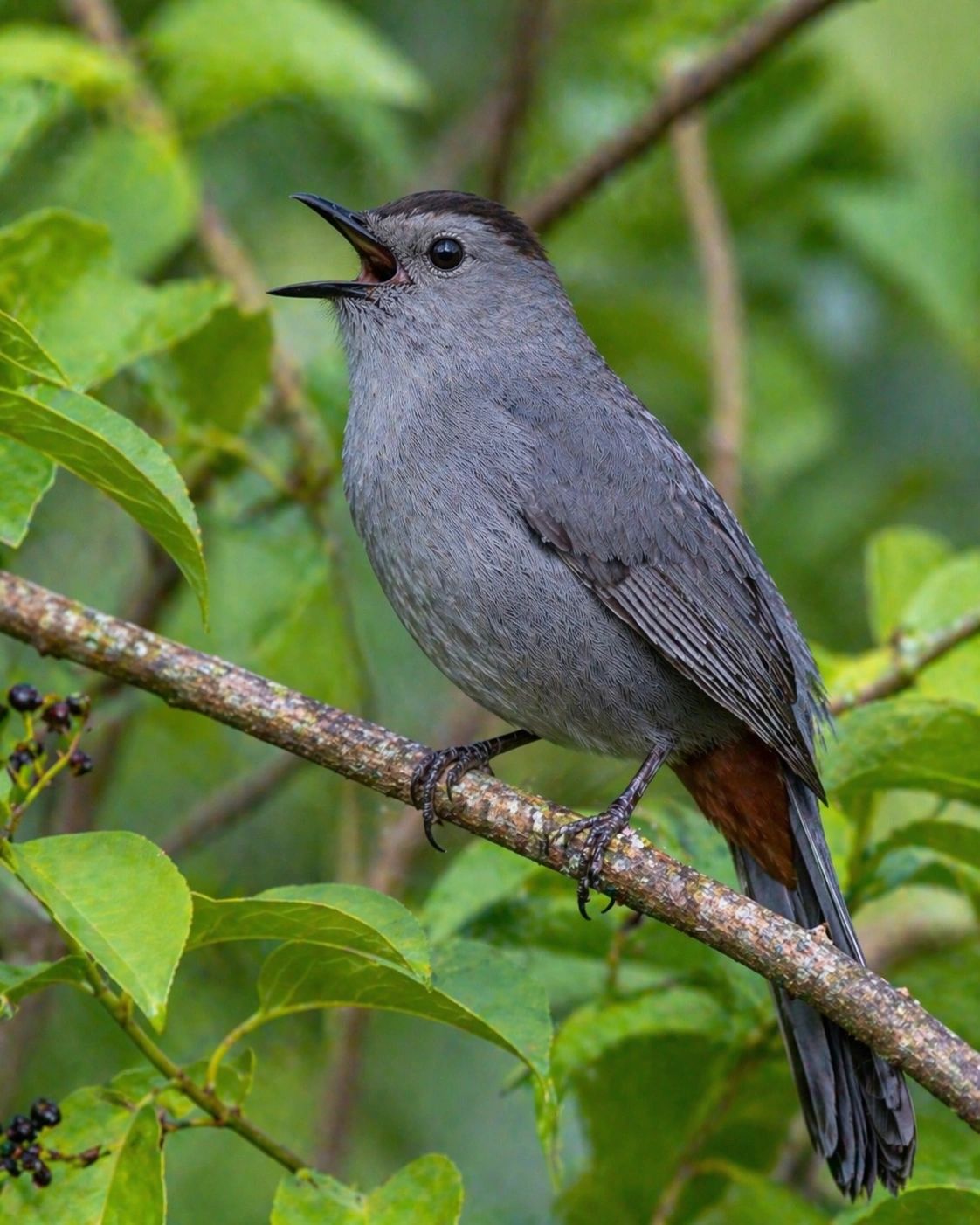
At first glance, the gray catbird doesn’t stand out visually.
Soft gray from head to tail.
A darker cap.
A hint of rust beneath the tail—subtle, almost hidden unless you know to look for it.
It doesn’t rely on color to get your attention.
It relies on sound.
According to the Smithsonian Handbooks: Birds of North America (Eastern Region), the gray catbird’s understated coloration allows it to remain less visible while it moves through dense vegetation.
And that fits perfectly with how it behaves.
A Voice That Doesn’t Stay the Same
The “cat-like” call is only part of the story.
Once I kept listening, something else became clear.
The sound changed.
Short phrases.
Different patterns.
Almost like the bird was trying out new combinations of notes.
That’s because it is.
Gray catbirds are mimics.
According to Smithsonian references, they can imitate the sounds of other birds—and sometimes even environmental noises—blending them into their own unique sequence.
It’s not one call.
It’s many.
A Bird That Feels Like It’s Talking
What makes the catbird stand out isn’t just what it sounds like.
It’s how it sounds.
There’s a rhythm to it that feels almost conversational. Not structured like a songbird’s melody, but broken, varied, and constantly shifting.
It doesn’t feel like a performance.
It feels like expression.
Movement That Matches Its Personality
Watching the catbird move, there’s a confidence to it.
Not bold like a blue jay.
Not calm like a bluebird.
But something in between.
It hops through branches, pauses, flicks its tail slightly, then moves again. It doesn’t stay in one place for long—but it doesn’t disappear completely either.
It keeps you aware of it.
A Bird That Stays Close—but Hidden
The gray catbird often stays within the same general area, especially in yards with dense shrubs or vegetation.
It doesn’t travel far.
But it doesn’t make itself obvious either.
It exists in that middle space—close enough to hear, just hidden enough to keep you searching.
The Moment Merlin Made It Clear
Like the other birds in this series, everything started with that moment.
Before Merlin, the sound didn’t make sense.
After Merlin, it did.
And once it did, everything changed.
The strange became familiar.
The confusing became recognizable.
And the bird became something I could follow—not just once, but every time it returned.
A Different Kind of Presence
The gray catbird doesn’t dominate the space.
It doesn’t rely on color.
It doesn’t stay fully visible.
But it adds something unique.
A sense of unpredictability.
A sound that doesn’t follow the rules.
A presence that feels just a little different from everything else around it.
A Bird That Changes What You Expect
What the gray catbird does best is challenge expectation.
It reminds you that not every bird will sound the way you think it should.
That not every call will match the pattern you’re used to.
And that sometimes, the most interesting things are the ones that don’t quite fit.
Conclusion: The Sound That Makes You Look Twice
The gray catbird is not the brightest bird.
It is not the most visible.
It is not the easiest to identify at first.
But it is one of the most memorable.
Because of that sound.
That strange, unexpected call that makes you stop and question what you’re hearing.
And once you recognize it—once you connect that sound to the bird moving quietly through the shrubs—you realize something simple.
Not everything is meant to sound familiar.
Some things stand out because they don’t.
Bibliography
Cornell Lab of Ornithology. All About Birds: Gray Catbird.
Smithsonian Institution. Smithsonian Handbooks: Birds of North America (Eastern Region).
National Audubon Society. Gray Catbird.
Sibley, David Allen. The Sibley Guide to Birds.
Florida Fish and Wildlife Conservation Commission. Florida Bird Species Information.
Originally published at the live site .