
Maritime ·
The Great Crested Flycatcher: The Voice in the Trees
Some birds are easy to find.
By Rebecca "Madam Chronicler" Ryan
Some birds are easy to find.
They sit out in the open.
They move where you expect them to be.
And once you hear them, you can quickly match the sound to the shape.
But not all birds make it that simple.
Some stay just out of view.
Some make themselves known without ever fully revealing where they are.
The great crested flycatcher is one of those birds.
A Call That Breaks Through the Canopy
The first time I noticed it, I wasn’t looking up.
I was just listening.
A loud, sharp call cut through everything else—clear, rising, almost echoing as it moved through the trees. It didn’t blend into the background like so many other birds.
It stood apart.
A quick, drawn-out sound that felt like it came from somewhere higher than everything else around me.
I stopped.
Listened again.
There it was.
Stronger this time.
Closer.
So I opened the Merlin Bird ID app and let it listen.
Within seconds, it gave me the answer.
Great Crested Flycatcher.
And just from the sound alone, I knew this one would be different.
Looking Higher Than Usual
After identifying it, I did what I had learned to do.
I started looking.
But this time, not at eye level.
Not along the ground or the lower branches.
Higher.
Into the canopy.
That’s where the sound was coming from—somewhere just beyond where it was easy to see.
And that made it harder.
A Bird That Stays Just Out of Reach
The great crested flycatcher doesn’t perch where you expect.
It stays above.
Moving between higher branches, often partially hidden by leaves, just visible enough to confirm it’s there—but not always clear enough to see all at once.
You catch pieces of it.
A shape.
A movement.
A shift in the leaves.
But rarely the full bird immediately.
And that’s what makes it different.
A Flash of Color in the Green
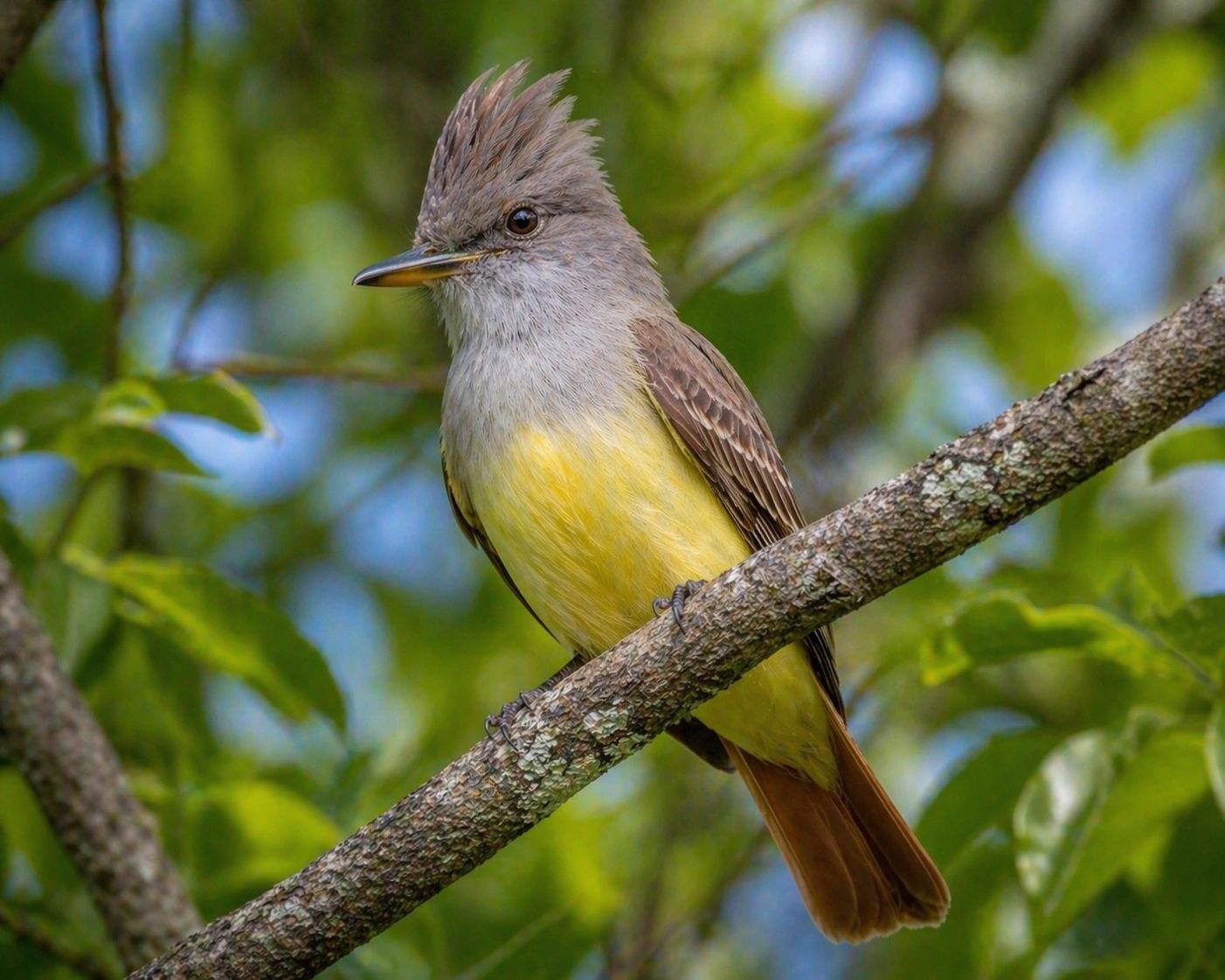
When I finally got a clearer look, the details stood out quickly.
Not bright in the way a goldfinch or bluebird is.
But noticeable once you see it.
A soft gray head.
A pale underside.
And then, something unexpected.
A warm yellow belly that catches the light just enough to stand out against the green around it.
A hint of rust along the tail.
Subtle.
But there.
According to the Smithsonian Handbooks: Birds of North America (Eastern Region), the great crested flycatcher’s coloring blends well with its surroundings while still allowing flashes of color to appear when it moves.
And watching it, that felt exactly right.
Movement That Feels Purposeful
Unlike birds that constantly shift and hop, the flycatcher moves with intention.
It perches.
Waits.
Watches.
Then suddenly, it launches.
A quick, direct flight out into open air, snapping at something invisible from a distance.
Then back.
To the same branch.
The same position.
Almost like nothing happened.
Hunting From Above
This is how the great crested flycatcher lives.
It doesn’t search constantly.
It observes.
According to Smithsonian references, flycatchers hunt insects in midair, using short bursts of flight to catch prey before returning to a perch.
It’s not about covering ground.
It’s about choosing the right moment.
And that’s what makes it feel controlled.
A Voice That Matches Its Presence
The call comes again.
Loud.
Clear.
Almost whistled, but sharper.
Field guides often describe it as a rising, piercing “wheep”, and hearing it in person makes that description feel exact.
It carries.
It cuts through everything else.
And even when you can’t see the bird, you know it’s there.
A Bird That Doesn’t Need to Be Seen
What stood out most wasn’t just how it looked.
It was how little it needed to rely on being visible.
The great crested flycatcher doesn’t sit out in the open.
It doesn’t make itself easy to spot.
It stays just far enough away, just high enough, just hidden enough.
But its voice does the work for it.
A Presence That Moves Through the Trees
Unlike birds that stay in one place, the flycatcher feels like it moves through the canopy.
Not randomly.
But with direction.
From one perch to another.
From one call to the next.
You don’t track it by sight alone.
You follow it by sound.
The Moment Merlin Made It Clear
Like the other birds in this series, everything started with that first moment.
Before Merlin, the sound felt distinct—but unplaced.
After Merlin, it had identity.
And once it had identity, everything became easier to follow.
The movement.
The pattern.
The presence.
A Bird That Changes How You Look Up
What the great crested flycatcher changes most is perspective.
It pulls your attention upward.
Into the canopy.
Into the places where movement is harder to track and visibility is limited.
It reminds you that not everything happens where it’s easiest to see.
Sometimes, you have to adjust where you’re looking.
A Different Kind of Visibility
The flycatcher isn’t hidden.
Not completely.
It just isn’t obvious.
And that creates a different kind of experience—one where you know something is there, but you have to stay with it long enough to really see it.
A Bird That Feels Just Out of Reach
Even after you’ve seen it, there’s still that feeling.
That it’s slightly beyond you.
Not distant.
But not fully accessible either.
And that’s part of what makes it memorable.
Conclusion: The Voice That Leads You Upward
The great crested flycatcher is not the easiest bird to see.
It is not the most obvious presence in the yard.
It doesn’t sit where you expect it to.
But it is one of the most recognizable.
Because of its voice.
Because of the way it draws your attention upward, into spaces you might not have noticed before.
And once you recognize it—once you connect that sharp, rising call with the bird moving just beyond the leaves—you realize something simple.
Some birds don’t come down to meet you.
They make you look up.
Bibliography
Cornell Lab of Ornithology. All About Birds: Great Crested Flycatcher.
Smithsonian Institution. Smithsonian Handbooks: Birds of North America (Eastern Region).
National Audubon Society. Great Crested Flycatcher.
Sibley, David Allen. The Sibley Guide to Birds.
Florida Fish and Wildlife Conservation Commission. Florida Bird Species Information.
Originally published at the live site .