
Maritime ·
The Great Egret: The Stillness That Moves
Some birds are defined by sound.
By Rebecca "Madam Chronicler" Ryan
Some birds are defined by sound.
They call out.
They announce themselves.
They fill the space around them.
But not all birds do that.
Some birds don’t need sound at all.
Some birds are defined by something else.
The great egret is one of those birds.
A Moment That Begins in Silence
The first time I noticed it, there was no sound.
No call.
No movement that immediately drew my attention.
Just stillness.
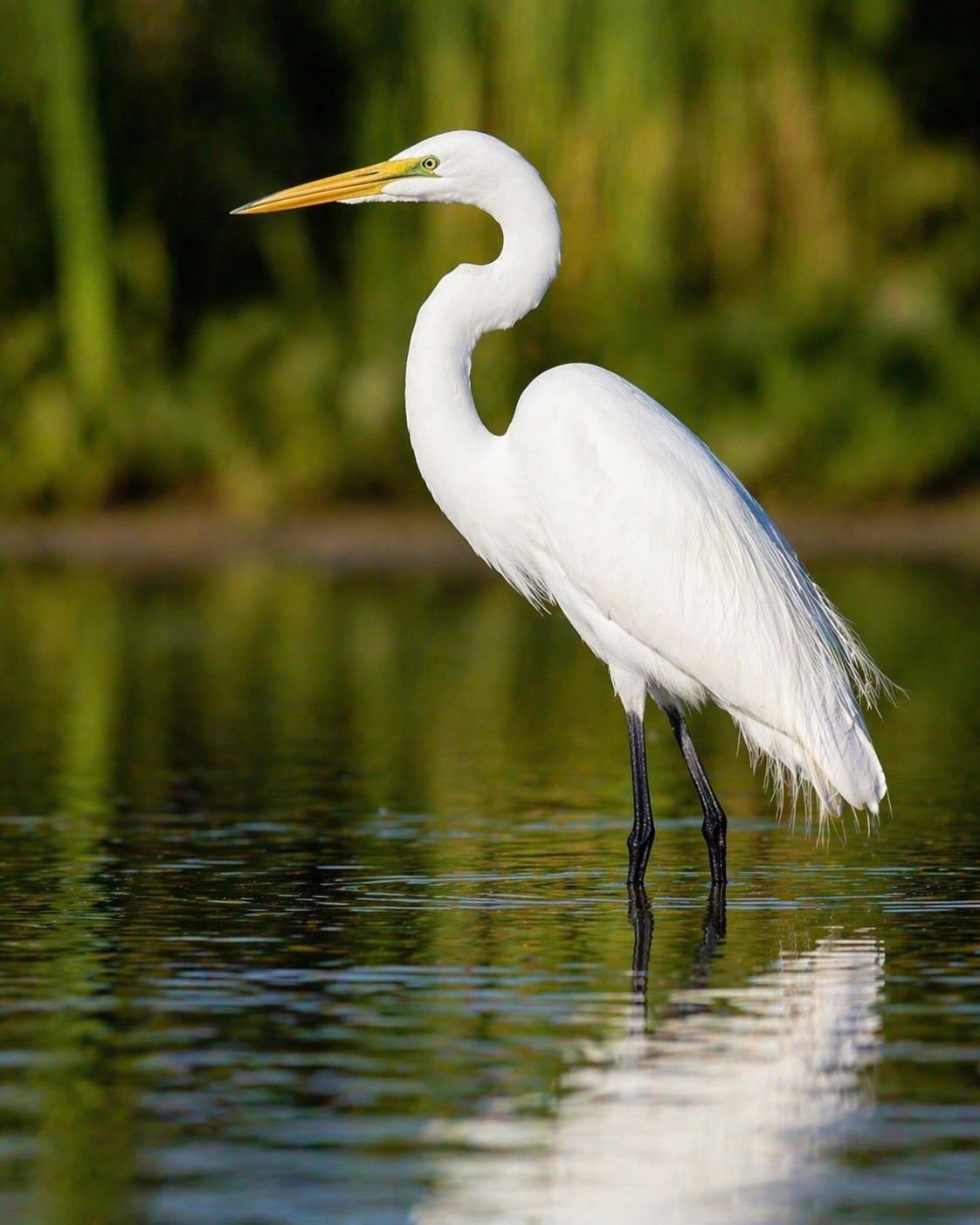
A white shape standing near the water, so motionless that for a moment, it didn’t even register as alive. It blended into the brightness of the shoreline, almost like part of the landscape itself.
If it hadn’t shifted—just slightly—I might have missed it completely.
A Presence That Doesn’t Rush
Once I focused on it, everything about the bird felt different from the others I had been watching.
It didn’t move quickly.
It didn’t adjust constantly.
It stood.
Long legs planted in the shallow water.
Neck slightly curved.
Body balanced in a way that felt steady and controlled.
There was no urgency.
No wasted motion.
A Shape That Feels Intentional
The great egret’s form is simple—but precise.
All white.
Clean.
Unbroken.
A long neck that curves like it’s always in motion, even when it isn’t. A sharp bill that points forward, aligned with its focus.
Every part of it feels designed for exactly what it’s doing.
According to the Smithsonian Handbooks: Birds of North America (Eastern Region), the great egret’s long legs and neck allow it to hunt efficiently in shallow water, striking quickly when the moment is right.
And watching it, that purpose becomes clear.
Movement That Comes All at Once
For a long time, nothing happened.
And then everything did.
In a single motion, the egret’s neck extended forward, its bill cutting through the water with precision. A quick strike.
Then stillness again.
The movement was fast.
Controlled.
Gone as quickly as it appeared.
It wasn’t constant.
It didn’t repeat unnecessarily.
It happened only when it needed to.
Hunting Through Patience
This is how the great egret works.
Not through constant searching.
But through waiting.
It watches the water.
Tracks subtle movement.
And then, when the moment is right, it acts.
According to Smithsonian references, great egrets feed on fish, amphibians, and small aquatic animals, relying on patience and timing rather than speed.
It doesn’t chase.
It waits.
A Bird That Becomes the Landscape
What stood out most wasn’t just the movement.
It was how easily the egret became part of its surroundings.
The white against the water.
The reflection beneath it.
The stillness that made it feel like it belonged there completely.
It didn’t disrupt the space.
It completed it.
A Presence That Feels Calm
There’s something about the great egret that changes how you experience the moment.
It slows everything down.
It shifts your attention from constant motion to quiet observation.
From looking for something to happen…
To noticing what already is.
A Bird That Doesn’t Need Sound
Unlike many birds in this series, the great egret doesn’t rely on its voice.
It doesn’t need to call out.
It doesn’t need to announce itself.
Its presence is enough.
Its movement—when it happens—is enough.
The Moment You Realize It Was There All Along
Like some of the other birds you’ve written about, there’s a moment of recognition.
But this one feels different.
It’s not about identifying a sound.
It’s about realizing that something has been there the entire time…
And you just hadn’t fully seen it yet.
A Different Kind of Awareness
The great egret changes how you observe.
It teaches you to wait.
To be still.
To notice what doesn’t move before noticing what does.
And that changes everything about how you experience the space around you.
A Bird That Redefines Movement
Most birds are defined by how often they move.
The egret is defined by how little it needs to.
And because of that, every movement matters more.
Every shift stands out.
Every action feels intentional.
Conclusion: The Stillness That Moves
The great egret is not the loudest bird.
It is not the most active.
It does not fill the space with sound or constant motion.
But it is one of the most striking.
Because of its stillness.
Because of its precision.
Because of the way it changes the moment without needing to do very much at all.
And once you notice it—once you understand how it moves, how it waits, how it exists within its environment—you realize something simple.
Not everything needs to move constantly to be seen.
Sometimes…
Stillness is enough.
Bibliography
Cornell Lab of Ornithology. All About Birds: Great Egret.
Smithsonian Institution. Smithsonian Handbooks: Birds of North America (Eastern Region).
National Audubon Society. Great Egret.
Sibley, David Allen. The Sibley Guide to Birds.
Florida Fish and Wildlife Conservation Commission. Florida Bird Species Information.
Originally published at the live site .