
Maritime ·
The Greater Yellowlegs: The Watchful Voice of Florida’s Wetlands
After the louder, more familiar voices of the backyard birds had begun to settle into a rhythm that morning, a different kind of sound cut through the air.
By Rebecca "Madam Chronicler" Ryan
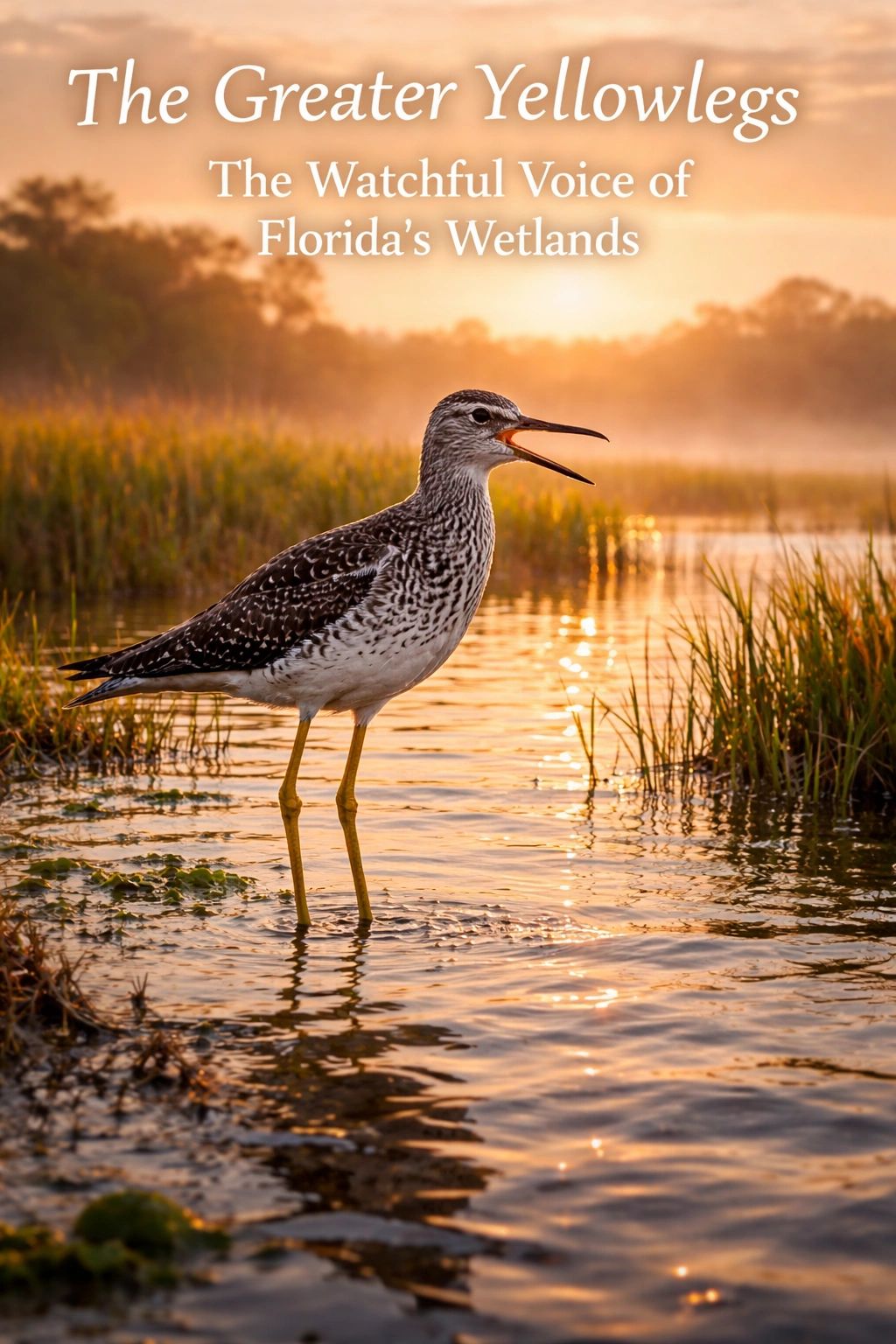
After the louder, more familiar voices of the backyard birds had begun to settle into a rhythm that morning, a different kind of sound cut through the air.
It came from farther away.
Sharp. Clear. Urgent.
It didn’t blend with the others. It stood apart, echoing across the distance in a way that made it feel almost like a warning.
I paused for a moment, trying to place it. The sound wasn’t coming from the trees or the nearby shrubs. It felt more open, more exposed, like it belonged to a space beyond the yard.
When I checked the Merlin Bird ID app, the answer appeared.
Greater Yellowlegs.
A Voice From the Water
Unlike the other birds identified that morning, the Greater Yellowlegs wasn’t a backyard regular.
Its call carried from somewhere beyond the immediate space, likely from a nearby wetland or the edges of the lagoon. There was something unmistakable about the tone of it. It wasn’t a song meant to be enjoyed in the same way as a cardinal’s whistle or a robin’s melody.
It was sharper than that.
More direct.
Often described as a three-note whistle, the call of the Greater Yellowlegs has an urgency to it. It is frequently used as an alarm, a way of signaling that something in the environment has changed.
Listening to it, there is a sense that the bird is not just communicating, but reacting.
Seeing the Greater Yellowlegs
Unlike the bright colors of a cardinal or the bold presence of a grackle, the Greater Yellowlegs is more subtle in appearance.
It is tall and slender, with long legs that immediately stand out. Those legs, a pale yellow that gives the bird its name, are its most defining feature. They lift the bird above the shallow water where it spends much of its time, allowing it to move with ease through its environment.
Its body is a mix of soft grays and whites, a pattern that helps it blend into the reflective surfaces of wetlands and tidal flats. At a distance, it can be difficult to spot, especially when it remains still.
But when it moves, it becomes easier to see.
There is a graceful quality to the way it walks, each step deliberate, each motion controlled.
A Life in the Shallows
The Greater Yellowlegs is a bird of water and open space.
It is most often found in wetlands, marshes, tidal flats, and the edges of lagoons. These environments provide the shallow water it needs to feed, as well as the visibility required to detect both prey and potential threats.
Watching one forage, there is a rhythm to its behavior. It moves through the water with careful steps, pausing occasionally before making a quick strike.
Its diet consists of small fish, insects, crustaceans, and other aquatic organisms. The long bill allows it to probe and snap at prey with precision, while its height gives it an advantage in deeper water compared to smaller shorebirds.
A Traveler Passing Through
Unlike the cardinal or mockingbird, the Greater Yellowlegs is not a permanent resident.
It is a migratory bird, moving between breeding grounds in northern North America and wintering areas farther south. Florida serves as an important stop along this journey, providing both food and habitat during migration and the winter months.
This means that its presence is temporary.
Hearing it that morning was not just a routine occurrence. It was part of a larger movement, a pattern that stretches across continents.
There is something different about encountering a migratory bird.
It carries with it a sense of distance, of travel, of places far beyond the immediate environment.
The Role of the Call
The sharp whistle of the Greater Yellowlegs is not just distinctive. It is functional.
In open environments like wetlands, sound travels easily. A clear, loud call allows the bird to communicate over long distances, whether it is alerting others to danger or maintaining contact with other members of its species.
When disturbed, Greater Yellowlegs often take flight while calling repeatedly, their voices carrying across the landscape as they move.
This behavior creates a ripple effect, as other birds respond to the signal, adding to the overall sense of activity in the area.
A Watchful Presence
There is a constant awareness in the behavior of the Greater Yellowlegs.
Its posture is upright, its movements controlled, its attention focused. Even while feeding, it remains alert, scanning its surroundings for any sign of danger.
This watchfulness is essential in open habitats, where cover is limited and threats can approach from any direction.
The bird’s call reflects this awareness.
It is not a relaxed or decorative sound. It is purposeful, shaped by the need to respond quickly to changes in the environment.
A Bird Easy to Overlook
Despite its size and distinctive features, the Greater Yellowlegs is often overlooked.
Part of this is due to its habitat. Wetlands and marshes are not always as accessible or familiar as backyards and neighborhoods. Many people simply don’t spend enough time in these environments to notice the species that live there.
But another reason is its subtlety.
It does not have the bright colors of more recognizable birds. It does not sing in a way that draws immediate attention. Its presence is quieter, more integrated into the landscape.
And yet, once you become aware of it, it is hard to miss.
Returning to That Morning
Standing in the backyard, listening to Merlin identify birds one after another, the Greater Yellowlegs felt like a connection to something beyond the immediate space.
It was a reminder that the environment does not end at the edge of the yard.
The call carried from somewhere unseen, linking the backyard to the nearby wetlands, to the lagoon, to a broader ecosystem that extends far beyond what is visible.
It added depth to the experience.
It made the moment feel larger.
The Importance of Wetland Birds
Birds like the Greater Yellowlegs play an important role in their ecosystems.
They help maintain balance within aquatic environments by feeding on a variety of small organisms. They also serve as indicators of environmental health, their presence reflecting the condition of the habitats they depend on.
When wetlands are healthy, species like the Greater Yellowlegs thrive.
When those habitats are lost or degraded, their numbers can decline.
In this way, the bird becomes more than just a species. It becomes a signal, a reflection of the state of the environment.
A Different Kind of Beauty
The beauty of the Greater Yellowlegs is not immediately obvious.
It does not rely on bright colors or elaborate songs. Instead, its appeal lies in its form, its movement, and its connection to its habitat.
There is a quiet elegance in the way it moves through the water, a simplicity in its design that feels perfectly suited to its environment.
Watching it, or even just hearing its call, creates a sense of stillness and space that is different from the more active energy of backyard birds.
Conclusion: A Voice From Beyond the Yard
That morning, the Greater Yellowlegs was not the closest bird, nor the easiest to see.
But it was one of the most memorable.
Its call carried across the distance, cutting through the layers of sound and connecting the backyard to the wider landscape.
It reminded me that even when we think we are observing a small, contained space, we are actually part of something much larger.
The Greater Yellowlegs may not always be visible.
But once you hear its voice, you know it’s there.
And you begin to understand just how far the world around you really extends.
Bibliography
Cornell Lab of Ornithology. All About Birds: Greater Yellowlegs.
Cornell Lab of Ornithology. Merlin Bird ID App. Cornell University.
National Audubon Society. Greater Yellowlegs.
Sibley, David Allen. The Sibley Guide to Birds. Alfred A. Knopf.
Florida Fish and Wildlife Conservation Commission. Florida Bird Species Information.
Originally published at the live site .