
Maritime ·
The House Finch: The Bird That Brings Color to the Ordinary
Some birds stand out immediately.
By Rebecca "Madam Chronicler" Ryan
Some birds stand out immediately.
Bright colors.
Bold movements.
Loud calls that demand attention.
But some birds don’t need to do any of that.
They become noticeable in a different way.
By being there.
By returning.
By slowly becoming part of the everyday.
The house finch is one of those birds.
A Sound That Blends Before It Stands Out
The first time I noticed it, I almost didn’t.
The sound was there, but it didn’t interrupt anything. It didn’t cut through the air the way a killdeer does or repeat with the urgency of a wren.
It flowed.
A soft, warbling series of notes that felt like it belonged in the background.
Not hidden.
Just… woven into everything else.
I paused, listening more closely this time, letting the sound repeat.
It wasn’t simple.
It wasn’t just one pattern.
It shifted slightly, rising and falling in a way that felt almost improvised.
So I opened the Merlin Bird ID app and let it listen.
Within seconds, it gave me the answer.
House Finch.
And just like that, the background became something specific.
Looking Where You Normally Wouldn’t
Unlike some of the other birds I had been following, the house finch wasn’t deep in the trees or far out of reach.
It was closer.
Much closer.
Perched on something ordinary—a fence, a rooftop edge, maybe even a nearby structure that I had passed by without thinking about before.
That’s what made it easy to overlook.
It didn’t place itself somewhere dramatic.
It stayed where everyday life already existed.
A Flash of Color in the Familiar
At first glance, the bird didn’t seem overly striking.
Small.
Compact.
A soft mix of browns and streaks across its body.
But then, as the light shifted, something else appeared.
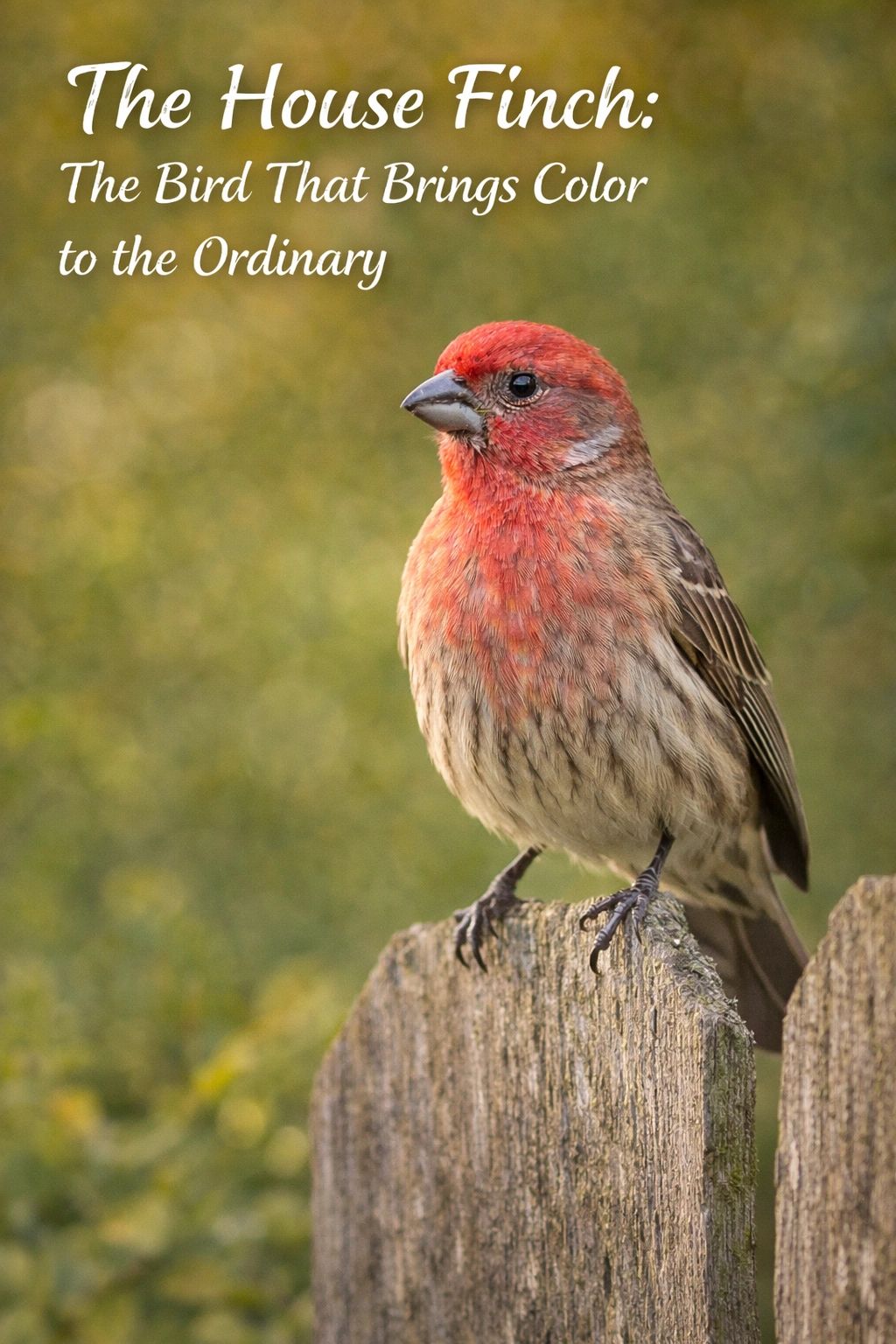
A wash of red.
Around the head.
Across the chest.
Not bright in a sharp, dramatic way—but warm, almost blended into the rest of its coloring.
According to the Smithsonian Handbooks: Birds of North America (Eastern Region), male house finches develop this red coloration based on their diet, with variations ranging from red to orange or even yellow.
And that made it feel even more unique.
Not just color.
But variation.
Movement That Feels Comfortable
The house finch doesn’t move with urgency.
It doesn’t dart constantly or stay completely still.
It shifts.
Adjusts.
Flies short distances, then settles again.
There’s a comfort to it.
A sense that it belongs exactly where it is.
A Song That Feels Continuous
The more I listened, the more the song stood out.
Not because it was loud.
But because it continued.
A steady, flowing series of notes that filled the space without overwhelming it.
Field guides describe the house finch’s song as a rich, warbling melody, and hearing it in person makes that description feel accurate.
It doesn’t repeat the same phrase over and over.
It evolves.
A Bird That Lives Alongside You
What makes the house finch different from many birds in this series is how closely it lives alongside people.
It doesn’t just visit.
It stays.
It nests on ledges, in vents, on structures that are part of everyday life. It builds its home in places that are already being used.
According to Smithsonian references, house finches have adapted extremely well to human environments, expanding their range by living in close proximity to people.
And once you notice them, they’re everywhere.
Feeding in Plain Sight
Watching the house finch feed reveals another layer of its behavior.
It doesn’t hide.
It doesn’t move far away.
It feeds openly—on seeds, small plant material, sometimes at feeders if they’re available.
It stays visible.
And that visibility makes it easier to observe over time.
A Familiar Presence That Grows Over Time
The more I noticed the house finch, the more it felt like it had always been there.
Not because it was hidden.
But because it didn’t demand attention.
It blended into the everyday environment so naturally that it became part of the background—until I stopped and focused on it.
The Moment Merlin Made It Clear
Like the other birds in this series, everything began with that moment of recognition.
Before Merlin, the song was just part of the atmosphere.
After Merlin, it became something I could identify.
Something I could follow.
Something I could expect.
A Different Kind of Beauty
The house finch doesn’t rely on bold contrast or dramatic movement.
Its beauty is quieter.
More subtle.
It reveals itself over time, through repetition, through familiarity, through small details that become more noticeable the longer you pay attention.
A Bird That Changes the Ordinary
What makes the house finch stand out isn’t just how it looks or sounds.
It’s where it is.
It takes places that feel ordinary—fences, rooftops, edges of buildings—and adds something to them.
Color.
Sound.
Movement.
And suddenly, those places don’t feel quite as ordinary anymore.
Conclusion: The Color You Almost Missed
The house finch is not the loudest bird.
It is not the most dramatic.
It is not the hardest to find.
But it is one of the easiest to overlook.
And once you recognize it—once you connect that soft, flowing song with the small bird perched in plain sight—you realize something simple.
Not all beauty stands out immediately.
Some of it waits.
Until you’re paying attention.
Bibliography
Cornell Lab of Ornithology. All About Birds: House Finch.
Smithsonian Institution. Smithsonian Handbooks: Birds of North America (Eastern Region).
National Audubon Society. House Finch.
Sibley, David Allen. The Sibley Guide to Birds.
Florida Fish and Wildlife Conservation Commission. Florida Bird Species Information.
Originally published at the live site .