Rivers ·
The Importance of the Indian River and Its Lagoons
The sun rises slowly over Florida’s east coast, casting golden light on the calm waters of the Indian River Lagoon. A fisherman launches his skiff from a sandy bank in Titusville, the smell of salt and seagrass thick in ...
By Rebecca "Madam Chronicler" Ryan
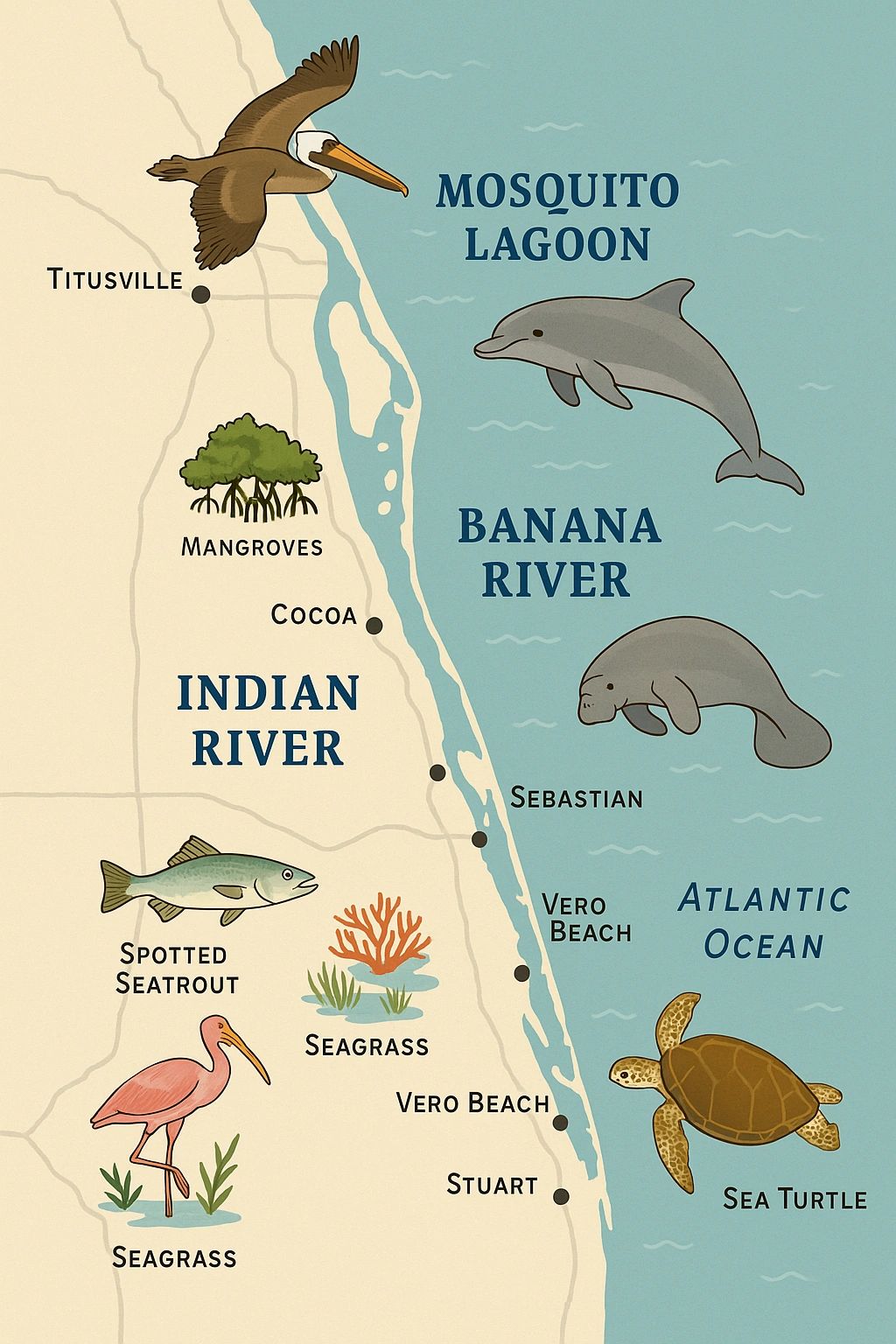
The sun rises slowly over Florida’s east coast, casting golden light on the calm waters of the Indian River Lagoon. A fisherman launches his skiff from a sandy bank in Titusville, the smell of salt and seagrass thick in the air. Dolphins surface in the distance, pelicans dive headfirst into schools of mullet, and manatees glide quietly through the shallows.
This isn’t just any body of water—it’s the Indian River Lagoon (IRL), a place many call the Amazon of North America for its incredible diversity of life. Stretching 156 miles from Volusia County down to Palm Beach County, the IRL is made up of three connected lagoons: Mosquito Lagoon, the Banana River, and the Indian River itself. Together, they form one of the most biodiverse estuaries in the United States.
But to truly understand why the Indian River and its lagoons matter, we need to step into the lives of those who depend on them: the fisherman, the student, the manatee, and the community. Their stories reveal why these waters are so precious—and why their future hangs in the balance.
A Fisherman’s Dawn: The Economic Lifeline
On that early morning in Titusville, Captain José Alvarez pulls a cast net from the deck of his skiff. He’s been fishing these waters for more than thirty years, supplying mullet to local markets and taking visitors on eco-tours.
“The lagoon has always been my bread and butter,” he says, hauling in a wriggling catch. “It’s not just fishing. It’s the way the lagoon feeds everything—from the birds overhead to the families who eat what we catch.”
He’s right. The IRL supports a multibillion-dollar economy. Commercial fishing brings in species like blue crab, clams, and mullet, while recreational anglers travel from all over the world for redfish, snook, and tarpon. Ecotourism—boat tours, kayaking, birdwatching—also flourishes here. Altogether, the IRL is estimated to contribute more than $7.6 billion annually to Florida’s economy.
For fishermen like José, the lagoon is not only a livelihood but a heritage. His grandfather fished these waters, and he hopes his grandchildren will too. But he admits it’s getting harder. “The fish are still here,” he says, “but the water isn’t what it used to be. We lose seagrass, we lose fish. It’s all connected.”
A Living Amazon: The Biodiversity of the Lagoon
What José sees every day is backed up by science. The IRL is one of the most biodiverse estuaries in North America. More than 4,300 species of plants and animals call it home. That includes:
- 700 fish species like spotted seatrout, tarpon, and sheepshead.
- 310 bird species, from roseate spoonbills to bald eagles.
- 2,100 plant species, including five types of mangroves and extensive seagrass beds.
- Threatened and endangered species, such as manatees, sea turtles, and smalltooth sawfish.
The lagoon’s seagrass meadows are especially important. They act as nurseries for fish and invertebrates, stabilize sediment, and filter water. Seagrass also captures carbon, helping to regulate climate. Unfortunately, since 2009, the lagoon has lost more than 58% of its seagrass cover due to pollution and algal blooms.
Still, when healthy, the lagoon is a symphony of life. Step into its shallow waters on a summer evening, and you might see something magical: bioluminescent plankton lighting up with every splash of your paddle. It’s a reminder of just how alive this ecosystem truly is.
A Student’s Project: Learning from the Lagoon
At a middle school in Melbourne, 13-year-old Maya Lopez carefully lowers a water sample into a test kit. Her science class is part of a citizen science program that monitors the health of the IRL.
“I didn’t know the water could change so much,” Maya says, recording pH and nitrogen levels. “Some days it’s really clear, and other days it’s green and murky. We learned that’s because of algae.”
Programs like these are teaching the next generation about the lagoon’s challenges. Students measure nutrients, track seagrass, and even help plant oyster reefs. They’re learning that pollution from fertilizer, leaking septic tanks, and stormwater runoff doesn’t just vanish—it ends up in the lagoon.
For Maya, the project was eye-opening. “We went kayaking, and I saw a dolphin come up right next to me. It felt like the lagoon was saying, ‘Take care of me.’”
The Manatee’s Struggle: A Symbol of Fragility
Perhaps no animal represents the IRL more than the Florida manatee. These gentle giants depend on seagrass for food, grazing for hours each day in shallow waters. In winter, hundreds gather in the warm-water refuges along the lagoon.
But recently, the manatee has become a heartbreaking symbol of the lagoon’s decline. With seagrass disappearing, manatees have starved in alarming numbers. In 2021 and 2022, record deaths were recorded, forcing wildlife officials to attempt emergency feedings of romaine lettuce.
Marine biologist Dr. Karen Wolfe explains, “Manatees are telling us something is deeply wrong. If the lagoon can’t support them, it’s failing many other species too.”
Yet there’s hope. Restoration projects are replanting seagrass and reducing nutrient pollution. Volunteers rescue sick manatees, nurse them back to health, and release them into the lagoon. Each rescue is a reminder that humans can also be caretakers of this fragile ecosystem.
Environmental Challenges: A Lagoon in Peril
The Indian River Lagoon is rich in life, but it is also on the edge. Its main challenges include:
- Nutrient Pollution: Runoff from fertilizers, wastewater, and urban development overloads the lagoon with nitrogen and phosphorus. This sparks algal blooms that cloud the water and smother seagrasses.
- Algal Blooms: The infamous 2011 “superbloom” lasted months and wiped out over 30,000 acres of seagrass. Since then, smaller but frequent blooms have continued.
- Fish Kills: When algae die, they deplete oxygen, suffocating fish. In 2016, tens of thousands of fish floated to the surface, shocking residents.
- Habitat Loss: Mangroves and wetlands, once natural filters, have been destroyed by development.
- Climate Change: Sea level rise, stronger hurricanes, and warming waters threaten to permanently alter the lagoon’s delicate balance.
These challenges are not abstract—they affect daily life. For fishermen, fewer fish means fewer catches. For boaters, murky water replaces once-clear channels. For wildlife, every algal bloom is a fight for survival.
The Lagoon as a Climate Ally
There’s another side to the IRL’s story that stretches beyond Florida: its role in climate regulation. Seagrasses, mangroves, and salt marshes are “blue carbon” ecosystems, which capture and store carbon dioxide. They sequester carbon up to four times faster than rainforests, locking it into the soil for centuries.
Protecting these habitats is not only about saving dolphins or oysters—it’s about fighting global climate change. Every acre of restored seagrass or mangrove is a natural tool in our climate defense.
Community Action: People Fighting for the Lagoon
Despite the challenges, the story of the IRL is not one of despair—it’s one of resilience and action. Across the six counties that border the lagoon, people are coming together to make a difference.
- Indian River Lagoon National Estuary Program (IRLNEP) coordinates restoration across the entire region.
- Living Shorelines Projects replace seawalls with oyster reefs and mangroves, providing natural storm protection.
- Seagrass Transplants are being planted by scientists and volunteers to jump-start recovery.
- Stormwater Retrofits are reducing nutrient runoff from neighborhoods.
- Citizen Scientists—from schoolchildren to retirees—are monitoring water quality and raising awareness.
On weekends, you’ll often see groups of volunteers along the shorelines, wearing gloves and boots, planting oyster shells or mangroves. These community-driven efforts show that the lagoon’s future is tied to the people who love it.
Why the IRL Matters to All of Us
The Indian River and its lagoons may seem like a local treasure, but their importance reaches far wider. They’re part of the fight against global biodiversity loss and climate change. They connect culture, economy, and ecology. They remind us that water is not just a resource—it’s a lifeline.
Protecting the IRL means safeguarding cultural heritage, supporting local economies, and preserving one of the richest ecosystems on Earth.
Conclusion: A Call to Care
As the sun sets over the lagoon, dolphins leap in the distance and the fisherman heads home with his catch. In a classroom, Maya finishes her science report, proud to have measured the health of her local waters. At a rescue center, a rehabilitated manatee is released back into the lagoon, greeted by cheers from the crowd.
These stories remind us that the Indian River Lagoon is more than just a body of water. It is a living system that supports thousands of species, inspires human communities, and even helps regulate the Earth’s climate. But it is fragile—and it needs our care.
Every choice we make, from reducing fertilizer use to supporting restoration programs, can help ensure the IRL thrives for generations to come.
The next time you stand along its banks and watch the tide shift with the moon, remember: the health of the Indian River Lagoon is the health of us all.
Bibliography
East Central Florida Regional Planning Council. (2016). Economic valuation of the Indian River Lagoon. IRLNEP Technical Report.
Fourqurean, J. W., Duarte, C. M., Kennedy, H., et al. (2012). Seagrass ecosystems as globally significant carbon stocks. Nature Geoscience, 5(7), 505–509. https://doi.org/10.1038/ngeo1477
Gilmore, R. G. (2016). Fish, crustaceans, and mollusks of the Indian River Lagoon: An annotated review. Florida Scientist, 79(4), 196–230.
Grabowski, J. H., Brumbaugh, R. D., & Conrad, R. F. (2012). Ecosystem services of oyster reefs: Enhancing biodiversity, water quality, and coastal protection. Bioscience, 62(10), 900–909. https://doi.org/10.1525/bio.2012.62.10.10
Lapointe, B. E., Herren, L. W., & Bedford, B. J. (2012). Effects of nutrient enrichment on algal blooms and seagrass decline in the Indian River Lagoon. Harmful Algae, 17, 58–69. https://doi.org/10.1016/j.hal.2012.03.002
Morris, L. J., & Hall, M. O. (2020). Seagrass status and trends in the Indian River Lagoon. Aquatic Botany, 167, 103276. https://doi.org/10.1016/j.aquabot.2020.103276
Obeysekera, J., Park, J., & Irizarry-Ortiz, M. (2019). Climate change impacts on sea level and storm surge in Florida estuaries. Climatic Change, 152(2), 203–218. https://doi.org/10.1007/s10584-018-2310-3
Phlips, E. J., Badylak, S., & Lasi, M. A. (2015). Phytoplankton dynamics in the Indian River Lagoon, Florida: The 2011 super bloom. Harmful Algae, 43, 82–96. https://doi.org/10.1016/j.hal.2015.01.004
Schaefer, J., & Frazier, M. (2021). Biodiversity of the Indian River Lagoon: An updated review. Estuaries and Coasts, 44(6), 1565–1579. https://doi.org/10.1007/s12237-020-00889-7
Stith, B. M., & Ward-Geiger, L. I. (2022). Unprecedented mortality of Florida manatees linked to seagrass loss in the Indian River Lagoon. Frontiers in Marine Science, 9, 849234. https://doi.org/10.3389/fmars.2022.849234
Trefry, J. H., Chen, N., & John, C. V. (2017). Transport and fate of materials in the Indian River Lagoon, Florida. Marine Pollution Bulletin, 121(1–2), 36–44. https://doi.org/10.1016/j.marpolbul.2017.05.062
Originally published at the live site .