
Maritime ·
The Lost Diver and the Tiger Shark Below
A Deep Sea Tale of Survival, Science, and One of the Ocean’s Most Feared Predators
By Rebecca "Madam Chronicler" Ryan
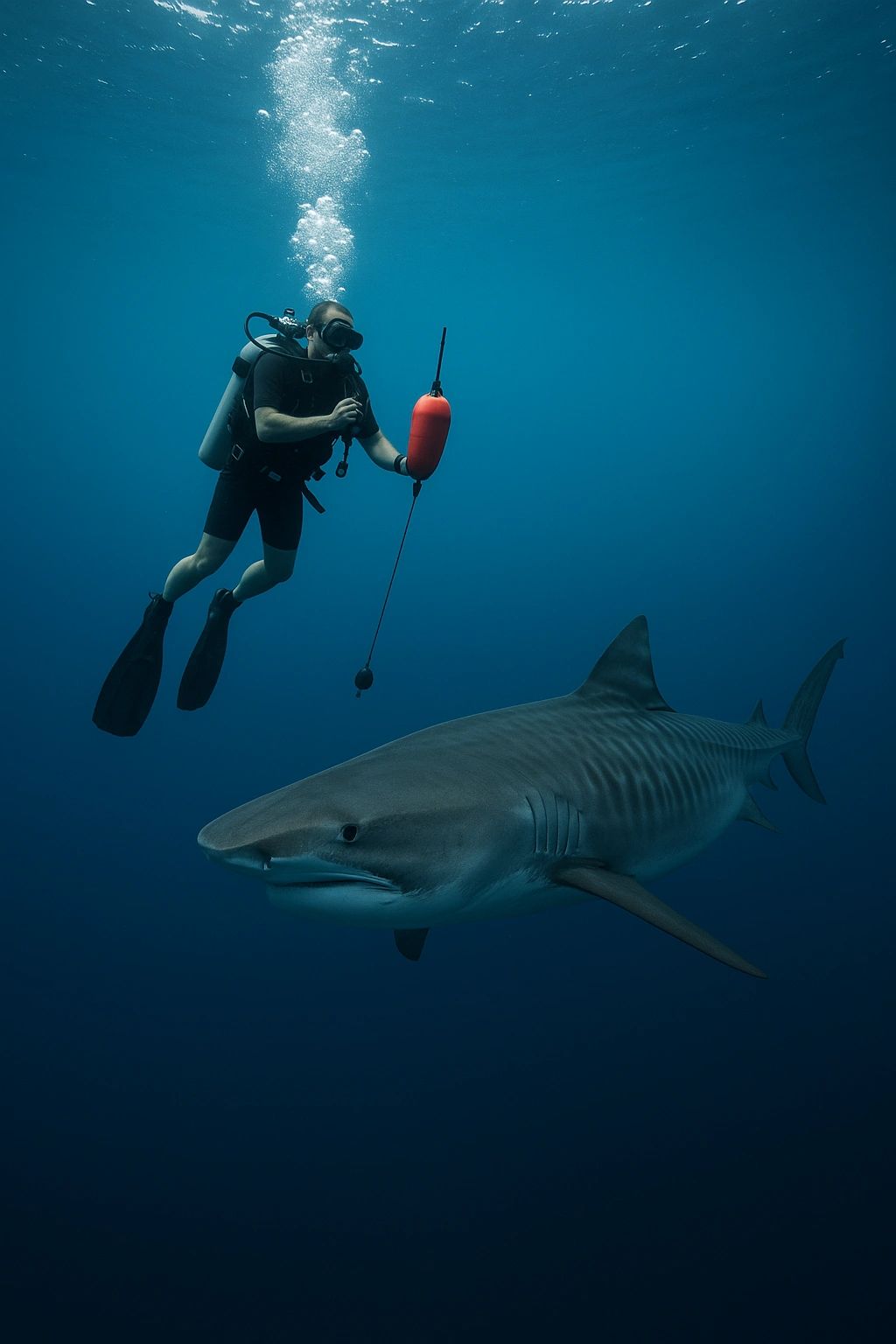
A Deep Sea Tale of Survival, Science, and One of the Ocean’s Most Feared PredatorsIt began with a splash.
Under the bright Hawaiian sun, diver Mark Halvorsen slipped beneath the surface of the Pacific Ocean. This was supposed to be a normal dive—just another day exploring the coral-rich lava tubes off the coast of Maui. With his gear secure, GoPro rolling, and oxygen tank topped off, Mark was ready to do what he loved most: study the mysteries of the deep.
But within the hour, everything would change.
Currents would shift. Visibility would vanish. And below him, something large and striped would start circling.
That something was a tiger shark.
Into the Blue: A Diver’s Descent
Mark wasn’t new to diving. He was a 38-year-old marine biologist with more than 1,200 dives under his belt. He’d explored reefs across the Bahamas, Australia, and his home state of Hawaii. On this particular dive, he was after a patch of rare lavender coral known to grow near a submerged lava tube about 100 feet below the surface.
At around 75 feet, he found what he was looking for. The coral glowed like something out of a dream—violet fans and delicate branches clinging to the black volcanic rock. He began taking photos, documenting their formation and health.
But then the current shifted.
It started slowly, a tug on his fins. Then it strengthened. Before long, it was clear that the tide had changed direction and speed. By the time Mark began his ascent, visibility had dropped significantly. His compass spun strangely, and his GPS stopped receiving a signal.
He was lost.
The Shadow Approaches: A Tiger Shark Appears
As Mark hovered in place trying to regain orientation, he felt that unmistakable sensation divers often describe—like being watched. Turning in slow circles with his flashlight sweeping the murk, he spotted it.
The stripes were unmistakable.
A tiger shark was gliding just at the edge of his light. It was around 12 feet long, strong and sleek, moving slowly but with purpose. Unlike some sharks that swim by and disappear, this one stayed. It circled. It watched.
Tiger sharks are top predators in tropical oceans. With their distinctive dark vertical stripes and massive size—often reaching over 16 feet in length—they command attention. Their diet is one of the most diverse of any shark species: fish, rays, turtles, seabirds, dolphins, even sea snakes. They’re sometimes called the “garbage cans of the sea” because they’re known to sample almost anything they come across.
But their curiosity is calculated, not random. And Mark knew he was now part of the shark’s world.
A Predator’s Approach
Mark knew he had to stay calm. One of the first things you learn as a diver is that panicking underwater is the worst thing you can do. He kept his body as still as possible, maintained eye contact, and kept his fins pointed at the shark—never his hands.
The tiger shark passed within ten feet. Then it disappeared into the blue.
Mark tried to ascend slowly, following safety protocol to avoid decompression sickness. But before long, the shark returned—this time, even closer.
Then it bumped him.
This kind of behavior, known as a “test bump,” is how tiger sharks investigate potential prey—or just unfamiliar objects. It doesn’t always lead to a bite, but it’s a serious warning that the shark is very interested in what it’s found.
Mark understood the risk. But he also knew that sharks aren’t mindless killers. They’re cautious hunters, driven by instincts and curiosity.
Still, this was no place to stay for long.
Sending the Signal
Realizing he was drifting further from his dive site and running low on options, Mark activated his emergency surface beacon. This bright orange device sends out a GPS signal to alert rescue teams of a diver in distress.
Back on land, the dive boat had already noticed his delay. When his signal was received, the crew jumped into action.
It took them 43 minutes to reach him.
Mark spent 31 of those minutes alone with the tiger shark.
Tiger Sharks: Fact vs. Fear
Let’s pause for a moment. Sharks often get a bad reputation—especially tiger sharks, which are responsible for more incidents with humans in tropical regions like Hawaii than almost any other species. But the reality is, shark attacks are extremely rare.
Globally, only a few dozen unprovoked shark bites happen each year, and only a handful are fatal. You’re far more likely to be struck by lightning or injured by fireworks than to be bitten by a shark.
That said, tiger sharks do show up close to shorelines, river mouths, and reefs—places where people swim, surf, and dive. That’s one reason they come into contact with humans more often.
Still, they aren’t aggressive without cause. They investigate. They observe. And many encounters end without a single bite.
Mark’s story is living proof of that.
The Rescue
As the boat approached the GPS coordinates, the crew spotted Mark’s beacon bobbing just beneath the waves. What they also saw was a shadow moving below him—the shark was still there.
A rescue diver jumped into the water, making noise to distract the predator. The tiger shark circled once more and then, as quickly as it had appeared, vanished.
Mark was pulled onto the deck, weak, sunburned, and thirsty—but alive.
The Aftermath
What Mark didn’t realize until later was that his GoPro had recorded nearly the entire experience—including multiple passes by the tiger shark. The footage captured a rare and extended interaction with one of the ocean’s top predators.
Marine biologists from around the world requested copies of the video to study shark behavior. What stood out most was how calm the encounter remained. The shark never attacked. It never lunged. It simply stayed close, observed, and left.
Mark used the attention to launch an ocean safety campaign. He began giving talks on shark behavior, ocean survival, and how education can replace fear. His message is simple but powerful: Respect the ocean, and you can coexist with its most powerful inhabitants.
Why Tiger Sharks Matter
Tiger sharks are incredibly important to the health of our oceans. As apex predators, they keep marine ecosystems in balance. They help control populations of species like sea turtles, rays, and even other sharks.
By maintaining this balance, tiger sharks play a role in protecting coral reefs and the animals that depend on them. They even help regulate the carbon cycle, indirectly influencing climate health.
Sadly, tiger shark numbers are declining. Overfishing, shark finning, and habitat loss have led to sharp population drops in some parts of the world. They often get caught in nets meant for other fish. And despite their critical role in the ocean, they’re still hunted in large numbers.
Without sharks like the tiger shark, entire marine ecosystems can fall out of balance.
How You Can Help
If Mark’s story has inspired you, here are a few ways you can help protect tiger sharks and their ocean home:
- Support ethical tourism: Choose dive operators and tour companies that follow safe, respectful, and science-backed practices around marine life.
- Avoid harmful products: Don’t purchase anything that contains shark ingredients like shark fin, liver oil, or cartilage.
- Get involved with shark conservation groups: Organizations around the world are working to protect sharks through research, education, and policy change.
- Share the truth: Talk to friends and family about the real facts behind sharks. Help shift the narrative from fear to fascination.
- Report sightings and log dives: If you dive or snorkel regularly, consider joining citizen science projects. Your observations can help scientists track shark movements and health.
A New Perspective
Mark says he still thinks about that tiger shark. But it doesn’t haunt him.
“It wasn’t a monster,” he explains. “It was doing what sharks do—being curious, cautious, and smart. I just happened to be there.”
Since that day, he’s returned to diving—and yes, he’s seen more tiger sharks. But now he sees them not as a threat, but as fellow inhabitants of the sea.
Every diver knows that the ocean is unpredictable. It can humble you, awe you, and yes, even scare you. But it also offers moments of connection that few will ever experience—like staring into the eyes of one of Earth’s most ancient and powerful creatures, and realizing that you’re not enemies. You’re just different species trying to survive in the same world.
Final Thoughts
“The Lost Diver and the Tiger Shark Below” is more than just a survival story—it’s a wake-up call. A reminder that while the ocean may be wild, it’s not out to get us. Its predators are not villains. They are essential, beautiful, and worth protecting.
So next time you’re standing on a beach or watching the waves roll in, think of Mark.
Think of the shark circling below.
And remember: the ocean isn’t haunted. It’s alive—with wonders, mysteries, and stories like this one.
Bibliography
Ferretti, F., Worm, B., Britten, G. L., Heithaus, M. R., & Lotze, H. K. (2010). Patterns and ecosystem consequences of shark declines in the ocean. Ecology Letters, 13(8), 1055–1071. https://doi.org/10.1111/j.1461-0248.2010.01489.x
Hammerschlag, N., Gallagher, A. J., Wester, J., Luo, J., & Ault, J. S. (2012). Don’t bite the hand that feeds: Assessing ecological impacts of provisioning ecotourism on an apex marine predator. Functional Ecology, 26(3), 567-576. https://doi.org/10.1111/j.1365-2435.2012.01973.x
Lowe, C. G., Wetherbee, B. M., Crow, G. L., & Tester, A. L. (1996). Ontogenetic dietary shifts and feeding behavior of the tiger shark, Galeocerdo cuvier, in Hawaiian waters. Environmental Biology of Fishes, 47(2), 203-211. https://doi.org/10.1007/BF00005044
Pacoureau, N., Rigby, C. L., Kyne, P. M., et al. (2021). Half a century of global decline in oceanic sharks and rays. Nature, 589(7843), 567–571. https://doi.org/10.1038/s41586-020-03173-9
Wetherbee, B. M., Crow, G. L., & Lowe, C. G. (1997). Distribution, reproduction and diet of the tiger shark (Galeocerdo cuvier) in Hawaii. Marine and Freshwater Research, 48(2), 129–134. https://doi.org/10.1071/MF96094
Florida Museum of Natural History. (2024). International Shark Attack File: 2023 World Shark Attack Summary. https://www.floridamuseum.ufl.edu/shark-attacks/yearly-summary/
Originally published at the live site .