
Places ·
The Maritime Influence on Cassadaga: Spirits and Seas
When you think about Cassadaga, Florida, images of fortune tellers, séances, and spiritual healing probably come to mind. This little town in Volusia County is often called the “Psychic Capital of the World,” and for goo...
By Rebecca "Madam Chronicler" Ryan
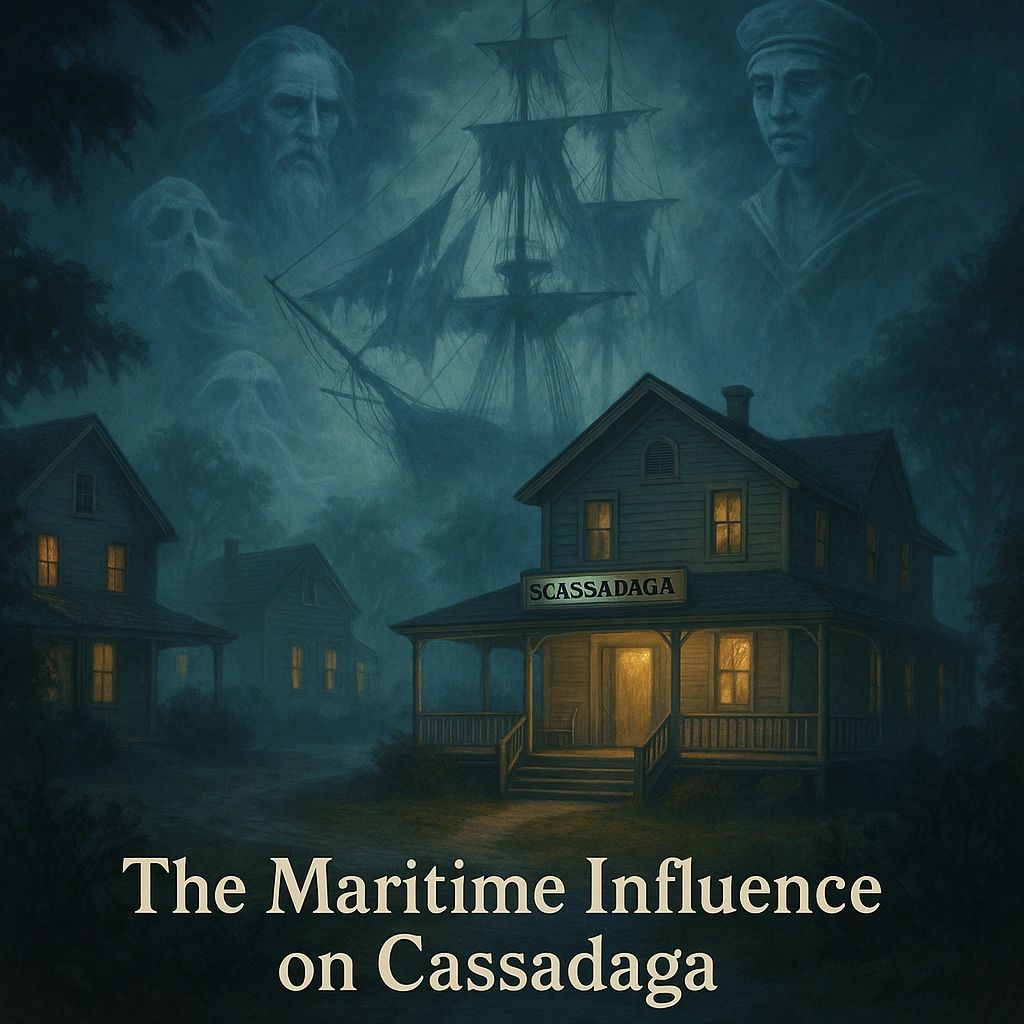
When you think about Cassadaga, Florida, images of fortune tellers, séances, and spiritual healing probably come to mind. This little town in Volusia County is often called the “Psychic Capital of the World,” and for good reason. Since its founding in 1894 by George Colby, a spiritualist from New York, Cassadaga has been a gathering place for mediums, healers, and those who believe in life beyond the veil.
But there’s another layer to Cassadaga’s story that’s often overlooked—its maritime influence. Nestled inland yet only a short distance from the Atlantic Ocean and the St. Johns River, Cassadaga has always been tied to the sea. Maritime culture, history, and even tragedies have shaped its people, its legends, and its sense of mysticism. The restless spirits of sailors, shipwreck victims, and coastal communities are said to drift through Florida’s waterways and into the psychic channels of Cassadaga.
In this blog, we’ll explore how maritime life, seafaring traditions, and Florida’s watery past influenced Cassadaga’s mystical rise. From shipwreck lore to ocean-inspired spirituality, the waves of the Atlantic have always rolled into Cassadaga’s story.
Florida’s Maritime Roots and Cassadaga’s Location
To understand Cassadaga’s maritime connections, we need to look at its geography. Cassadaga is located about 20 miles inland from Daytona Beach and the Atlantic Ocean. It’s also near the St. Johns River, one of Florida’s most important waterways, which runs northward all the way to Jacksonville and the sea.
This location made Cassadaga part of a region steeped in maritime culture. The Spanish first explored and settled Florida through coastal ports in the 1500s, followed by British, French, and later American seafarers. Indigenous peoples before them, such as the Timucua, relied on rivers and coasts for fishing and transport. Every wave of Florida history has been carried by ships.
When George Colby and his followers founded Cassadaga, they built their spiritualist camp in a region already buzzing with maritime influence. Railroads and riverboats connected inland towns like Cassadaga to ports, while sailors and dockworkers carried stories of ghosts, superstitions, and sea legends with them.
Ghosts of the Sea and Spiritualism
Maritime culture is rich with ghost stories. Sailors have long believed in phantom ships, drowned souls, and restless spirits that wander the seas. Shipwrecks were tragically common along Florida’s coast, especially near Cape Canaveral and the treacherous reefs of the Keys. Each storm claimed lives, and legends say their spirits never left the waters.
Spiritualism—the belief that the dead can communicate with the living—found fertile ground in Florida because of these maritime tragedies. Mediums in Cassadaga often reported contact with sailors lost at sea or fishermen who never returned from storms. The imagery of water, storms, and shipwrecks is woven through many séances and readings held in Cassadaga’s history.
For many visitors, Cassadaga became a place to seek closure after losing loved ones to the sea. Mothers of drowned sailors, wives of fishermen, and even survivors of maritime disasters sought the guidance of Cassadaga’s mediums. The ocean’s influence was not just physical but deeply emotional.
The St. Johns River: A Spiritual Highway
The nearby St. Johns River also played a major role. Rivers in many cultures are seen as spiritual highways between worlds. The ancient Greeks believed in the River Styx, while Native American tribes in Florida viewed rivers as sacred paths for souls.
The St. Johns River was once called “Welaka” by Indigenous peoples, meaning “river of lakes.” It connected inland Florida communities to the ocean, carrying not just goods but also beliefs and traditions. Cassadaga’s proximity to this river meant it absorbed the maritime spiritual symbolism tied to water as a passage between life and death.
Some oral histories from Cassadaga suggest that mediums believed the St. Johns acted like an antenna for spirit communication. Water, after all, has long been thought to amplify psychic energy. Sailors’ tales, Indigenous traditions, and spiritualist beliefs blended into a unique mix that made Cassadaga feel like it was floating in two worlds—the physical and the spiritual.
Shipwrecks and Psychic Energy
Florida’s coastline is sometimes called the “Graveyard of the Atlantic.” Hundreds of shipwrecks lie beneath its waters, from Spanish galleons carrying treasure to modern fishing boats caught in hurricanes. Maritime archaeologists have documented these wrecks not just as historical artifacts, but also as cultural touchstones that feed local ghost lore.
Cassadaga, though inland, was influenced by these stories. Visitors to the camp often carried with them tales of lost treasure ships or ghostly sightings of drowned sailors along the beaches. Psychic mediums would sometimes reference these maritime tragedies during readings. The belief was that shipwreck victims had unfinished business and their energy lingered along Florida’s waterways, drifting inland toward Cassadaga.
Seafaring Superstitions Meet Spiritualism
Maritime traditions are full of superstitions. Sailors feared whistling on ships because it was thought to summon storms. They believed seeing certain birds meant death was near. Bananas on boats were considered bad luck, while dolphins swimming alongside were seen as good omens.
When these beliefs crossed paths with the Spiritualist movement in Cassadaga, they created a fascinating overlap. Mediums sometimes incorporated seafaring symbols in their practices. Visitors might hear references to storms as metaphors for spiritual upheaval, or to calm seas as symbols of peace after death.
The blending of sea superstitions with psychic practice gave Cassadaga a maritime flavor that distinguished it from other Spiritualist communities in the U.S.
The Port Cities’ Influence
Nearby port cities like Jacksonville, St. Augustine, and Daytona Beach also shaped Cassadaga’s development. These towns brought in sailors, immigrants, and dockworkers, each carrying their own cultural beliefs about the sea and spirits.
- St. Augustine, the nation’s oldest city, has long been tied to shipwrecks and ghost stories. Visitors to Cassadaga often passed through St. Augustine, bringing tales of haunted forts and drowned sailors.
- Jacksonville, a busy port, sent riverboats up the St. Johns, carrying passengers who later visited Cassadaga. Many of them were steeped in maritime traditions.
- Daytona Beach, though more modern, attracted coastal tourists who also sought spiritual experiences inland at Cassadaga.
Thus, Cassadaga was not isolated—it was part of a maritime network stretching from the ocean to inland rivers.
Cassadaga’s Psychic Homes with Nautical Touches
Even the architecture of Cassadaga reflects maritime influence. Many of its homes and meeting halls are built in a simple, wooden style similar to seaside cottages. Some visitors note the resemblance between Cassadaga’s Spiritist Camp buildings and the clapboard houses found in coastal fishing villages.
Inside, nautical symbols sometimes appear in décor. Anchors, seashells, and even paintings of ships decorate some of the homes. While partly decorative, they also reflect the community’s quiet acknowledgment of the sea’s spiritual role.
Maritime Tragedies Remembered in Spirit
One of the strongest connections between Cassadaga and maritime culture comes through remembrance of tragedies. Florida has seen devastating hurricanes that sank fleets, drowned entire communities, and reshaped coastlines. Each tragedy left behind grieving families seeking comfort.
Cassadaga became a sanctuary for these families. Mediums helped connect survivors with lost loved ones, offering solace in times of overwhelming loss. Whether it was a sailor taken by a storm, or a fisherman swept overboard, Cassadaga’s reputation grew as a place where the maritime dead could “speak” once more.
The Ocean as a Spiritual Metaphor
Beyond specific stories, the ocean itself serves as a powerful spiritual metaphor in Cassadaga. The sea is vast, mysterious, and seemingly endless—much like the spirit world. Spiritualists often use ocean imagery when describing the afterlife. They speak of crossing waves, drifting into eternal waters, or being carried by tides of energy.
For Cassadaga mediums, the ocean became a natural language for explaining spiritual concepts. Visitors often left with a sense that the spirit world was as deep and mysterious as the sea itself.
Tourism: From the Beach to the Psychic Camp
Another maritime influence on Cassadaga is tourism. Florida’s east coast beaches have always drawn visitors, from Gilded Age elites to modern families. Many of those tourists took day trips inland to see Cassadaga.
For beachgoers, the jump from surfing the Atlantic to exploring psychic readings wasn’t as far as it might seem. Both experiences tapped into mystery and awe—whether it was the power of the waves or the mystery of the unseen world. In fact, some visitors said their most profound Cassadaga experiences happened after a day spent by the ocean, as if the sea had opened their minds to spiritual energy.
Conclusion: A Village Shaped by Waves
Cassadaga may be nestled in the pine forests of inland Florida, but the sea is never far away. From shipwreck ghost stories to ocean-inspired spiritual metaphors, maritime culture has flowed into Cassadaga like a rising tide. The Atlantic Ocean, the St. Johns River, and centuries of maritime life shaped the beliefs, practices, and stories that still echo through Cassadaga’s Spiritualist Camp today.
So next time you hear about Cassadaga as the “Psychic Capital of the World,” remember that its roots aren’t just in séances and spirit circles—they’re also in the restless waves of Florida’s maritime past.
Bibliography
- Butler, J. (2017). Spiritualism in America: The rise and fall of a religious movement. Harvard University Press.
- Gannon, M. (2018). Florida: A short history. University Press of Florida.
- McCarthy, K. M. (2014). Ghosts of St. Augustine. Pineapple Press.
- Meide, C. (2015). Florida’s maritime cultural landscape: Shipwrecks and seafaring traditions. The Florida Historical Quarterly, 94(1), 1–28.
- Roach, H. (2016). Water, spirit, and soul: Rivers as sacred spaces in Native American traditions. American Indian Quarterly, 40(3), 267–289.
- Taves, A. (1999). Fits, trances, and visions: Experiencing religion and explaining experience from Wesley to James. Princeton University Press.
- Worth, J. E. (2009). The Timucua and Florida’s maritime world. Ethnohistory, 56(3), 369–400.
Originally published at the live site .