
Maritime ·
The Megalodon Mistake: When a Giant Shark Stalked a Sub
Imagine you're thousands of feet under the ocean, inside a small submarine. It’s dark, cold, and completely silent—until something massive brushes against the metal hull. The sub rocks. Then it happens again. And again. ...
By Rebecca "Madam Chronicler" Ryan
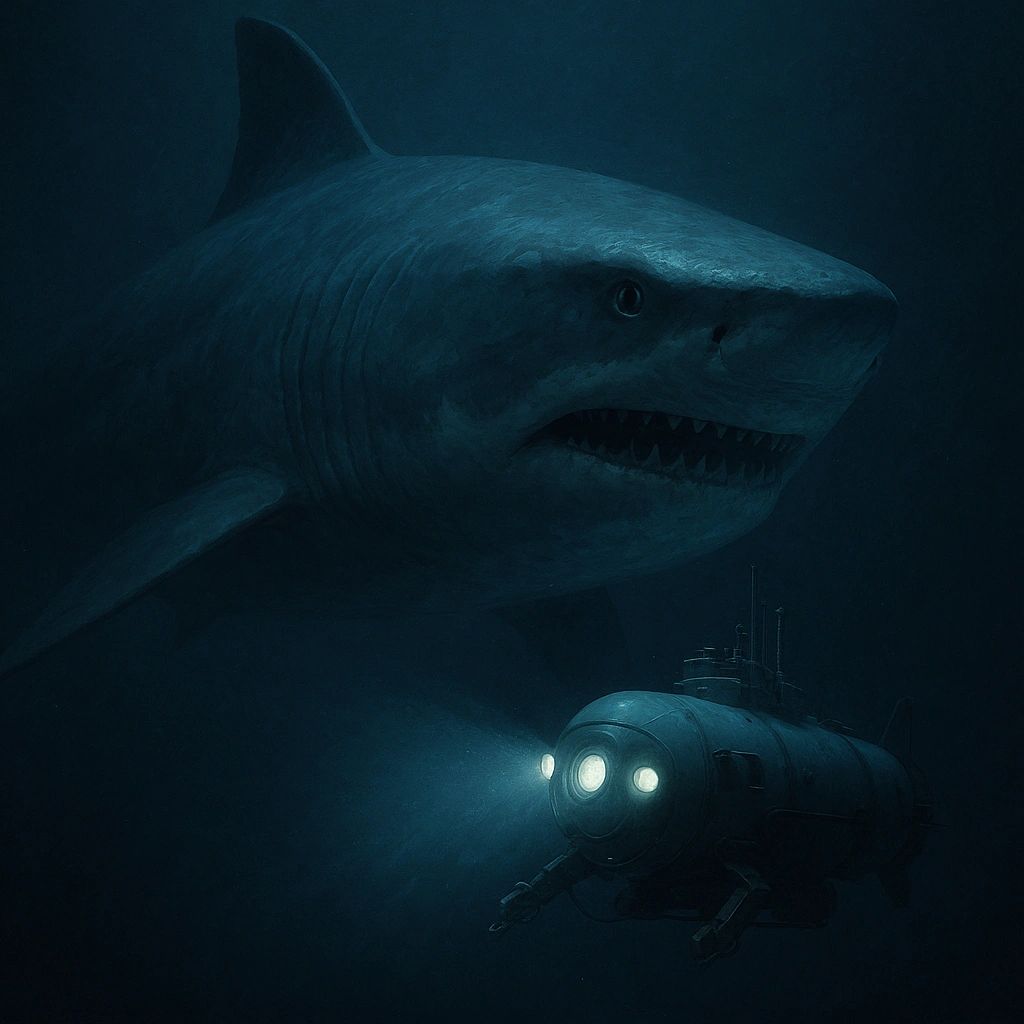
Imagine you’re thousands of feet under the ocean, inside a small submarine. It’s dark, cold, and completely silent—until something massive brushes against the metal hull. The sub rocks. Then it happens again. And again. Could it be a whale? A giant squid? Or… a megalodon?
In 2022, something very strange happened during a deep-sea expedition off the coast of Papua New Guinea. A submersible, carrying a team of researchers, was suddenly bumped—several times—by a mysterious, powerful animal. The crew reported the whole sub vibrated as if hit by a freight train. What they thought they saw afterward stunned even the most experienced marine biologists.
Let’s dive into this real-life mystery that had the world buzzing. Was a giant prehistoric shark really stalking a sub? Or was it all just a big misunderstanding?
What Is a Megalodon?
Before we get into what happened to the sub, let’s meet the star of the story: the megalodon (Otodus megalodon). This ancient shark was the biggest shark to ever swim the oceans—possibly the biggest predator to ever live on Earth.
Megalodons lived around 23 to 3.6 million years ago, during the Miocene and Pliocene epochs. They could grow up to 60 feet long (about the size of a school bus!) and had tooth marks wider than your hand. These sharks ate whales for breakfast and hunted other huge ocean creatures with ease (Gottfried et al., 1996).
Their bite was estimated to be over 40,000 pounds per square inch, which is strong enough to crush a car. Scientists know this because of the massive teeth that have been found all over the world—from California to South Africa. But so far, no living megalodon has ever been found.
The Submarine Encounter That Shook the Internet
In early 2022, a research crew from a private oceanographic company was exploring deep-sea ridges near the Solomon Islands. Using a manned submersible, they were mapping areas of the seafloor that had never been visited before. Around 5,000 feet down, something unexpected happened.
According to their report, the sub was struck three times by a large, fast-moving object. The team inside thought it might be a curious whale at first, but the location and depth made that unlikely. They quickly activated cameras, and what they captured led to a storm of theories: a giant, shark-like shape swimming just beyond the range of the sub’s lights.
Was it a hoax? A new species? Or worse, something prehistoric that had never really gone extinct?
What the Crew Claimed to See
The video was blurry, as you might expect at that depth. But the crew described a long, torpedo-shaped body, a massive tail fin, and something that looked like a dorsal fin bigger than a car door.
It swam with quick, smooth movements and circled the sub before disappearing into the black. While no clear photo was captured, sonar showed a large, fast-moving animal at least 40 feet long.
Naturally, when the footage was leaked, the word “megalodon” exploded across social media. TikTok videos, YouTube breakdowns, and even major news networks ran stories suggesting the prehistoric shark might still be alive.
But is that really possible?
The Science Behind the Hype
Let’s hit the brakes for a second.
There’s no scientific evidence that megalodons are still alive today. Zero. Zilch. Nada.
Scientists have studied the oceans for hundreds of years and found no modern bones, no fresh teeth, no reliable footage—nothing to support the idea that the species still exists (Pimiento & Balk, 2015).
In fact, we have a pretty good idea why they went extinct. During the Pliocene epoch, global cooling caused sea levels to drop. Food sources changed. Whales became harder to catch. A new competitor—the great white shark—also rose in numbers. These changes likely pushed megalodons to extinction over 3 million years ago (Pimiento et al., 2017).
But Could Something Be That Big Today?
Okay, so maybe it wasn’t a megalodon. But could a giant shark like that still be roaming the deep?
Actually, yes—just not that giant.
Meet the sleeper shark, a slow-moving deep-sea predator that can grow over 20 feet long. There’s also the sixgill shark, which can reach 26 feet and lives in deep waters where sunlight doesn’t reach. And of course, the basking shark and whale shark both reach huge sizes, though they’re filter feeders.
Another likely suspect? The bluntnose sixgill shark (Hexanchus griseus). This shark is rarely seen and can live deeper than 6,000 feet. It has a large body, slow tail-swishing movements, and can grow over 18 feet long. Some deep-sea sub operators have confused them for something prehistoric due to their size and strange features (Cotton et al., 2011).
So what the crew saw might not be a “monster” at all—just an animal we still don’t fully understand.
Deep Sea Illusions: Why Our Eyes Play Tricks
It’s important to remember how easy it is to misjudge size underwater, especially in total darkness. Cameras distort distance. Lights don’t travel far in deep water. And the human brain is wired to fill in gaps when it sees something unfamiliar.
That’s why stories about sea monsters go back centuries. Ancient sailors reported giant krakens, ghostly mermaids, and sea serpents—all likely based on real animals seen under weird conditions.
Could the “giant shark” seen by the sub team just be a normal-sized shark, magnified by shadows and fear? Possibly. Or could it be an unknown species? That’s exciting—and not impossible. Scientists estimate that 91% of ocean species remain undiscovered (Mora et al., 2011).
The Megalodon Obsession
Part of what makes stories like this so irresistible is the megalodon’s place in pop culture. It’s the king of “what if” scenarios.
Movies like The Meg (2018) and The Black Demon (2023) have made people think these creatures could be lurking in the unexplored deep. But Hollywood is Hollywood—it’s not science.
Many “sightings” of megalodons are hoaxes or misunderstandings. Some use photoshopped images or misidentified whale carcasses to stir attention online. One famous fake showed a megalodon swimming near a Navy ship. It was later confirmed as a digital manipulation.
Still, these stories stick in our imagination. After all, the idea of a massive predator from the past surviving in the shadows today? It’s a thrilling thought.
Real Sharks That Could Fool You
Here are a few shark species that might explain strange sightings like the one in 2022:
- Bluntnose Sixgill Shark – Up to 20 feet, deep-dwelling, and prehistoric-looking.
- Greenland Shark – Up to 24 feet, super slow, and nearly blind. Some live over 400 years!
- Pacific Sleeper Shark – Also massive and rarely seen, with a wide range in cold, deep waters.
- Basking Shark – The second largest fish on Earth. Its open mouth looks terrifying, but it only eats plankton.
- Whale Shark – The biggest fish in the sea, reaching over 60 feet, but completely harmless to humans.
Any one of these could create confusion or fear in the murky deep.
So What Really Hit the Sub?
That’s the big question. Was it a whale shark? A sixgill? Something we’ve never cataloged? We may never know.
But one thing is certain: it wasn’t a megalodon.
Scientists have pointed out that if megalodons were still alive, we’d see fresh teeth washing ashore, bite marks on whales, and sonar evidence from deep-sea scans. None of that has happened. Also, a predator that big would need a huge amount of food, and it’s hard to imagine them going undetected for millions of years (Pimiento et al., 2017).
Even the crew of the sub eventually backed off the megalodon claim. Later interviews suggested they believed it was a massive but unknown shark species, not a prehistoric throwback.
Still, it gave the world an exciting mystery to chew on—and reminded us just how little we know about the deep ocean.
What We Can Learn From the Megalodon Mistake
Even if the 2022 event wasn’t proof of a living megalodon, it was proof of something important:
The ocean still holds mysteries.
Only about 25% of the seafloor has been mapped. Species are discovered all the time. And every once in a while, something bumps into a submarine and makes the whole world wonder: What was that?
These moments spark curiosity, bring attention to ocean science, and remind us to protect the fragile ecosystems of the deep. Whether it’s sharks, whales, or mysterious creatures we haven’t even named yet, they all deserve our respect—and our curiosity.
Conclusion: Fact vs. Fiction
Let’s wrap this up:
- No, the megalodon didn’t stalk a submarine in 2022.
- Yes, something large hit the sub, but it was likely a known species.
- And yes, the ocean is still full of surprises—and maybe even giant ones.
Megalodons may be extinct, but our fascination with them is very much alive. And honestly, that’s not a bad thing. If stories about giant sharks get people excited about marine science, ocean exploration, and conservation, then bring on the buzz.
Because while we might never meet a real megalodon, we still have a deep, wild ocean full of wonders to explore.
Bibliography
Cotton, C. F., Grubbs, R. D., & Musick, J. A. (2011). Reproductive biology of sixgill sharks in the western North Atlantic Ocean. Marine and Freshwater Research, 62(6), 567–576. https://doi.org/10.1071/MF10164
Gottfried, M. D., Compagno, L. J. V., & Bowman, S. C. (1996). Size and skeletal anatomy of the giant “megatooth” shark Carcharodon megalodon. Historical Biology, 12(4), 355–372. https://doi.org/10.1080/08912969609386530
Mora, C., Tittensor, D. P., Adl, S., Simpson, A. G. B., & Worm, B. (2011). How many species are there on Earth and in the ocean? PLoS Biology, 9(8), e1001127. https://doi.org/10.1371/journal.pbio.1001127
Pimiento, C., & Balk, M. A. (2015). Body-size trends of the extinct giant shark Carcharocles megalodon: a deep-time perspective on marine apex predators. Paleobiology, 41(3), 479–490. https://doi.org/10.1017/pab.2015.16
Pimiento, C., Clements, C. F., & Benton, M. J. (2017). The past is the key to the present: the impact of the fossil record on extinction risk estimates in sharks. Proceedings of the Royal Society B: Biological Sciences, 284(1856), 20172186. https://doi.org/10.1098/rspb.2017.2186
Originally published at the live site .