
Maritime ·
The Purple Martin: The Bird That Returns From the Sky
Some birds are found in the trees.
By Rebecca "Madam Chronicler" Ryan
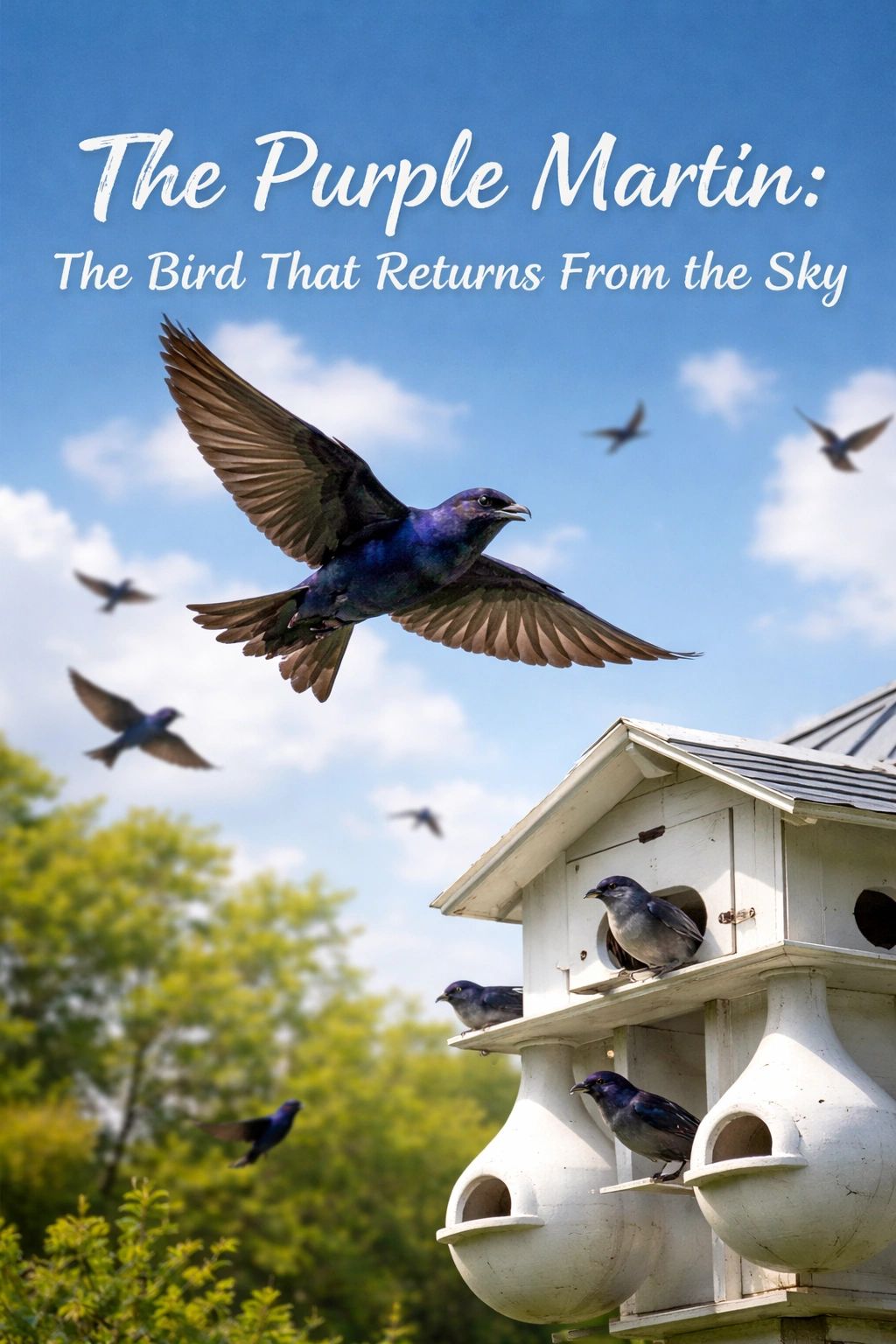
Some birds are found in the trees.
Some along the water.
Some are close enough that you can follow them from branch to branch.
And then there are birds that remain just out of reach.
High above everything else.
The Purple Martin belongs to that last group.
A Sound That Comes From Above
The first time I noticed it, I wasn’t looking up.
I was listening.
By now, I had gotten used to the rhythm of the yard—the calls that came from the trees, the shrubs, the edges of the water. Most of the birds I had been writing about revealed themselves somewhere within reach, somewhere I could follow with my eyes once I knew what to look for.
But this sound felt different.
It was softer than a Blue Jay, less repetitive than a Wren, and lighter than anything I had been hearing before. It moved through the air in a way that didn’t seem tied to a single place.
It didn’t feel like it was coming from the trees.
It felt like it was coming from everywhere.
So I opened the Merlin Bird ID app and let it listen.
Within seconds, it gave me the answer.
Purple Martin.
And for the first time, instead of looking around, I looked up.
Searching the Open Sky
At first, I didn’t see anything.
The sky stretched wide and open, empty in a way that made it hard to focus on any one point. There were no branches to guide your eyes, no fence lines or edges to narrow your search.
Just space.
Then something moved.
A small, dark shape cut across the sky, fast enough that I almost missed it. Then another followed, then another, each one moving in wide arcs, looping and turning in ways that felt effortless.
They weren’t hovering.
They weren’t gliding slowly like an osprey.
They were moving constantly.
Flying.
A Bird That Rarely Stops
The more I watched, the more I realized something that set the purple martin apart from almost every other bird I had observed.
It didn’t land.
Or at least, it didn’t seem to.
It stayed in motion, sweeping through the air in smooth, controlled turns. Its wings moved quickly, but not erratically. There was a rhythm to it, a pattern that repeated without ever feeling predictable.
It wasn’t just flying.
It was living in the sky.
A Flash of Color in the Light
When one of them finally passed closer, the detail became clearer.
At a distance, the bird looked almost black, but as it turned into the light, something changed. Its feathers caught the sun in a way that revealed a deep, glossy color—not just black, but a rich, iridescent purple-blue.
It wasn’t bright in the way a cardinal is bright.
It was subtle.
But unmistakable.
The Smithsonian Handbooks: Birds of North America (Eastern Region) often describe the Purple Martin as having a dark, glossy sheen that shifts in color depending on the light, and seeing it in motion made that description feel completely accurate.
It wasn’t just color.
It was reflection.
Movement With Purpose
Watching them longer, it became clear that their movement wasn’t random.
They followed patterns.
Wide arcs.
Quick turns.
Sudden shifts that seemed to respond to something invisible in the air.
That something was food.
Purple Martins are aerial insect hunters, catching their prey mid-flight. They don’t search the ground or probe through trees. They hunt in open air, tracking insects that most people never even notice.
According to Smithsonian descriptions, they are built for this kind of life—long wings, streamlined bodies, and a flight style that allows them to remain airborne for extended periods.
Everything about them points upward.
A Bird That Lives Close to People
What makes the Purple Martin even more interesting is where it chooses to live.
Unlike many birds that avoid human structures, purple martins in the eastern United States have developed a strong relationship with people. They often nest in man-made houses—rows of small compartments specifically designed to attract them.
This isn’t accidental.
It’s a pattern that has developed over time.
Field guides note that Purple Martins have become almost entirely dependent on these structures in certain regions, returning year after year to the same locations.
It’s a different kind of connection.
Not just observation.
But coexistence.
The Idea of Returning
One of the most compelling things about the Purple Martin isn’t just where it is.
It’s where it has been.
These birds migrate long distances, traveling to South America and back each year. And when they return, they often come back to the same place.
The same area.
The same structures.
The same space in the sky.
That idea changes how you see them.
They’re not just passing through.
They’re returning.
A Presence That Isn’t Grounded
Unlike the other birds in this series, the Purple Martin doesn’t feel tied to a specific surface.
The Wren moves through the shrubs.
The Dove settles on fences and rooftops.
The Anhinga moves between water and shore.
But the Purple Martin exists above all of that.
It doesn’t anchor itself to one place.
It moves through the space above it.
And that gives it a different kind of presence—one that feels less fixed and more continuous.
Hearing Before Seeing
What stood out most about the experience wasn’t just seeing the bird.
It was how it started.
With sound.
That moment when the call didn’t quite match anything familiar. When it felt like it was coming from everywhere instead of one direction.
Before Merlin, it was just part of the background.
After Merlin, it became something specific.
Something I could follow.
Something I could understand.
A Different Kind of Awareness
Once I knew what I was listening for, the sky changed.
What had once felt empty now felt active.
There was movement everywhere, even if it was subtle. Birds passing through, looping back, crossing paths in ways that were easy to miss if you weren’t looking for them.
The space above the yard wasn’t empty.
It was full.
Living in Motion
The purple martin doesn’t spend much time still.
Its life is built around movement.
Flight is not just something it does—it’s how it exists. It eats in the air, travels in the air, and interacts with its environment from above.
Watching it, there’s a sense that landing is the exception, not the rule.
Everything about it is designed to stay in motion.
A Bird That Changes the Space Around You
What makes the purple martin stand out isn’t just how it looks or how it moves.
It’s how it changes your perspective.
It shifts your attention upward.
It makes you aware of space you might not have noticed before.
It expands the environment beyond what’s directly in front of you.
The Role of Merlin in the Moment
Like the other birds in this series, everything came back to that first moment of recognition.
Without Merlin, the sound might have passed unnoticed, blending into everything else. The movement in the sky might have been dismissed as distant or unimportant.
But with that identification, everything changed.
The sound had a name.
The movement had meaning.
The moment had context.
A Bird That Exists Just Beyond Reach
The purple martin is not a bird you follow through branches.
It’s not one you watch from a few feet away.
It stays just out of reach, moving through a space that feels close but remains distant.
And that distance is part of what makes it memorable.
It’s there.
You can see it.
You can hear it.
But you can’t quite get close to it.
Conclusion: The Sky Was Never Empty
The purple martin is not the loudest bird in the yard.
It is not the most grounded.
It is not the easiest to follow.
But it is one of the most expansive.
It lives in a space that often feels empty until you realize it isn’t.
It moves in patterns that are easy to miss until you start paying attention.
And once you recognize it—once you connect that soft, drifting sound to the movement above—you realize something simple.
The sky was never empty.
It was always alive.
You just hadn’t looked up yet.
Bibliography
Cornell Lab of Ornithology. All About Birds: Purple Martin.
Smithsonian Institution. Smithsonian Handbooks: Birds of North America (Eastern Region).
National Audubon Society. Purple Martin.
Sibley, David Allen. The Sibley Guide to Birds.
Florida Fish and Wildlife Conservation Commission. Florida Bird Species Information.
Originally published at the live site .