
Maritime ·
The Sandhill Crane: The Bird That Feels Ancient
Some birds blend into the background.
By Rebecca "Madam Chronicler" Ryan
Some birds blend into the background.
Some pass through quietly.
Some are easy to miss if you’re not paying attention.
And then there are birds that stop you the moment you see—or hear—them.
The sandhill crane is one of those birds.
A Sound That Doesn’t Feel Modern
The first time I noticed it, I didn’t see anything at all.
I heard it.
A loud, rolling call that carried farther than anything else I had heard in the yard. It wasn’t soft or musical. It wasn’t layered or subtle.
It was raw.
Echoing.
Almost mechanical—but not in a modern way.
It felt older than that.
The sound stretched out across the air, rising and falling in a way that didn’t feel like it belonged to the same world as the smaller birds I had been watching.
I paused.
Listened again.
There it was.
Louder this time.
Closer.
So I opened the Merlin Bird ID app and let it listen.
Within seconds, it gave me the answer.
Sandhill Crane.
And somehow, even before I saw it, that name already felt right.
Looking for Something Larger
After identifying it, I knew I wasn’t looking for something small.
This wasn’t going to be hidden in the trees.
It wasn’t going to blend into the background.
So I looked out across the open space.
And that’s when I saw them.
A Presence You Can’t Ignore
They weren’t just birds.
They were tall.
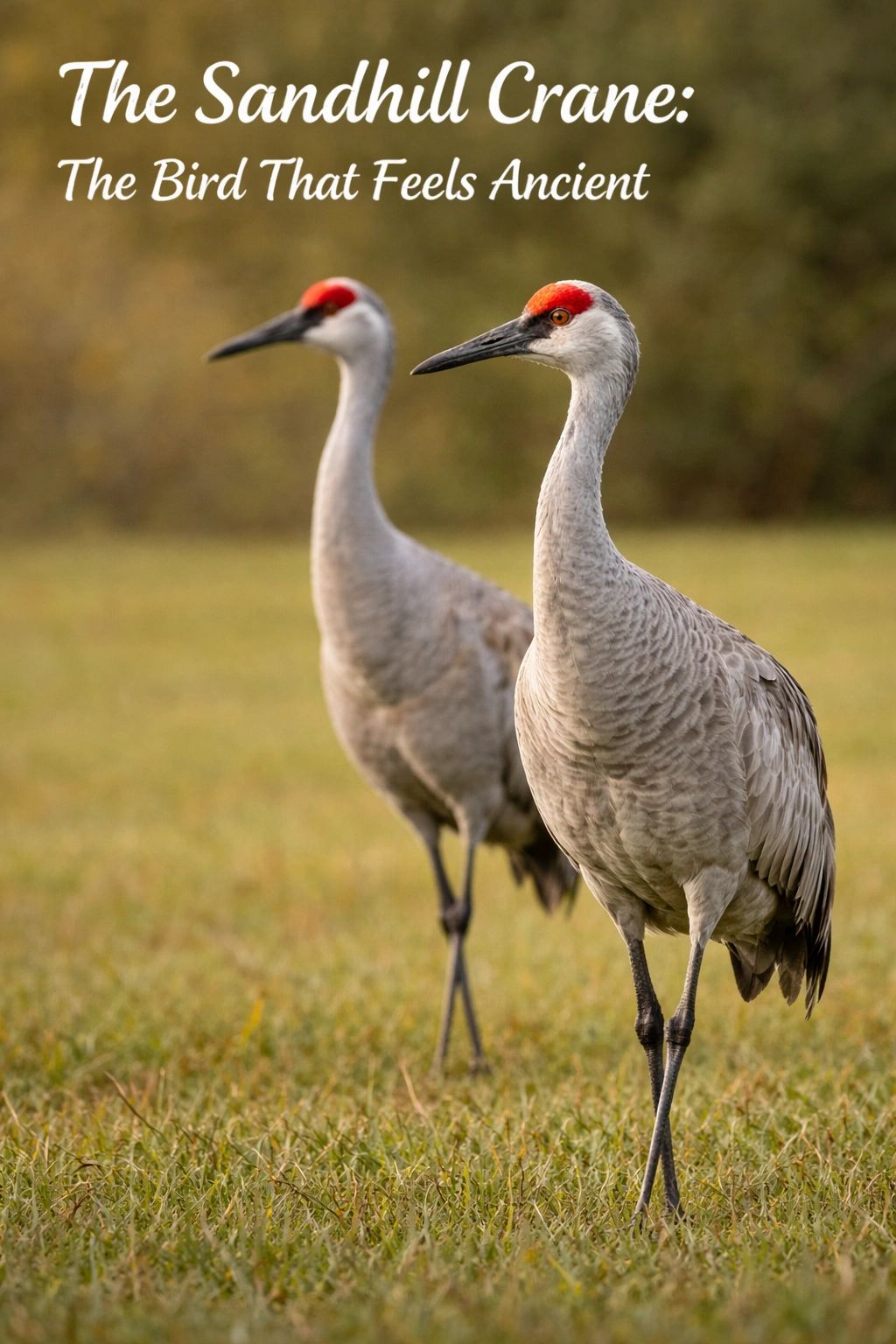
Standing well above everything else around them, their long legs lifting them high above the ground, their bodies upright in a way that felt deliberate and steady.
Gray feathers.
A long neck that moved slowly, almost thoughtfully.
And a flash of red at the top of the head—subtle, but striking.
They didn’t move quickly.
They didn’t need to.
Their presence alone was enough.
Movement That Feels Measured
The sandhill crane doesn’t rush.
It walks.
Slowly.
Each step placed with care, as if the ground itself matters. There’s a rhythm to it, but not one built on speed.
It’s built on control.
Watching them move feels different from watching smaller birds. There’s no darting, no sudden changes in direction.
Just steady, deliberate motion.
A Call That Carries Across Everything
Then the sound comes again.
That same rolling, trumpeting call.
Loud.
Clear.
Impossible to ignore.
Field guides, including the Smithsonian Handbooks: Birds of North America (Eastern Region), describe the sandhill crane’s call as a loud, rattling bugle, and hearing it in person makes that description feel exact.
It doesn’t stay close.
It travels.
Across water.
Across yards.
Across entire neighborhoods.
It announces itself whether you’re ready or not.
A Bird That Feels Older Than the Moment
There is something about the sandhill crane that doesn’t feel entirely connected to the present.
Not because it’s out of place—but because it feels like it has been here for a very long time.
Its size.
Its posture.
Its voice.
Everything about it feels… ancient.
Like something that existed long before the environment around it changed.
And in a place like Florida, where the landscape shifts between natural and developed, that contrast stands out even more.
Living in Open Space
Unlike birds that rely on trees or dense cover, sandhill cranes prefer open areas.
Fields.
Wetlands.
Edges of water.
Even neighborhoods, where open lawns and retention ponds create spaces that resemble their natural habitat.
They don’t hide.
They move through visible space.
And that visibility changes how you experience them.
Often Not Alone
One of the first things I noticed was that there wasn’t just one.
There were two.
Moving together.
Close, but not crowded.
Aware of each other in a way that felt constant.
Sometimes you’ll see them in pairs, sometimes in small family groups, and that connection becomes part of their presence.
They don’t feel isolated.
They feel connected.
A Bond You Can See
Sandhill cranes are known for forming strong pair bonds, often staying together for long periods of time.
According to Smithsonian references, these bonds are reinforced through shared movement, vocalizations, and even synchronized displays.
And watching them, you can see that connection.
They move together.
Pause together.
Call together.
It’s not something you have to look for.
It’s something you notice immediately.
Feeding in Plain Sight
When they feed, the cranes remain just as visible.
They lower their heads, scanning the ground, picking at small plants, insects, or other food sources. There’s no rush.
No urgency.
Just a steady continuation of movement.
Even while feeding, they remain aware of their surroundings.
Nothing about them feels distracted.
The Moment Merlin Made It Clear
Like the other birds in this series, everything began with that first moment.
Before Merlin, the sound felt unfamiliar—almost out of place.
After Merlin, it had context.
And once it had context, the entire experience changed.
The sound made sense.
The presence felt intentional.
And the bird became something I could recognize again.
A Bird That Changes the Entire Space
What the sandhill crane does more than anything else is change the scale of the environment.
Everything feels bigger.
More open.
More connected.
It pulls your attention outward, away from small details and toward the larger space around you.
And once it does, that space doesn’t feel empty anymore.
It feels occupied.
A Presence That Stays With You
Some birds you notice for a moment.
Some stay longer.
But the sandhill crane is the kind of bird that stays with you even after it’s gone.
Because of the sound.
Because of the size.
Because of the way it changes the environment just by being there.
Conclusion: The Sound That Feels Like Another Time
The sandhill crane is not subtle.
It is not quiet.
It is not easy to overlook.
But it is something more than that.
It is a reminder.
That not everything in the world feels new.
Some things carry a sense of history with them.
A presence that feels older than the moment you’re standing in.
And once you hear it—once you see it—you realize something simple.
Some birds don’t just exist in the present.
They bring the past with them.
Bibliography
Cornell Lab of Ornithology. All About Birds: Sandhill Crane.
Smithsonian Institution. Smithsonian Handbooks: Birds of North America (Eastern Region).
National Audubon Society. Sandhill Crane.
Sibley, David Allen. The Sibley Guide to Birds.
Florida Fish and Wildlife Conservation Commission. Florida Bird Species Information.
Originally published at the live site .