
Maritime ·
The Tufted Titmouse: The Bird That Watches You Back
Some birds pass through your yard.
By Rebecca "Madam Chronicler" Ryan
Some birds pass through your yard.
Some stay hidden.
Some make themselves known from a distance.
And then there are birds that come closer.
Close enough that it feels like they’re not just part of the environment—
But aware of you in it.
The tufted titmouse is one of those birds.
A Sound That Feels Familiar Before You Know It
The first time I noticed it, I didn’t think much of it.
It wasn’t loud like a blue jay or sharp like a killdeer. It didn’t carry the emotional weight of a mourning dove or the constant repetition of a wren.
It was lighter.
Shorter.
Almost conversational.
A quick series of notes that felt like they belonged there, like they had always been part of the background even if I hadn’t paid attention before.
I paused.
Listened again.
Then opened the Merlin Bird ID app and let it do what it had been doing for every new sound I didn’t quite recognize.
Within seconds, it gave me the answer.
Tufted Titmouse.
And just like that, the sound had a place.
Looking for Something Small
Once I had a name, I started looking for it.
Not up high in the sky like the purple martin.
Not out in the open like the killdeer.
But somewhere closer.
Somewhere in between.
At first, it was hard to spot. The movement was quick, subtle, easy to miss if you weren’t focused. A small shape moving through branches, pausing just long enough to be seen, then shifting again.
It didn’t stay still for long.
But it didn’t disappear either.
It stayed within reach.
A Bird With a Watchful Presence
When I finally got a clear look, what stood out wasn’t just what it looked like.
It was how it looked back.
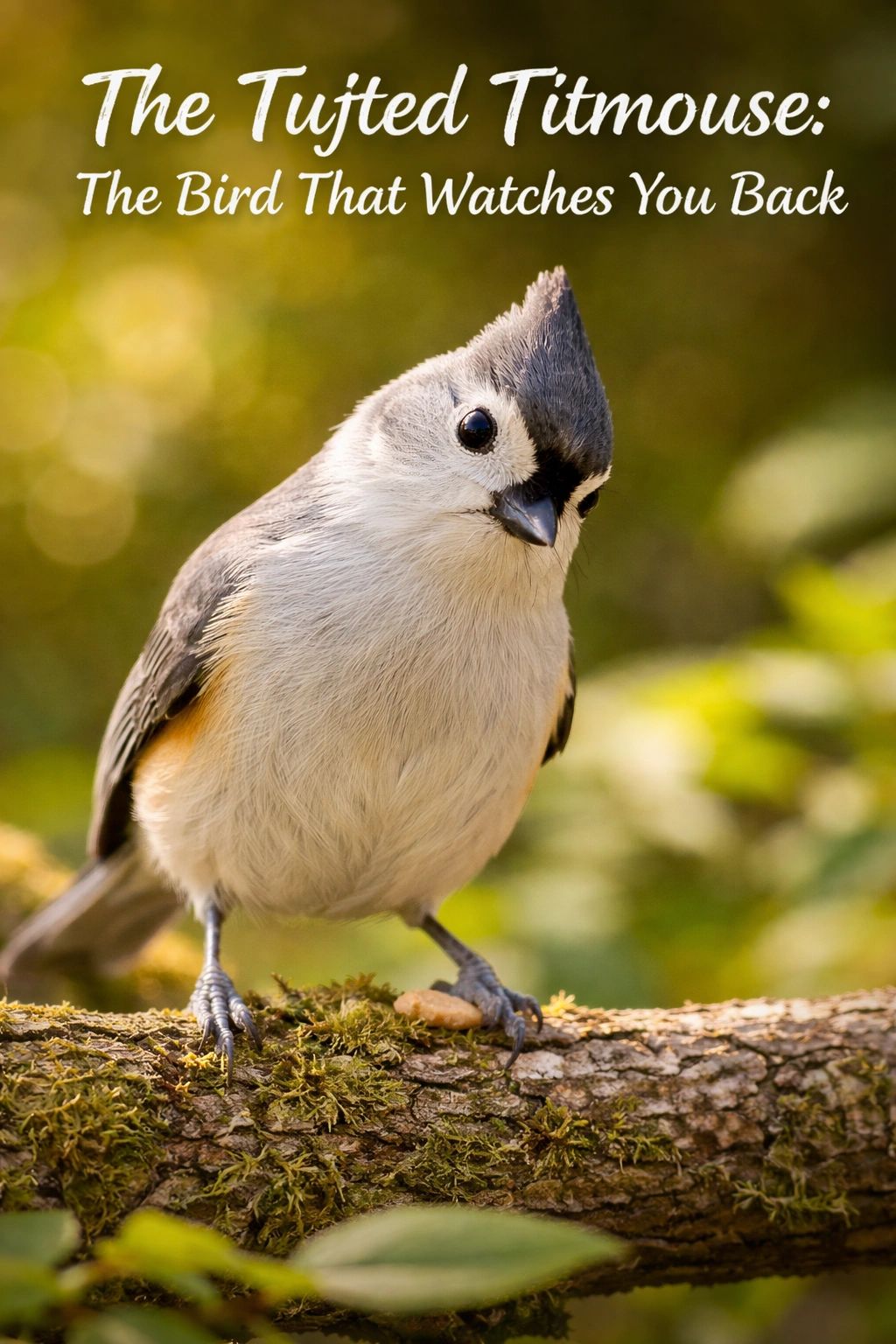
The tufted titmouse is small, with soft gray coloring, a pale underside, and a distinct crest that gives its head a slightly raised, alert appearance. Its dark eyes are round and expressive, set in a way that makes its gaze feel direct.
It doesn’t just move through the space.
It observes it.
And for a moment, it felt like it was observing me too.
Movement That Feels Curious
Unlike birds that keep their distance, the tufted titmouse moves in a way that feels almost curious.
It hops from branch to branch, pausing frequently, tilting its head slightly as if assessing something before moving again.
There’s no urgency in it.
No sense of alarm.
Just awareness.
It doesn’t rush away.
It stays.
A Voice That Matches Its Nature
The call of the tufted titmouse reflects that same personality.
Field guides, including the Smithsonian Handbooks: Birds of North America (Eastern Region), often describe its song as a clear, whistled “peter-peter-peter.”
Simple.
Direct.
Easy to recognize once you’ve heard it a few times.
But what makes it stand out isn’t just the sound—it’s the consistency. It repeats, but not in a way that feels overwhelming. It feels like part of a conversation, something ongoing rather than intrusive.
A Bird That Lives Close
The tufted titmouse doesn’t just pass through your yard.
It lives there.
It builds nests in tree cavities, often using natural holes or old woodpecker spaces, lining them with soft materials. It stays within a familiar range, returning to the same areas again and again.
According to Smithsonian references, it is a year-round resident in much of the eastern United States, including Florida.
That consistency makes it part of the environment in a different way.
It’s not temporary.
It’s present.
Feeding With Intent
Watching it feed adds another layer to its behavior.
The tufted titmouse doesn’t just grab food and stay in one place. It moves, collects, and often carries food away to eat elsewhere. Sometimes it stores food, tucking it into bark or crevices for later.
This behavior reflects a level of planning.
A sense of awareness that goes beyond the immediate moment.
It isn’t just reacting.
It’s preparing.
A Familiar Presence Over Time
The more I watched, the more familiar the bird became.
Not because it stayed in one place, but because it returned.
Again and again.
The same movement patterns.
The same sounds.
The same pauses between motion.
It became something expected—not in a way that made it less interesting, but in a way that made it more noticeable.
The Moment Merlin Made It Clear
Like the other birds in this series, everything started with that first moment of recognition.
Before Merlin, the sound blended into the background.
After Merlin, it stood out.
The bird didn’t change.
My awareness did.
A Bird That Changes Distance
What makes the tufted titmouse unique in this series is how close it feels.
Not physically, but in presence.
It doesn’t stay far away like the purple martin.
It doesn’t disappear beneath the surface like the anhinga.
It exists in that middle space—close enough to observe, far enough to remain wild.
And that balance is what makes it stand out.
A Quiet Kind of Connection
There’s something about watching a bird that doesn’t immediately fly away that changes the experience.
It creates a moment of stillness.
A shared space.
Even if it’s brief.
The tufted titmouse brings that kind of moment into the yard.
Conclusion: The Bird That Notices You Too
The tufted titmouse is not the loudest bird.
It is not the most colorful.
It is not the most dramatic.
But it is one of the most aware.
It moves through the yard with a quiet curiosity, observing as much as it explores.
And once you notice it—once you recognize that soft call and the small bird moving through the branches—you realize something simple.
You’re not the only one watching.
Bibliography
Cornell Lab of Ornithology. All About Birds: Tufted Titmouse.
Smithsonian Institution. Smithsonian Handbooks: Birds of North America (Eastern Region).
National Audubon Society. Tufted Titmouse.
Sibley, David Allen. The Sibley Guide to Birds.
Florida Fish and Wildlife Conservation Commission. Florida Bird Species Information.
Originally published at the live site .