
Maritime ·
The White-eyed Vireo: The Voice You Can’t Find
Some birds reveal themselves the moment they call.
By Rebecca "Madam Chronicler" Ryan
Some birds reveal themselves the moment they call.
You hear them.
You look.
And there they are.
Perched in plain sight, exactly where you expect them to be.
But not all birds do that.
Some stay hidden.
Some stay just out of reach.
Some make themselves known without ever fully appearing.
The white-eyed vireo is one of those birds.
A Sound That Doesn’t Stay Still
The first time I noticed it, I didn’t see anything at all.
I heard it.
Sharp.
Quick.
A series of notes that didn’t flow the way most bird songs do. It wasn’t smooth or melodic. It felt broken into pieces—short phrases strung together in a way that almost sounded like something trying to be understood.
It came from somewhere nearby.
Then it shifted.
Then it came again—from somewhere slightly different.
I paused, listening, trying to follow it, but the sound didn’t stay in one place long enough to track.
So I opened the Merlin Bird ID app and let it listen.
Within seconds, it gave me the answer.
White-eyed Vireo.
And even before I saw it, I knew this one would be different.
Looking Into the Brush Instead of Above It
After identifying it, I did what I had done with so many other birds.
I looked up.
Into the trees.
Along branches where birds usually perch.
But there was nothing there.
The sound came again—quick, sharp, almost conversational—but still hidden.
That’s when I realized I was looking in the wrong place.
This bird wasn’t in the open.
It was in the brush.
A Bird That Refuses to Be Seen
The search changed.
Instead of scanning wide open space, I started focusing on the dense areas—the shrubs, the tangled edges where branches overlap and light doesn’t fully reach.
And still, nothing.
The sound continued.
Close.
Clear.
Almost as if the bird was right there.
But every time I tried to locate it, it shifted again, just enough to stay out of view.
It wasn’t just hidden.
It was intentionally difficult to find.
Movement You Catch Before You See
Eventually, I noticed something.
Not the bird itself.
Movement.
A small flicker inside the leaves—quick, controlled, gone before I could focus on it.
Then another.
Just enough to confirm that something was there.
But not enough to fully reveal it.
That’s what made it different.
It didn’t give itself away all at once.
It made you work for it.
The Moment It Finally Appears
And then, for just a second, it stepped into the open.
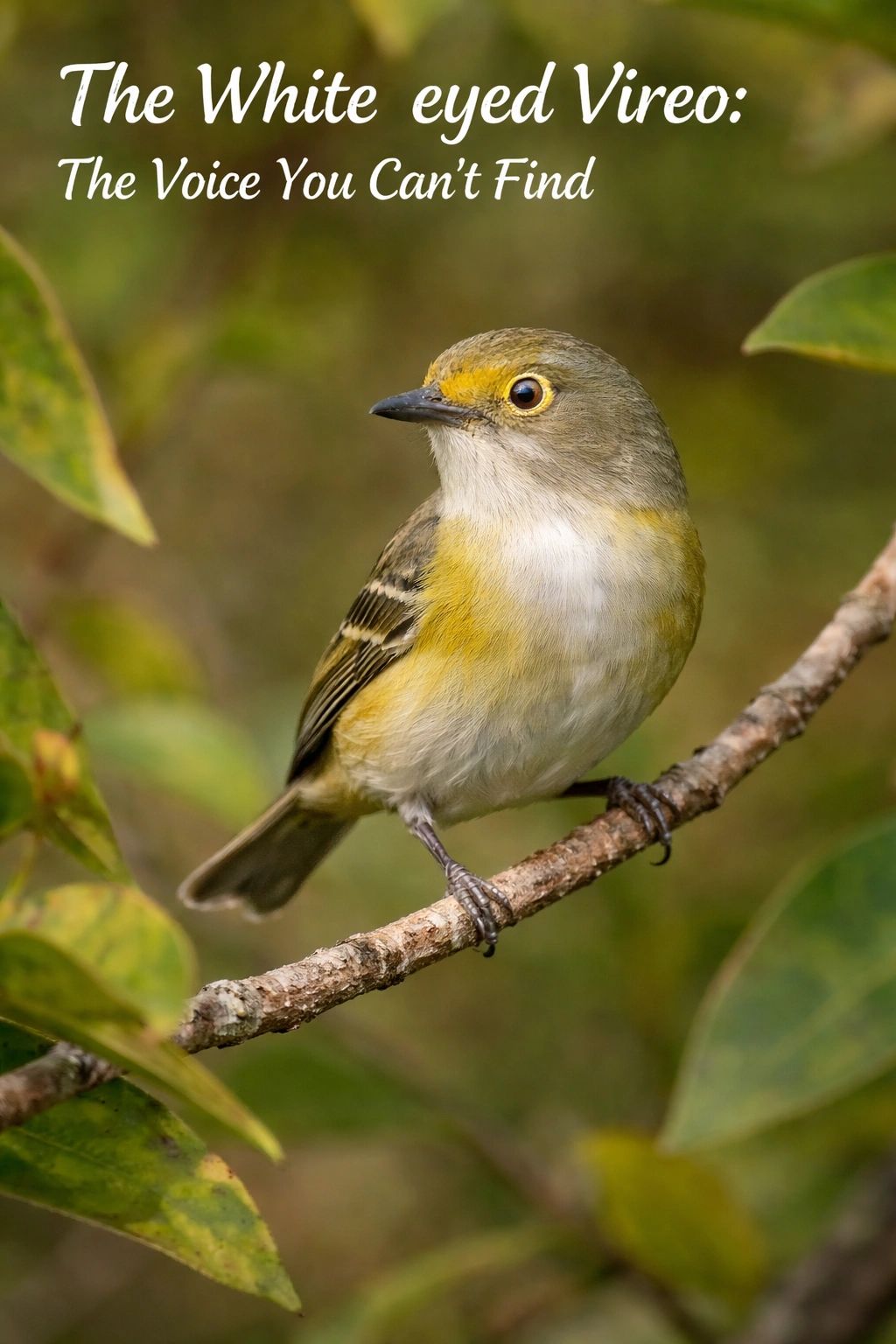
Small.
Compact.
Olive-gray above, lighter underneath.
Nothing overly bold in color—but the details stood out once you saw them.
A pale outline around the eye.
And then the feature that gives it its name.
That eye.
Bright.
Light-colored.
Almost white.
It didn’t blend in.
It stood out immediately.
And then, just as quickly as it appeared, it was gone again.
Back into the brush.
A Voice That Feels Like It Has Something to Say
The call of the white-eyed vireo is one of the most distinctive things about it.
Not because it’s loud.
But because it feels structured—almost like phrases rather than notes.
Field guides, including the Smithsonian Handbooks: Birds of North America (Eastern Region), describe its song as a series of short, sharp phrases, often with pauses in between, giving it a rhythm that feels almost conversational.
And hearing it in person, that description feels exact.
It doesn’t blend.
It stands apart.
A Bird That Stays Hidden by Design
Unlike birds that perch out in the open, the white-eyed vireo stays low.
Inside dense vegetation.
Along edges.
In places where visibility is limited.
According to Smithsonian references, this behavior helps it remain protected while still allowing it to move efficiently through its environment.
It doesn’t need open space.
It uses cover.
And that changes how you have to observe it.
Movement That Feels Controlled
When you do catch glimpses of it, the movement is quick but not frantic.
It shifts from branch to branch within the brush, staying just inside the edge of visibility.
Never fully exposed.
Never completely gone.
Always just enough to remind you it’s still there.
A Bird That Keeps You Searching
What makes the white-eyed vireo stand out isn’t just how it looks or sounds.
It’s how it makes you engage.
You don’t just notice it once.
You keep looking.
Keep listening.
Trying to match the sound to the movement, the movement to the shape, the shape to the name.
And that process becomes part of the experience.
The Moment Merlin Made It Clear
Like the other birds in this series, everything started with that first moment of recognition.
Before Merlin, the sound felt scattered.
After Merlin, it had identity.
And once it had identity, the search had purpose.
A Different Kind of Reward
Most birds reveal themselves quickly.
You see them.
You recognize them.
You move on.
The white-eyed vireo doesn’t work that way.
It gives you pieces.
Sound first.
Then movement.
Then, finally, a brief moment of clarity.
And that makes the experience feel earned.
A Bird That Changes How You Listen
What the white-eyed vireo changes most is how you listen.
It teaches you to focus.
To follow sound more carefully.
To accept that you might not see everything right away.
And that sometimes, the experience is in the searching.
Conclusion: The Voice You Can’t Find
The white-eyed vireo is not the most colorful bird.
It is not the easiest to see.
It is not the most obvious presence in the yard.
But it is one of the most memorable.
Because it challenges you.
It makes you listen more closely.
Look more carefully.
And once you finally see it—once you connect that sharp, shifting song to the small bird hidden in the brush—you realize something simple.
Some things aren’t meant to be found right away.
Some things reveal themselves slowly.
One moment at a time.
Bibliography
Cornell Lab of Ornithology. All About Birds: White-eyed Vireo.
Smithsonian Institution. Smithsonian Handbooks: Birds of North America (Eastern Region).
National Audubon Society. White-eyed Vireo.
Sibley, David Allen. The Sibley Guide to Birds.
Florida Fish and Wildlife Conservation Commission. Florida Bird Species Information.
Originally published at the live site .