
Stories ·
The White Ibis: The Wandering Bird Beneath an Afternoon Launch
The afternoon didn’t feel ordinary.
By Rebecca "Madam Chronicler" Ryan
The afternoon didn’t feel ordinary.
The light sat lower in the sky, casting a warm glow across the water on Merritt Island. A steady breeze moved across the lagoon, rippling the surface in soft patterns. Along the shoreline, people had already gathered, their attention fixed in one direction.
Upward.
Toward the sky.
Everyone was waiting for Artemis II.
This was going to be a historic event, and we were going to witness it firsthand.
There was a quiet anticipation in the air—the kind that builds before something powerful happens. Conversations were softer, movements slower, as if the entire scene was holding its breath.
People from all around the globe were here to witness this event, as it has been over 50 years. Their mission is 10 days and will have them loop around the moon and then return to earth.
But while nearly everyone was focused on what was about to leave the ground, something else was already there.
Something grounded.
Something easy to miss.
A Moment on the Shoreline
As I stood near the water that afternoon, watching the shifting light across the lagoon, a white shape moved into view.
At first, it barely registered.
Then it became clear.
A White Ibis.
It walked calmly along the edge of the shoreline, completely undisturbed by the people nearby or the anticipation building in the air. Its movements were steady and deliberate, as if it had all the time in the world.
I raised my camera and captured the moment.
A Bird That Ignores the Noise
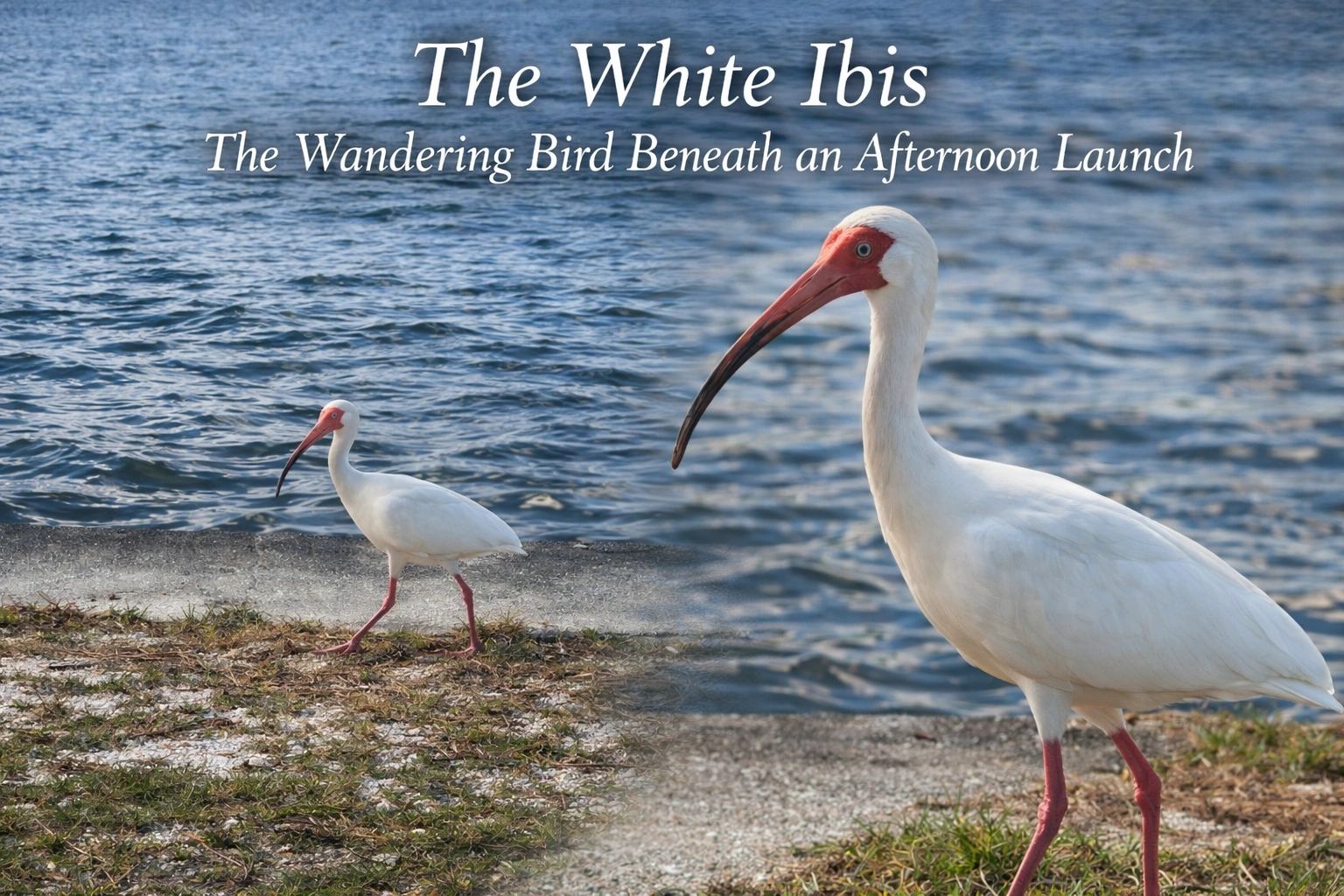
In the first photo, the ibis moves along the water’s edge, the lagoon stretching out behind it. The surface of the water reflects the sky everyone was watching, but the bird never looks up.
It stays focused on the ground.
On the next step.
On what lies just beneath the surface.
There is something striking about that contrast.
While people gathered to witness something extraordinary happening above them, the ibis continued its routine, completely unaffected by the moment.
Seeing the Details Up Close
In the second image, the bird is closer.
Now the details stand out.
Its long, curved bill is sharply defined, perfectly shaped for probing into the soil. The reddish color of its face contrasts with the bright white feathers of its body, and its pale blue eye gives it a look of quiet awareness.
Up close, it feels less like a distant part of the landscape and more like an individual presence.
Still calm.
Still focused.
Still moving with purpose.
A Bird Designed for the Ground
The White Ibis is built for this kind of environment.
Its long legs carry it easily across uneven ground, while its curved bill allows it to search for food beneath the surface. But what makes it especially effective is how it feeds.
It doesn’t rely on sight.
Instead, it uses touch.
As it walks, it lowers its bill into the ground, feeling for movement. Hidden beneath the soil or just below the surface are small creatures—crustaceans, insects, and other prey.
When it senses something, it reacts instantly.
A quick motion.
A small catch.
Then it continues.
Step by step.
A Bird Between Two Worlds
Standing there, it was impossible not to notice the contrast.
On one side, the open water of the lagoon, stretching out toward the horizon.
On the other, a gathering of people waiting for a spacecraft designed to leave Earth entirely.
And in between, the ibis.
A species that has lived in these environments long before rockets, countdowns, or launch windows.
It didn’t react to the energy around it.
Didn’t look toward the sky.
Didn’t pause.
It remained exactly where it belonged—connected to the ground, to the water, to the moment.
Florida’s Wandering Resident
The White Ibis is one of Florida’s most familiar birds, but that familiarity often hides how adaptable it truly is.
Traditionally, it belongs to wetlands—marshes, swamps, and shallow waters where food is abundant. But over time, it has expanded its range into neighborhoods, parks, and open grassy areas.
Lawns have become feeding grounds.
Sidewalk edges have replaced marsh edges.
And places like Merritt Island, where natural and developed spaces meet, have become ideal environments.
The bird in your photos reflects that adaptability perfectly.
It exists comfortably in a place shaped by both nature and human activity.
Movement Without Urgency
There was no rush in the ibis’s behavior.
No reaction to the crowd.
No awareness of the anticipation building nearby.
It moved with a rhythm that felt entirely separate from everything else happening around it.
Watching it, there was a sense that time worked differently for the bird.
The launch had a schedule.
A countdown.
A moment it was building toward.
The ibis had none of that.
Only the next step.
A Quiet Presence in a Loud Moment
When people think about moments like a rocket launch, they often think about noise, power, and spectacle.
But what made this moment memorable wasn’t just what was happening in the sky.
It was what was happening at the same time on the ground.
The ibis didn’t compete with the moment.
It didn’t try to stand out.
And yet, it became one of the most memorable parts of the experience.
The Meaning of Staying Grounded
There is something symbolic in that contrast.
A rocket represents movement away from Earth, a push toward exploration beyond what we know.
The ibis represents something else entirely.
Connection.
Adaptation.
Presence within the environment.
Both are remarkable in their own way.
But only one exists fully in the moment.
More Than Just a Common Bird
It would be easy to describe the White Ibis as a common bird in Florida.
And it is.
But moments like this reveal something deeper.
Common doesn’t mean unimportant.
It means present.
It means consistent.
It means part of the environment in a way that shapes everyday experience.
The ibis is not rare.
But it is essential.
Conclusion: The Bird That Stayed While Others Looked Up
As the afternoon moved forward and the anticipation for Artemis II continued to build, the focus of the crowd remained fixed on the sky.
But along the shoreline, the ibis continued its quiet routine.
Walking.
Probing.
Moving forward without interruption.
It didn’t need to look up to be part of the moment.
It was already part of something larger—the landscape, the ecosystem, the quiet rhythm of life happening at ground level.
And in a moment defined by looking toward space, the White Ibis offered a different perspective.
A reminder that even as we look beyond the Earth, there is still so much happening right here beneath our feet.
Bibliography
Cornell Lab of Ornithology. All About Birds: White Ibis.
Cornell Lab of Ornithology. Merlin Bird ID App. Cornell University.
National Audubon Society. White Ibis.
Sibley, David Allen. The Sibley Guide to Birds. Alfred A. Knopf.
Florida Fish and Wildlife Conservation Commission. Florida Bird Species Information.
Originally published at the live site .