
Stories ·
USS Indianapolis: The Survivors' Perspective – Trauma and Memory
📷
By Rebecca "Madam Chronicler" Ryan
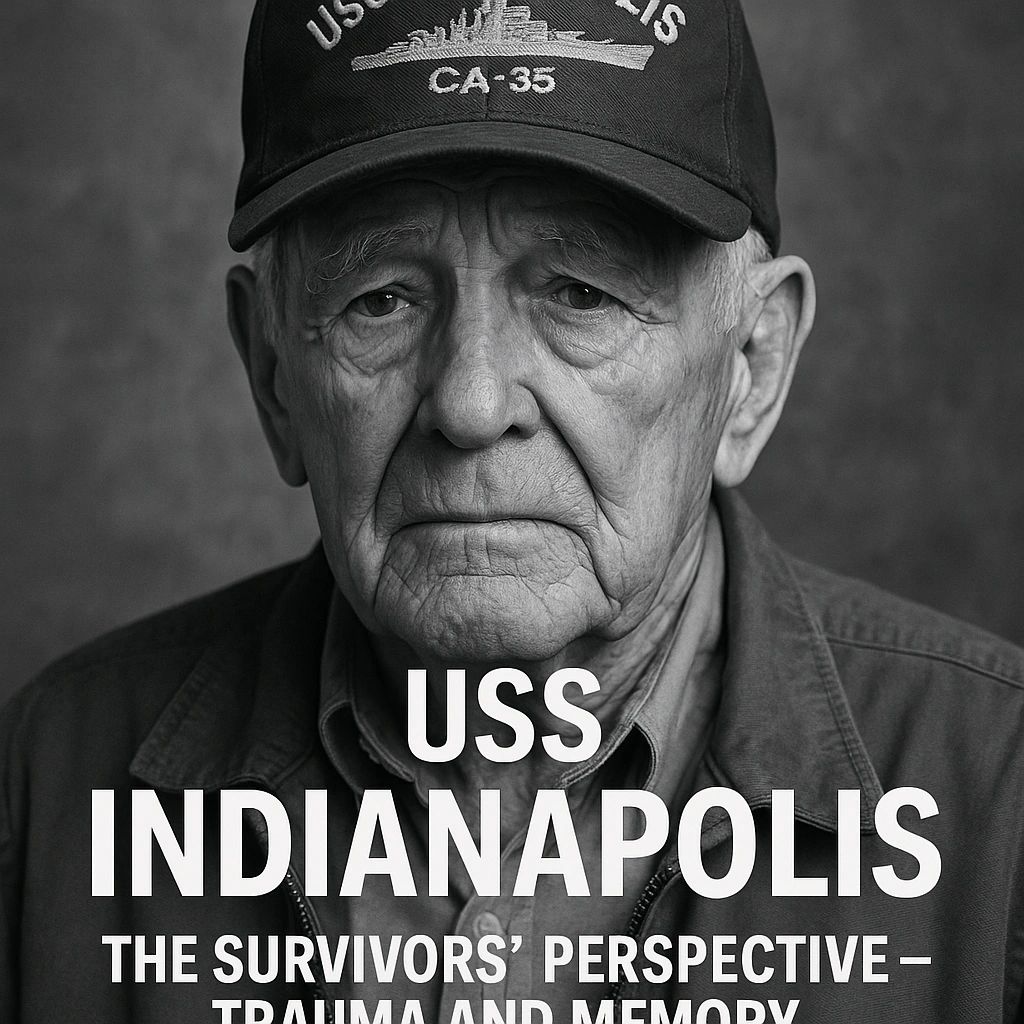
📷IMAGE: Indianapolis survivors at a reunion decades later Caption: Indianapolis survivors at one of their regular reunions, carrying the psychological scars of their shark encounters for decades after the tragedy.
It’s crucial to remember that for the Indianapolis survivors, sharks represented a very real and terrifying threat during their ordeal. While we can analyze the ecological and behavioral aspects of shark involvement, we must never minimize the trauma experienced by these brave men.
Many survivors carried the psychological scars of their shark encounters for the rest of their lives. The constant fear of attack, watching shipmates disappear beneath the surface, and the helplessness of floating defenseless in predator-infested waters created lasting post-traumatic stress that affected survivors for decades¹³.
Survivor Woody James later recalled: “You’d hear guys scream, especially late in the afternoon. Seemed like the sharks were more active in the evening and early morning than during the day.” These accounts, while sometimes influenced by the extreme conditions they endured, provide valuable firsthand observations of shark behavior in an unprecedented situation¹².
Honoring the Experience
📷IMAGE: Memorial wall with names of Indianapolis crew members
Caption: The Indianapolis Memorial honors all crew members, including those lost to shark attacks during the four-day ordeal in the Pacific.
As we study the role of sharks in the Indianapolis tragedy, we do so not to sensationalize or exploit the story, but to better understand both human survival and animal behavior in extreme circumstances. The courage shown by the Indianapolis survivors in the face of multiple threats—including sharks—remains an inspiration and a testament to human resilience².
Dr. Lewis Haynes, the ship’s chief medical officer and a survivor, spent years after the war treating other survivors for what we now recognize as PTSD. His medical training allowed him to observe shark behavior more objectively than many others, and his accounts provide some of the most reliable descriptions of the predators’ actions during those four days³.
Conservation Message: Protecting Ocean Predators
The Importance of Apex Predators
📷
IMAGE: Healthy coral reef ecosystem with sharks present
Caption: Healthy marine ecosystems depend on apex predators like sharks to maintain the balance of marine food webs.
Both oceanic whitetip and tiger sharks play crucial roles as apex predators in marine ecosystems. They help maintain the balance of marine food webs by controlling populations of prey species and removing sick or weak individuals from populations—a process that actually strengthens the overall health of marine communities⁹.
The dramatic decline in oceanic whitetip populations since 1945 has had cascading effects throughout Pacific ecosystems. These sharks’ role in the Indianapolis tragedy, while tragic from a human perspective, was simply natural predator behavior in response to an unprecedented situation⁸. Their presence in healthy numbers is actually an indicator of ocean health¹⁰.
Modern Threats
📷IMAGE: Commercial fishing vessel with shark bycatch
Caption: Modern commercial fishing operations pose a far greater threat to shark populations than sharks pose to humans, with millions of sharks killed annually as bycatch.
Today, both species face far greater threats from human activities than humans face from them. Overfishing, bycatch in commercial fishing operations, and habitat degradation pose existential threats to these magnificent predators⁹. The annual number of sharks killed by humans is estimated in the tens of millions, while shark attacks on humans number in the dozens globally⁶.
Oceanic whitetips are particularly vulnerable because they’re slow to reproduce and their curious nature makes them easy targets for fishing operations. Their populations have crashed by an estimated 90% in many areas since the 1940s, earning them critically endangered status from the International Union for Conservation of Nature⁸.
The Science of Survival: What We’ve Learned
Physiological Responses to Shark Presence
📷IMAGE: Diagram showing human stress responses in water
Caption: The presence of sharks triggers intense physiological stress responses that can affect survival in maritime disasters.
Modern research has revealed how the presence of predators affects human survival in maritime disasters. The constant stress of potential shark attack triggers the release of stress hormones like cortisol and adrenaline, which can actually impair decision-making and accelerate dehydration—ironically making survivors more vulnerable to the very predators they fear⁷.
Understanding these physiological responses has led to improved survival training for maritime personnel. Modern protocols emphasize staying calm, conserving energy, and making rational decisions even in the presence of sharks—lessons learned from tragedies like the Indianapolis⁵.
Behavioral Adaptations
Some Indianapolis survivors developed remarkable strategies for dealing with shark presence. They learned to remain motionless when sharks approached, to stay in tight groups, and to support injured comrades who might attract predators through bleeding or erratic movement³.
IMAGE: Survivors demonstrating group survival techniques Caption: Indianapolis survivors learned to stay in tight groups and support injured comrades to reduce vulnerability to shark attacks.
These survival strategies, born from desperation, have informed modern maritime survival training. The survivors’ experiences taught us that panic and thrashing movements are more likely to trigger predatory responses, while calm, deliberate actions can help avoid unwanted attention from sharks⁷.
The Ripple Effects: How the Indianapolis Changed Shark Science
Spurring Research Interest
📷IMAGE: From left to right: Dr. Perry Gilbert, Dr. Sylvia Earle, Dr. Eugenie Clark and William R. Mote. Caption: The Indianapolis tragedy spurred increased interest in shark research during the 1950s and 1960s, leading to better understanding of these predators.
The Indianapolis tragedy, along with other wartime shark encounters, sparked increased scientific interest in understanding shark behavior. The U.S. Navy began funding shark research programs in the late 1940s and 1950s, seeking to develop better protection for sailors and aviators who might find themselves in shark-inhabited waters¹¹.
This research led to some of the first systematic studies of shark behavior, feeding patterns, and sensory capabilities. Scientists like Dr. Perry Gilbert and Dr. Eugenie Clark began the foundational work that would eventually revolutionize our understanding of these predators¹⁰.
Debunking Myths Through Science
Early shark research helped debunk many of the myths that arose from wartime encounters. Scientists discovered that sharks are not mindless killing machines but sophisticated predators with complex behaviors and important ecological roles⁹.
This research revealed that most shark species are actually quite cautious around humans and that attacks are often cases of mistaken identity or defensive behavior rather than predatory aggression⁶.
Modern Applications: Lessons for Today
Maritime Safety Protocols
The Indianapolis tragedy directly influenced the development of modern maritime safety protocols. Today’s life rafts are equipped with shark deterrent devices, emergency beacons for rapid location, and improved survival supplies that can sustain castaways for extended periods⁵.
Communication protocols have been revolutionized to prevent the kind of oversight that left the Indianapolis survivors floating undetected for four days¹². Modern ships are tracked continuously via satellite, and overdue vessels trigger immediate search and rescue responses¹³.
Climate Change Implications
📷
IMAGE: Map showing changing shark distribution patterns due to climate change
Caption: Climate change is altering shark distribution patterns, potentially creating new scenarios where humans and sharks interact in unexpected ways.
As climate change alters ocean temperatures and currents, shark distribution patterns are shifting. Warmer waters are expanding the range of tropical species like tiger sharks, while changing prey distributions are forcing oceanic whitetips into new areas⁹.
Understanding how sharks responded to the Indianapolis disaster helps us prepare for potential future scenarios where climate-driven changes might bring humans and sharks into contact in new ways¹⁰. This knowledge is crucial for developing adaptive safety measures for maritime activities in a changing ocean.
The Legacy of Understanding
From Fear to Respect
The Indianapolis story has evolved from a tale of terror to one of scientific understanding and conservation awareness. While the survivors’ experiences were undeniably traumatic, their story has contributed to a broader understanding of shark behavior that ultimately benefits both humans and sharks¹⁴.
Modern shark education programs use the Indianapolis case study to teach about predator behavior, survival strategies, and the importance of marine conservation. The goal is to replace fear with respect and understanding⁹.
Honoring Both Stories
Today, we can honor both the human story of courage and survival and the ecological story of predators responding to an unprecedented situation. The Indianapolis survivors showed remarkable bravery in the face of multiple threats, while the sharks were simply following millions of years of evolutionary programming².
Understanding Nature’s Role in Human Tragedy
The role of oceanic whitetip and tiger sharks in the Indianapolis tragedy represents a complex intersection of human history and natural predator behavior⁸. These sharks were not monsters or villains—they were wild animals responding to an unprecedented situation in their environment according to millions of years of evolutionary programming⁹.
As we remember the courage and sacrifice of the Indianapolis crew, we can also use their story to better understand and appreciate the complex marine ecosystems they encountered. The sharks that terrorized the survivors were the same species that help maintain the health and balance of our oceans—apex predators deserving of our respect, understanding, and protection¹⁰.
The Indianapolis tragedy reminds us that the ocean remains a wild and unpredictable environment where humans are visitors, not masters. By studying events like this through both historical and ecological lenses, we gain valuable insights that can help prevent future tragedies while fostering a deeper appreciation for the magnificent predators that rule the deep blue sea¹⁰.
In the end, the story of the Indianapolis sharks is not just about predation and survival—it’s about the complex relationship between humans and the natural world, and our responsibility to understand and protect the ecosystems we share with these ancient and magnificent creatures. The survivors’ courage in the face of nature’s challenges continues to inspire us, while the sharks’ role reminds us of our place in the larger web of life that connects all ocean dwellers¹¹.
End Notes
Bray, H. (2021, August 10). How one sailor survived the sinking of the USS Indianapolis. HistoryNet. https://www.historynet.com/how-sailor-survived-sinking-uss-indianapolis/
Cox, L. D. (2016, August). The sinking of the USS Indianapolis triggered the worst shark attack in history. Smithsonian Magazine. https://www.smithsonianmag.com/history/sinking-uss-indianapolis-triggered-worst-shark-attack-history-25715092/
Harrell, E. (2017). Out of the depths: An unforgettable WWII story of survival, courage, and the sinking of the USS Indianapolis (Rev. ed.). Bethany House Publishers.
Stanton, D. (2001). In harm’s way: The sinking of the USS Indianapolis and the extraordinary story of its survivors. Henry Holt and Company.
Kiger, P. J. (2022, November 16). What is the deadliest shark attack ever recorded? Live Science. https://www.livescience.com/animals/sharks/what-is-the-deadliest-shark-attack-ever-recorded
National Geographic. (2019, August 2). USS Indianapolis: The worst shark attack in history. National Geographic. https://www.nationalgeographic.com/history/article/uss-indianapolis-shark-attack-jaws
Living Sharks Museum. (n.d.). Survival at sea: The USS Indianapolis. LivingSharks.org. https://www.livingsharks.org/survival
IUCN Shark Specialist Group. (2023). Carcharhinus longimanus: Oceanic whitetip shark – Red List status. https://www.iucnredlist.org/species/39374/2911619
NOAA Fisheries. (n.d.). Sharks. https://www.fisheries.noaa.gov/topic/sharks
Shark Research Institute. (n.d.). Research library and conservation efforts. https://www.sharks.org/library
Woods Hole Oceanographic Institution. (n.d.). Sharks: Predators with a purpose. https://www.whoi.edu/oceanus/feature/sharks-predators-with-a-purpose/
U.S. Naval History and Heritage Command. (n.d.). USS Indianapolis (CA-35). https://www.history.navy.mil/research/histories/ship-histories/danfs/i/indianapolis-ca-35.html
National Archives and Records Administration. (n.d.). USS Indianapolis archival records. https://catalog.archives.gov/search?q=USS%20Indianapolis
USS Indianapolis CA-35 Legacy Organization. (n.d.). Survivor interviews and educational outreach. https://www.ussindianapolis.org/
Indiana War Memorials Foundation. (n.d.). USS Indianapolis Museum. https://www.indianawarmemorials.org/uss-indianapolis-museum/
References
Bray, H. (2021, August 10). How one sailor survived the sinking of the USS Indianapolis. HistoryNet. https://www.historynet.com/how-sailor-survived-sinking-uss-indianapolis/
Cox, L. D. (2016, August). The sinking of the USS Indianapolis triggered the worst shark attack in history. Smithsonian Magazine. https://www.smithsonianmag.com/history/sinking-uss-indianapolis-triggered-worst-shark-attack-history-25715092/
Harrell, E. (2017). Out of the depths: An unforgettable WWII story of survival, courage, and the sinking of the USS Indianapolis (Rev. ed.). Bethany House Publishers.
Kiger, P. J. (2022, November 16). What is the deadliest shark attack ever recorded? Live Science. https://www.livescience.com/animals/sharks/what-is-the-deadliest-shark-attack-ever-recorded
Living Sharks Museum. (n.d.). Survival at sea: The USS Indianapolis. LivingSharks.org. https://www.livingsharks.org/survival
National Geographic. (2019, August 2). USS Indianapolis: The worst shark attack in history. National Geographic. https://www.nationalgeographic.com/history/article/uss-indianapolis-shark-attack-jaws
Stanton, D. (2001). In harm’s way: The sinking of the USS Indianapolis and the extraordinary story of its survivors. Henry Holt and Company.
Image Sources
U.S. Naval History and Heritage Command
Originally published at the live site .