
Rivers ·
What Lurks Beneath: Night Fishing Tales from Bayou Lafourche
When the sun dips below the horizon and the skies turn a deep purple over southern Louisiana, Bayou Lafourche changes. What seemed like a calm, winding waterway in daylight transforms into something mysterious, buzzing w...
By Rebecca "Madam Chronicler" Ryan
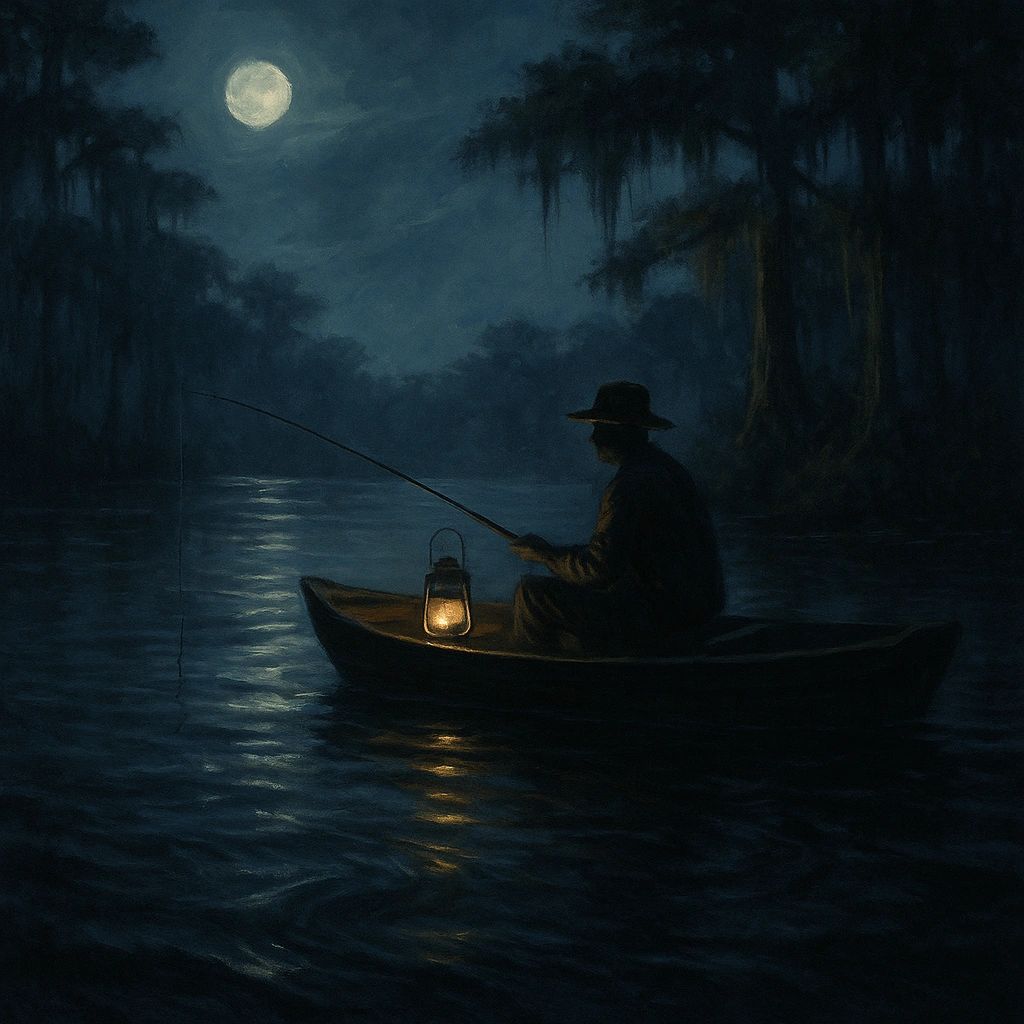
When the sun dips below the horizon and the skies turn a deep purple over southern Louisiana, Bayou Lafourche changes. What seemed like a calm, winding waterway in daylight transforms into something mysterious, buzzing with night sounds and shadowy ripples. For generations, locals have cast their lines into the bayou after dark, swapping tales of giant fish, ghostly lights, and predators lurking unseen beneath the still waters.
Night fishing in Bayou Lafourche isn’t just about catching dinner—it’s about stepping into a living story, one that mixes Cajun folklore with real-life encounters with the creatures that call the bayou home. Whether it’s catfish the size of logs, alligators gliding like silent submarines, or the whispers of something older and stranger, the bayou keeps her secrets well. But every once in a while, a fisherman gets a glimpse of what really lurks beneath.
This blog takes you deep into the legends and science of Bayou Lafourche’s nocturnal world. We’ll explore the history of this watery lifeline, the fish that prowl under starlight, the predators that send chills up a fisherman’s spine, and the eerie stories that make you wonder what’s fact and what’s folklore. So grab a lantern, a pole, and maybe a little courage—because once the night falls on Bayou Lafourche, anything is possible.
The Heart of the Bayou
Bayou Lafourche stretches more than 100 miles, flowing south from Donaldsonville to the Gulf of Mexico. Once it was the Mississippi River’s main distributary, carrying water and sediment that helped shape Louisiana’s marshes and swamps. Today, it’s a cultural and ecological lifeline for the Cajun heartland. Small towns, sugarcane fields, and oak-lined levees flank its banks. Boats of all sizes—from tiny pirogues to shrimp trawlers—slip quietly through its dark waters.
For locals, the bayou isn’t just geography. It’s family, food, and survival. Generations have fished here for blue catfish, alligator gar, and crappie. They’ve hunted alligators, trapped crawfish, and gathered stories that pass from father to son, mother to daughter, neighbor to neighbor. By day, the bayou bustles with life. But at night, when the heat eases and the water mirrors the moon, it becomes something else—a place where the line between natural and supernatural blurs.
The Nighttime Hunters
So what exactly is moving under the dark surface when anglers set out at night? Quite a lot, actually. Some species in Bayou Lafourche are more active after sunset, making night fishing both thrilling and productive.
1. The Catfish
The undisputed king of night fishing in Louisiana is the catfish. Blue catfish, channel catfish, and flathead catfish are all common in Bayou Lafourche. These bottom-dwellers rely on their barbels—those whisker-like feelers—to detect food in murky waters. At night, they move closer to the banks, searching for insects, small fish, and anything edible that drifts their way.
Some anglers swear that the biggest catfish bite only at night. Tales abound of hooked catfish so huge they snap rods, tear lines, or drag boats into spinning circles. While not all of those stories are true, biologists confirm that blue catfish can weigh over 100 pounds in Louisiana waters. That’s a lot of muscle pulling against your reel in the dark.
2. The Alligator Gar
Few fish inspire awe like the alligator gar. Growing up to 8 feet long, with armor-like scales and jaws filled with needle teeth, these prehistoric fish are straight out of a nightmare. Gar are ambush predators, lying still near the surface before lunging at prey. At night, they sometimes thrash near boats, their long snouts breaking the water with eerie splashes. Many a fisherman has mistaken them for monsters before realizing they’ve hooked a gar.
3. The Bass and Crappie
Largemouth bass and crappie may be more famous as daytime catches, but experienced anglers know they also bite well after dusk. They prowl the edges of vegetation, feasting on minnows and insects that gather under dock lights. Their sudden strikes can startle even the most seasoned fisherman when the night is quiet.
4. The Silent Predators
Of course, not every movement in the bayou at night is a fish. Alligators often glide silently in search of frogs, birds, or unlucky fish. Their eyes glow red in lantern light, a reminder that you’re not the only hunter out there. Raccoons scavenge along the banks, owls call from cypress branches, and occasionally a shadow that doesn’t quite match anything known slips beneath the current.
Folklore and Fear: Cajun Tales of the Bayou
Fishing at night in Bayou Lafourche is as much about stories as it is about the catch. Cajun folklore is rich with creatures and spirits said to haunt the waterways, many of them woven into night fishing tales passed down for centuries.
The Rougarou
The Rougarou is Louisiana’s own werewolf legend. Said to haunt swamps and bayous, the Rougarou prowls at night looking for sinners to punish. Some fishermen swear they’ve heard splashing footsteps that weren’t alligator or man. Others claim to have seen glowing eyes just beyond their lantern light, vanishing before they could focus. Whether real or not, the Rougarou keeps more than a few folks from venturing out too far after dark.
The Ghost Lights
Another legend tells of ghostly lights that float over the bayou, leading fishermen astray. Some call them will-o’-the-wisps, others say they’re the souls of lost travelers. A few old-timers even believe the lights are omens, warning of storms or bad luck. Skeptics blame swamp gases, but when you’re alone on the bayou at 2 a.m., even a natural explanation feels eerie.
The Drowned Souls
Bayou Lafourche has seen its share of tragedy, from boat accidents to hurricanes. Fishermen whisper that some spirits never leave, appearing as cold spots, voices on the wind, or ripples in calm water. Whether it’s imagination or something more, night fishing stories often end with goosebumps.
Real Science Behind the Scares
While folklore adds mystery to the bayou, science explains much of what happens beneath the surface. Understanding the natural behavior of animals can turn spooky tales into fascinating lessons.
- Gar splashes mistaken for monsters: Alligator gar gulp air at the surface, creating sudden, loud splashes that sound larger than life in the dark.
- Glowing eyes: Alligators, raccoons, and even frogs have a reflective layer behind their retinas called the tapetum lucidum, making their eyes shine red or green in lantern light.
- Ghostly lights: Methane from decaying plants can create flickering flames when it ignites, explaining the will-o’-the-wisp legends.
- Strange calls: Frogs, owls, and night herons produce eerie cries that echo across the water, often mistaken for supernatural voices.
Still, even science can’t take away the thrill of casting into black water and feeling a massive tug from below.
Tales from the Fishermen
Every bayou family seems to have at least one unforgettable night fishing tale. Some are funny, some terrifying, and some border on unbelievable.
The Catfish That Almost Sank the Boat
One Lafourche angler recalled hooking a fish so heavy it dragged his small jon boat across the bayou. Thinking he’d caught a log, he nearly cut the line—until the “log” surged upward and thrashed, soaking him from head to toe. After an hour-long struggle, he finally hauled in a blue catfish weighing nearly 90 pounds. The fish fed his extended family for weeks, but the memory of its shadow in the water stayed with him for life.
The Gar That Wouldn’t Die
Another fisherman swore that after spearing a massive alligator gar, the creature leapt back into his boat, snapping its jaws and thrashing wildly. He described its armored scales and teeth with awe, saying it felt like wrestling a dinosaur. Though he eventually subdued it, he told the story every year, each time making it sound just a little scarier.
The Rougarou Chase
One group of teenage fishermen told a tale of being chased by something along the bank one foggy night. They described red eyes glowing through the mist, splashing footsteps, and a guttural growl that sent them rowing for their lives. Was it a Rougarou, a big gator, or their imagination? No one knows, but none of them ever fished that stretch of the bayou again.
Safety in the Shadows
Fishing Bayou Lafourche at night is exciting, but it also requires respect for both nature and danger. Locals follow a few golden rules:
- Bring proper lights: Lanterns, headlamps, and flashlights not only help you see but also warn others of your presence.
- Watch for gators: Never dangle hands or feet over the side, and avoid areas with nests.
- Wear life jackets: Even calm waters can turn dangerous quickly.
- Fish with a buddy: Stories are better when shared, and safety doubles with another set of eyes.
- Know the weather: Bayou storms can roll in fast, and fog can disorient even seasoned boaters.
The Magic of Night Fishing
Despite the risks, there’s a reason people keep fishing Bayou Lafourche after dark. It’s the magic of being part of something bigger—the hum of crickets, the splash of feeding fish, the glow of fireflies, and the sense that the bayou is alive in ways you can’t see in daylight.
Some nights you’ll bring home a cooler full of fish. Other nights you’ll bring home only stories. But every night leaves you with a memory: the moment you felt your line tighten in the dark, the time you thought you saw glowing eyes, or the quiet when the water was still and the stars were endless.
Bayou Lafourche at night is more than a fishing hole—it’s a stage where history, folklore, and nature perform together. Whether you believe in Rougarous or not, one thing is certain: something always lurks beneath, waiting for the next tale to be told.
Conclusion
From giant catfish to ghostly lights, Bayou Lafourche’s night fishing tales capture the spirit of Louisiana itself—wild, mysterious, and unforgettable. Science explains some of the mysteries, but folklore and lived experience keep the stories alive. Each cast in the dark is a leap into the unknown, a chance to connect not only with the fish below but also with generations of Cajuns who have fished these same waters under the same stars.
So the next time you find yourself near Bayou Lafourche as night falls, listen closely. You might hear the splash of a feeding gar, the bellow of a bullfrog, or maybe—just maybe—the whisper of something older, watching from the shadows.
Because in the bayou, the night belongs to what lurks beneath.
Bibliography
- Boschung, H. T., & Mayden, R. L. (2004). Fishes of Alabama. Smithsonian Institution Press.
- Ferrara, A. M., & Irwin, E. R. (2001). Differences in the reproductive biology of the alligator gar (Atractosteus spatula) among river systems of the southeastern United States. Transactions of the American Fisheries Society, 130(1), 91–98.
- Guillory, V. (2001). Management of blue catfish and channel catfish in Louisiana. Proceedings of the Annual Conference Southeastern Association of Fish and Wildlife Agencies, 55, 180–194.
- Poole, A., & Gochfeld, M. (1992). The birds of North America. Cornell Lab of Ornithology.
- Simberloff, D. (1998). Ghost stories: Natural and supernatural in Louisiana folklore. Louisiana Folklore Miscellany, 10(1), 45–62.
- Slack, W. T., Peterson, M. S., & Ross, S. T. (2004). The alligator gar in Mississippi waters: Biology, ecology, and conservation. Southeastern Fishes Council Proceedings, 45, 1–5.
- Sublette, J. E., Hatch, M. D., & Sublette, M. (1990). The fishes of New Mexico. University of New Mexico Press.
- Timmons, J. B., & Howell, R. L. (2009). Creel survey of catfish anglers in Louisiana. North American Journal of Fisheries Management, 29(3), 645–653.
Originally published at the live site .