
Maritime ·
When the Red Berries Take Root
The Waterline Chronicles — Entry 02
By Rebecca "Madam Chronicler" Ryan
The Waterline Chronicles — Entry 02
Executive Summary
This entry examines the presence of Brazilian pepper tree (Schinus terebinthifolia) in Florida wetlands and transitional habitats. Known for its glossy compound leaves and dense clusters of red berries, Brazilian pepper is one of Florida’s most aggressive invasive plant species. Introduced as an ornamental in the 19th century, it now occupies extensive areas, displacing native vegetation, altering hydrology, and reducing biodiversity. This essay documents observed conditions, identifies the species, and explains its ecological influence within Florida’s wetland systems.
Observed Conditions
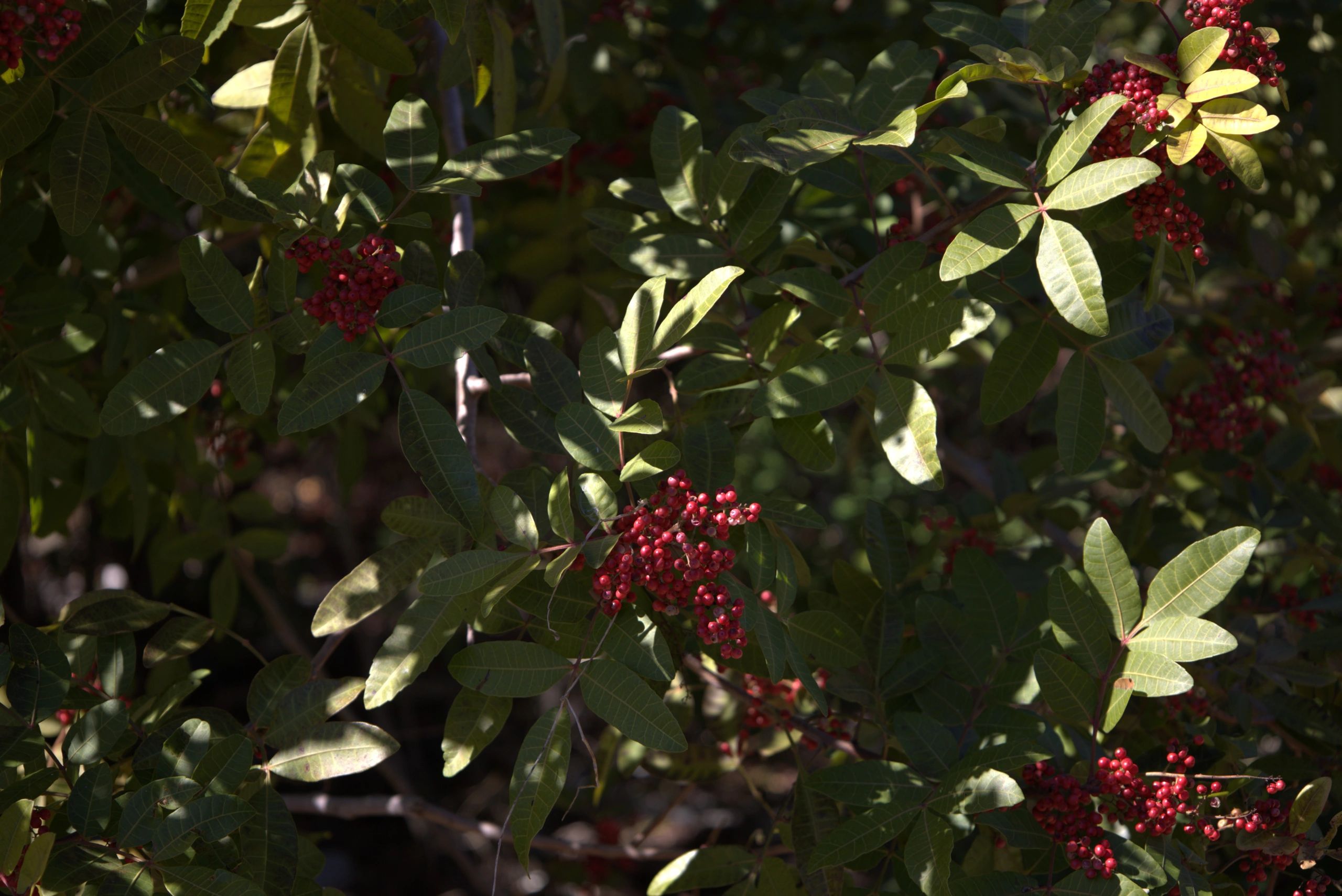
The plant in the frame features dense clusters of small, bright red berries along its terminal branches. Its foliage consists of pinnately compound leaves with multiple, oval leaflets that have smooth margins and pointed tips. The leaves appear glossy to semi-glossy, and their arrangement on woody stems indicates a mature shrub or small tree. The plant retains its foliage while bearing fruit, suggesting evergreen growth in a subtropical climate.
Light filtering through the canopy highlights the contrast between the red drupes and dark green leaves. The density of the foliage suggests thicket formation rather than isolated growth. Based on these morphological characteristics, the plant is most consistent with Brazilian pepper tree (Schinus terebinthifolia), a non-native invasive species well-established throughout Florida.
Species Identification and Botanical Context
Brazilian pepper tree belongs to the Anacardiaceae family, which includes cashew, sumac, and poison ivy. Native to parts of South America, including Brazil, Paraguay, and Argentina, the species was introduced into Florida in the mid-1800s for ornamental landscaping purposes (Ferriter et al., 2010). Its rapid growth, drought tolerance, adaptability to varied soils, and attractive red fruit contributed to its widespread cultivation.
The species is now classified as a Category I invasive plant by the Florida Invasive Species Council, meaning it has been documented to alter native plant communities by displacing native species and changing ecosystem structure or function (FISC, 2023). The red fruit clusters are particularly diagnostic but are often mistaken for native hollies or sumacs; however, Brazilian pepper differs in its growth density and ecological behavior.
Historical Expansion and Establishment
Following its ornamental introduction, Brazilian pepper spread beyond cultivated landscapes into disturbed and transitional habitats. By the mid-20th century, it was established along canal banks, coastal hammocks, pine flatwoods, and wetland margins (Ewel et al., 1982). This expansion coincided with large-scale hydrological modifications across Florida, including canal construction, drainage projects, and urban development.
Brazilian pepper thrives in ecotonal areas with fluctuating hydrology. Its tolerance to both periodic flooding and drought provides a competitive edge in wetland edges and disturbed soils, allowing it to form expansive monocultures that displace native vegetation over time.
Ecological Effects in Wetland Systems
The ecological impact of Brazilian pepper in Florida wetlands is multifaceted. Its dense canopy shades out native shrubs and herbaceous plants, reducing species diversity and structural complexity. Native plants, such as saw palmetto, wax myrtle, and various wetland grasses, may be suppressed beneath its growth (Ferriter et al., 2010). As plant diversity declines, habitat heterogeneity diminishes, affecting organisms that depend on varied vegetation layers.
Hydrologically, dense stands of Brazilian pepper can influence surface water flow and evapotranspiration rates. Vegetation plays a critical role in regulating wetland water movement, and changes in plant composition can alter infiltration patterns and soil moisture regimes. Because Brazilian pepper tolerates fluctuating water levels, it persists in environments where native species are more sensitive to hydrological variability (Ewel et al., 1982).
Wildlife interactions with Brazilian pepper are complex. Birds readily consume its berries, facilitating seed dispersal across wide areas. Species like robins and waxwings may temporarily benefit from winter fruit availability. However, replacing native fruiting plants with a single dominant species can reduce dietary diversity and alter ecological balance. Research on invasive plant monocultures indicates that faunal diversity often declines when structural and botanical diversity are reduced (Simberloff et al., 2013).
Beyond physical displacement, Brazilian pepper can also exert chemical effects. Research indicates it produces allelopathic compounds that inhibit the germination or growth of nearby plants (Morgan & Overholt, 2005). Its leaf litter further modifies soil chemistry and influences decomposition, thereby shaping the microhabitat.
Invasion as a Process
Invasive species rarely spread independently of broader environmental changes. Brazilian pepper’s success is a reflection of ecological disturbances, including altered fire regimes, urban expansion, and water management infrastructure. These disturbances create open niches that invasive species exploit efficiently. In this way, Brazilian pepper acts as both a driver and a symptom of ecological transformation.
Simberloff et al. (2013) highlight that biological invasions often occur gradually, leading to the normalization of altered conditions before their full impact is understood. Consequently, landscapes dominated by invasive species can be misidentified as natural, obscuring historical baselines.
Documentation as Ecological Record
Within the framework of The Waterline Chronicles, documenting Brazilian pepper serves as a record of ecological composition at a specific moment in time. Much like a staff gauge documents hydrological conditions, the presence of an invasive species documents community structure.
Photographic documentation complements field surveys and management data, preserving spatial context, density, and association with surrounding habitats. In restoration ecology, these records can later serve as reference points for evaluating intervention success or continued spread.
The aim is clarity, not rhetoric. Identification fosters awareness, which in turn supports informed management.
Management and Restoration
Control efforts for Brazilian pepper in Florida encompass mechanical removal, herbicide application, and biological control agents. State agencies and conservation organizations implement targeted management in protected areas. Biological control programs have introduced insects from the plant’s native range to reduce seed production and vegetative growth (Overholt et al., 2009). Although these methods are promising, complete eradication across the landscape is unlikely.
Effective restoration necessitates both the removal and reestablishment of native vegetation. Replanting native shrubs and restoring natural hydrological patterns can increase resilience against reinvasion. Long-term monitoring is essential, as Brazilian pepper can rapidly recolonize disturbed sites.
Closing Reflection
The vibrant red berries are visually striking, seemingly indicative of vitality and ecological success. However, this success in an introduced species does not translate to ecological integration.
Brazilian pepper’s dominance in Florida wetlands reflects its adaptability to a changing landscape. It thrives where disturbances create opportunities. Its presence signals altered conditions, whether through hydrological modification, land use change, or disrupted fire regimes.
As the red berries take root, the landscape undergoes shifts in composition and function. Documenting these changes is an act of recordkeeping. Over time, these records help distinguish between native persistence and invasive dominance, revealing how wetlands evolve under pressure.
References
Ewel, J. J., Ojima, D. S., Karl, D. A., & DeBusk, W. F. (1982). Schinus in successional ecosystems of Everglades National Park. South Florida Research Center Report T-676.
Ferriter, A., Doren, R., Winston, R., et al. (2010). The biology, distribution and management of Brazilian pepper tree (Schinus terebinthifolia). Florida Department of Environmental Protection.
Florida Invasive Species Council (FISC). (2023). Florida invasive plant species list. https://www.floridainvasivespecies.org
Morgan, E. C., & Overholt, W. A. (2005). Potential allelopathic effects of Brazilian pepper (Schinus terebinthifolia). Florida Scientist, 68(2), 76–82.
Overholt, W. A., et al. (2009). Biological control of Brazilian pepper tree in Florida. Biological Control, 49(3), 203–212.
Simberloff, D., Martin, J. L., Genovesi, P., et al. (2013). Impacts of biological invasions: What’s what and the way forward. Trends in Ecology & Evolution, 28(1), 58–66. https://doi.org/10.1016/j.tree.2012.07.013
Originally published at the live site .