
Maritime ·
Why Hammerhead Sharks Evolved Their Strange Heads
Few animals in the ocean are as instantly recognizable as the hammerhead shark. With eyes spread wide across a flattened, hammer-shaped head and a silhouette unlike any other predator in the sea, hammerheads almost look ...
By Rebecca "Madam Chronicler" Ryan
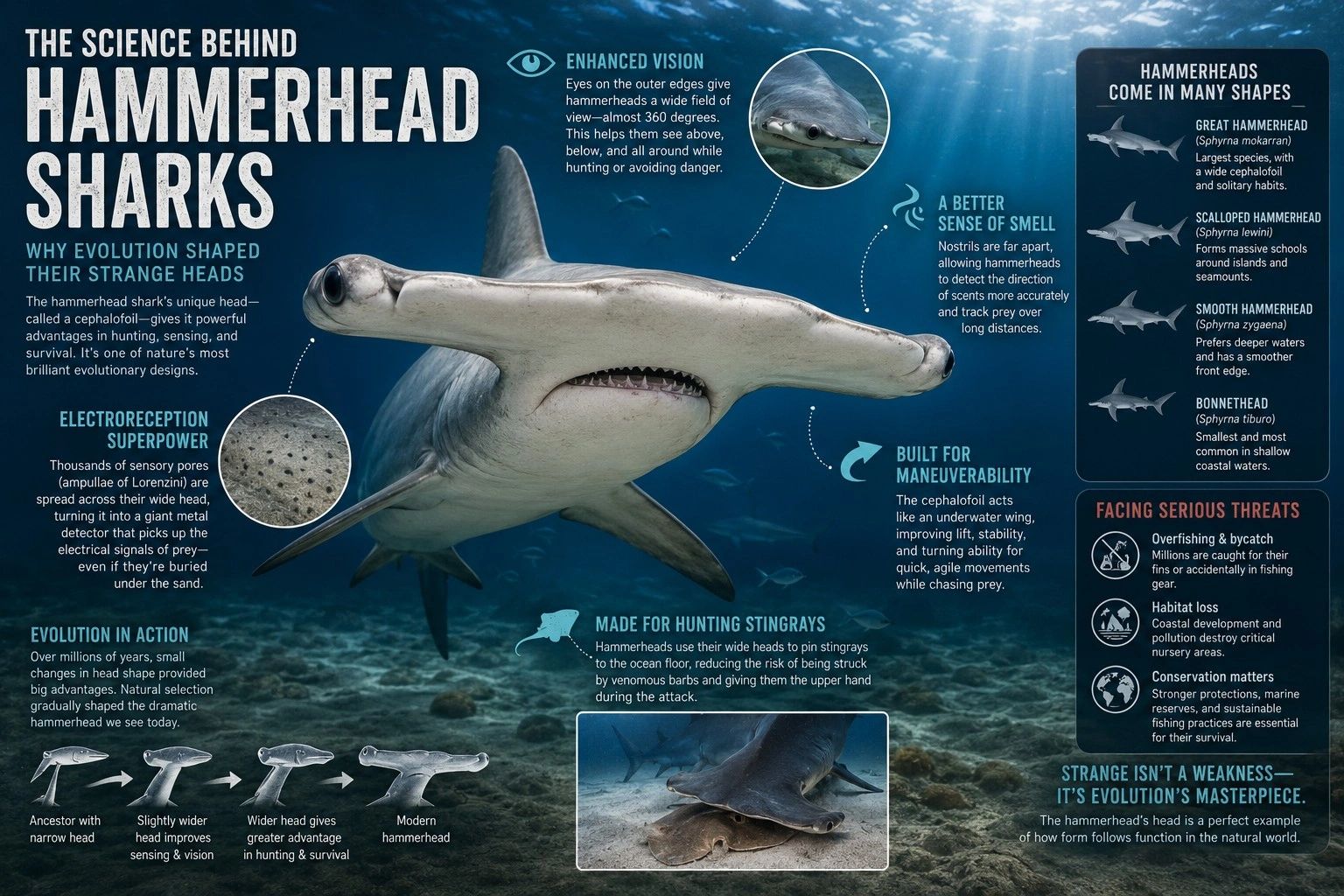
Few animals in the ocean are as instantly recognizable as the hammerhead shark. With eyes spread wide across a flattened, hammer-shaped head and a silhouette unlike any other predator in the sea, hammerheads almost look alien. For centuries, fishermen, divers, and scientists alike have wondered the same thing:
Why would evolution create such a bizarre head shape?
At first glance, the hammerhead’s cephalofoil—the scientific term for its distinctive head—seems impractical. It looks oversized, awkward, and strangely designed compared to the streamlined forms of most sharks. Yet evolution rarely produces features without purpose. In nature, unusual adaptations often exist because they provide powerful survival advantages.
And that is exactly what scientists discovered about hammerhead sharks.
Their strange heads are not evolutionary accidents. They are highly specialized biological tools that improve hunting, navigation, sensory perception, and maneuverability. Over millions of years, natural selection shaped the hammerhead into one of the ocean’s most efficient predators.
Today, researchers believe the cephalofoil gives hammerheads several important advantages over other sharks, helping them detect prey hidden beneath the sand, execute tight turns while hunting, and sense the ocean in ways few predators can.
The more scientists study hammerheads, the clearer it becomes that their strange appearance may actually represent one of evolution’s most brilliant designs.
Meet the Hammerhead Shark Family
Hammerhead sharks belong to the family Sphyrnidae, which includes several different species ranging from small bonnetheads to massive great hammerheads.
Some of the best-known species include:
- Great hammerhead (Sphyrna mokarran)
- Scalloped hammerhead (Sphyrna lewini)
- Smooth hammerhead (Sphyrna zygaena)
- Bonnethead shark (Sphyrna tiburo)
- Winghead shark (Eusphyra blochii)
Each species possesses a differently shaped cephalofoil. Some are narrow and curved, while others are dramatically wide.
The great hammerhead has the most extreme head structure, reaching widths of nearly half the shark’s body length. The winghead shark, found in the Indo-Pacific, possesses an even wider cephalofoil relative to body size, giving it one of the most unusual appearances in the shark world.
Despite their differences, all hammerheads share the same fundamental evolutionary innovation: a flattened head that dramatically separates the eyes, nostrils, and sensory organs.
Scientists now believe this structure evolved because it enhanced several critical functions simultaneously.
The Cephalofoil: Nature’s Multi-Tool
The hammer-shaped head is called a cephalofoil, derived from Greek words meaning “head” and “foil” or “wing.”
At first, researchers debated whether the cephalofoil served a single primary purpose or multiple functions at once. Modern studies strongly support the idea that the structure provides numerous overlapping advantages.
The cephalofoil acts as:
- A sensory platform
- A navigation aid
- A hydrodynamic control surface
- A hunting weapon
- A tool for improved vision
- An advanced scent detector
Very few evolutionary adaptations provide so many benefits simultaneously.
This multifunctional design helps explain why the hammerhead body plan proved successful enough to diversify into multiple species across oceans worldwide.
Enhanced Vision: Seeing More of the Ocean
One of the most obvious features of a hammerhead shark is the placement of its eyes.
Unlike most sharks, whose eyes sit close together on either side of the head, hammerheads position their eyes at the far outer edges of the cephalofoil. This dramatically increases their field of vision.
Scientists believe this arrangement provides several advantages.
Nearly 360-Degree Vision
Hammerheads can see a much larger area around them without moving their heads. Their wide-set eyes allow them to scan both above and below more effectively than many other sharks.
Research published in the Journal of Experimental Biology found that hammerheads possess superior binocular vision compared to other shark species. Their visual overlap directly in front of the head improves depth perception and helps them judge distances more accurately while hunting.
This enhanced visual coverage may be especially important in open-water environments where prey can approach from multiple directions.
Better Detection of Prey
Hammerheads often hunt fast-moving fish, squid, and stingrays. Wider visual coverage allows them to monitor prey movements more efficiently while simultaneously scanning for predators or competitors.
The great hammerhead, in particular, frequently hunts stingrays on sandy ocean floors. Its eye placement may help it track prey while maintaining awareness of the surrounding environment.
For an apex predator, seeing more of the ocean can mean the difference between success and failure.
The Ultimate Underwater Metal Detector
Vision alone does not explain the hammerhead’s strange evolution.
One of the cephalofoil’s most important advantages involves electroreception—the ability to detect electrical signals produced by living organisms.
Like all sharks, hammerheads possess specialized sensory organs called the ampullae of Lorenzini. These jelly-filled pores detect tiny electrical fields generated by muscle contractions and nerve activity in prey animals.
Even buried beneath sand, fish and rays produce faint electrical signals.
Hammerheads are extraordinarily good at detecting them.
A Wider Sensory Array
Because the cephalofoil spreads sensory receptors across a much broader area, hammerheads essentially possess a giant underwater electromagnetic scanner.
Scientists compare it to increasing the size of an antenna.
The wider the sensory platform, the more precise the shark’s ability to locate prey.
This is especially useful when hunting stingrays buried beneath sediment. Hammerheads can sweep their heads side to side across the seafloor, triangulating electrical signals with remarkable precision.
Research suggests the cephalofoil enhances directional sensitivity, allowing hammerheads to pinpoint prey locations more accurately than many other sharks.
This ability gives them a major advantage in coastal hunting grounds.
Built for Hunting Stingrays
Few predator-prey relationships in the ocean are as dramatic as the interaction between hammerheads and stingrays.
Great hammerheads are among the few predators that routinely target large stingrays, even those armed with venomous barbs.
Scientists believe the cephalofoil evolved partly because it helps hammerheads subdue these dangerous prey animals.
Pinning Prey to the Ocean Floor
Hammerheads have been observed using their broad heads to pin stingrays against the seabed before biting them.
This behavior serves several purposes:
- Prevents escape
- Reduces the risk of being struck by the stingray’s barb
- Allows the shark to control prey movement during attack
The wide cephalofoil acts almost like a shield or grappling tool during hunting.
Some researchers believe this mechanical advantage played a significant role in hammerhead evolution, especially for species specializing in ray predation.
Specialized Diets
Great hammerheads consume large numbers of rays, including southern stingrays, eagle rays, and cownose rays.
Their unusual head shape may have allowed ancestral hammerheads to exploit prey resources unavailable to competing shark species.
In evolution, access to a unique food source can drive major anatomical innovation.
Superior Maneuverability in the Water
The cephalofoil also functions as a hydrodynamic structure.
Hammerheads are surprisingly agile swimmers, capable of making sharp turns and rapid directional changes while chasing prey.
Scientists believe the flattened head acts somewhat like an underwater wing.
Improved Stability
The broad cephalofoil helps stabilize the shark while swimming, reducing unwanted rolling motions and improving balance in the water.
This stability may be particularly important during fast pursuits or while navigating complex reef and coastal environments.
Tighter Turning Ability
Research using fluid dynamics models suggests the cephalofoil improves maneuverability by generating lift and increasing turning efficiency.
This allows hammerheads to execute tighter turns than many similarly sized sharks.
For a predator chasing quick prey in three-dimensional environments, agility is a major advantage.
Better Sense of Smell
Hammerheads also possess an enhanced ability to track scents in the water.
Because the nostrils are spread farther apart on the cephalofoil, hammerheads may be better at determining the direction of odor sources.
Scientists compare this to stereo hearing in humans.
By detecting slight differences in timing and concentration between the two nostrils, hammerheads can identify where a scent originates more accurately.
This may help them track wounded prey or locate food over long distances.
In the ocean, where visibility can be limited, chemical detection is often critical for survival.
The cephalofoil enhances this capability dramatically.
How Did Hammerheads Evolve?
The evolution of hammerhead sharks remains one of the most fascinating examples of natural selection in marine biology.
Scientists believe ancestral hammerheads gradually evolved wider and wider heads over millions of years because each small increase provided advantages.
Evolution does not create radical changes overnight. Instead, slight variations that improve survival become more common over generations.
Gradual Expansion
Early hammerhead ancestors likely possessed only mildly flattened heads.
Individuals with slightly broader cephalofoils may have:
- Detected prey more effectively
- Turned more efficiently
- Hunted stingrays more successfully
- Navigated better
Because those traits improved survival and reproduction, natural selection favored wider head structures over time.
Eventually, the dramatic hammer shape emerged.
Fossil Evidence
Fossil records suggest hammerhead sharks evolved relatively recently compared to some ancient shark lineages.
Researchers estimate modern hammerheads appeared roughly 20 million years ago during the Miocene epoch.
Genetic studies indicate the winghead shark may represent one of the earliest diverging hammerhead species, providing clues about how extreme cephalofoil shapes developed.
The Great Hammerhead: Apex Predator of the Tropics
Among all hammerhead species, the great hammerhead is perhaps the most impressive.
Growing up to 20 feet long and weighing over 1,000 pounds, it is the largest member of the hammerhead family.
Great hammerheads inhabit warm tropical and subtropical waters worldwide, often patrolling reefs, coastlines, and continental shelves.
Masters of Precision Hunting
Unlike many sharks that rely primarily on ambush attacks, great hammerheads often actively search for prey across the seafloor.
Their cephalofoils allow them to detect hidden stingrays with extraordinary precision.
Researchers studying great hammerheads have documented complex hunting behavior involving:
- Rapid turns
- Head sweeps
- Pinning techniques
- Strategic attacks from above
This level of specialization demonstrates how evolution shaped the cephalofoil into a sophisticated predatory tool.
Solitary Hunters
Great hammerheads are generally solitary animals, unlike scalloped hammerheads, which sometimes form massive schools.
Their independent hunting style may also have influenced the evolution of their sensory systems and maneuverability.
Scalloped Hammerheads and Massive Schools
While great hammerheads often roam alone, scalloped hammerheads are famous for forming enormous schools containing hundreds of individuals.
These schools commonly gather around seamounts and islands in the Pacific Ocean.
Scientists are still studying why scalloped hammerheads school in such large numbers, but theories include:
- Predator protection
- Social interaction
- Reproductive behavior
- Energy conservation
Schooling behavior highlights the diversity within the hammerhead family and demonstrates that the cephalofoil evolved successfully across different ecological strategies.
Hammerheads Face Serious Threats
Despite their evolutionary success, hammerhead sharks are now facing severe threats from human activity.
Many hammerhead species are considered endangered or critically endangered by the International Union for Conservation of Nature (IUCN).
Overfishing
Hammerheads are heavily targeted in commercial fisheries because their fins are highly valued in the shark fin trade.
Unfortunately, hammerheads are especially vulnerable because they mature slowly and produce relatively few offspring.
Overfishing can devastate populations quickly.
Bycatch
Hammerheads are also frequently caught accidentally in longline and gillnet fisheries targeting other species.
Even when released, many suffer stress-related mortality.
Habitat Loss
Coastal development, pollution, and climate change are degrading important nursery habitats used by juvenile hammerheads.
Mangroves, estuaries, and shallow coastal zones are critical for young sharks.
Protecting these habitats is essential for population recovery.
Why Hammerhead Conservation Matters
Hammerhead sharks play important ecological roles as apex and mesopredators.
Their decline can affect entire marine ecosystems.
Like many sharks, hammerheads help regulate prey populations and maintain ecological balance. Removing them from ocean food webs can trigger cascading effects throughout marine environments.
Conservation efforts now focus on:
- Fishing regulations
- Marine protected areas
- Shark fin trade restrictions
- Bycatch reduction technology
- International cooperation
Public awareness also plays a major role.
For many people, hammerheads inspire fascination rather than fear because of their unusual appearance. This makes them powerful ambassadors for shark conservation.
The Strange Head That Changed Shark Evolution
At first glance, the hammerhead shark’s bizarre appearance seems almost unnatural.
But the cephalofoil is not an evolutionary mistake.
It is one of nature’s most remarkable examples of specialized design.
The hammer-shaped head improves vision, expands sensory capabilities, increases maneuverability, enhances hunting precision, and strengthens prey detection all at once. Few anatomical adaptations in the animal kingdom serve so many functions simultaneously.
Over millions of years, natural selection transformed a simple modification into one of the ocean’s most sophisticated predatory tools.
The hammerhead’s strange head is proof that evolution does not always produce creatures that look familiar or symmetrical by human standards. Instead, evolution favors what works.
And for hammerhead sharks, the cephalofoil works extraordinarily well.
These sharks are not strange because evolution failed.
They are strange because evolution succeeded.
Bibliography and Primary Sources
Primary Sources
- Kajiura, Stephen M. “Head Shape and Electroreception in Hammerhead Sharks.” Journal of Experimental Biology. https://journals.biologists.com/jeb/
- Florida Museum of Natural History. International Shark Attack File and Hammerhead Shark Research. https://www.floridamuseum.ufl.edu/shark-attacks/
- NOAA Fisheries. Hammerhead Sharks and Conservation. https://www.fisheries.noaa.gov/
- Compagno, Leonard J.V. Sharks of the World. Food and Agriculture Organization of the United Nations (FAO).
- Nature Communications. “Landscape of Fear Between Sharks and Grazers in Marine Ecosystems.” https://www.nature.com/
- IUCN Red List of Threatened Species. Hammerhead Shark Assessments. https://www.iucnredlist.org/
- National Geographic. Hammerhead Sharks Facts and Biology. https://www.nationalgeographic.com/animals/fish/facts/hammerhead-sharks
- Smithsonian Ocean Portal. Hammerhead Shark Adaptations. https://ocean.si.edu/
- Save Our Seas Foundation. Hammerhead Shark Conservation and Research. https://saveourseas.com/
- University of Miami Shark Research & Conservation Program. https://sharkresearch.earth.miami.edu/
Originally published at the live site .